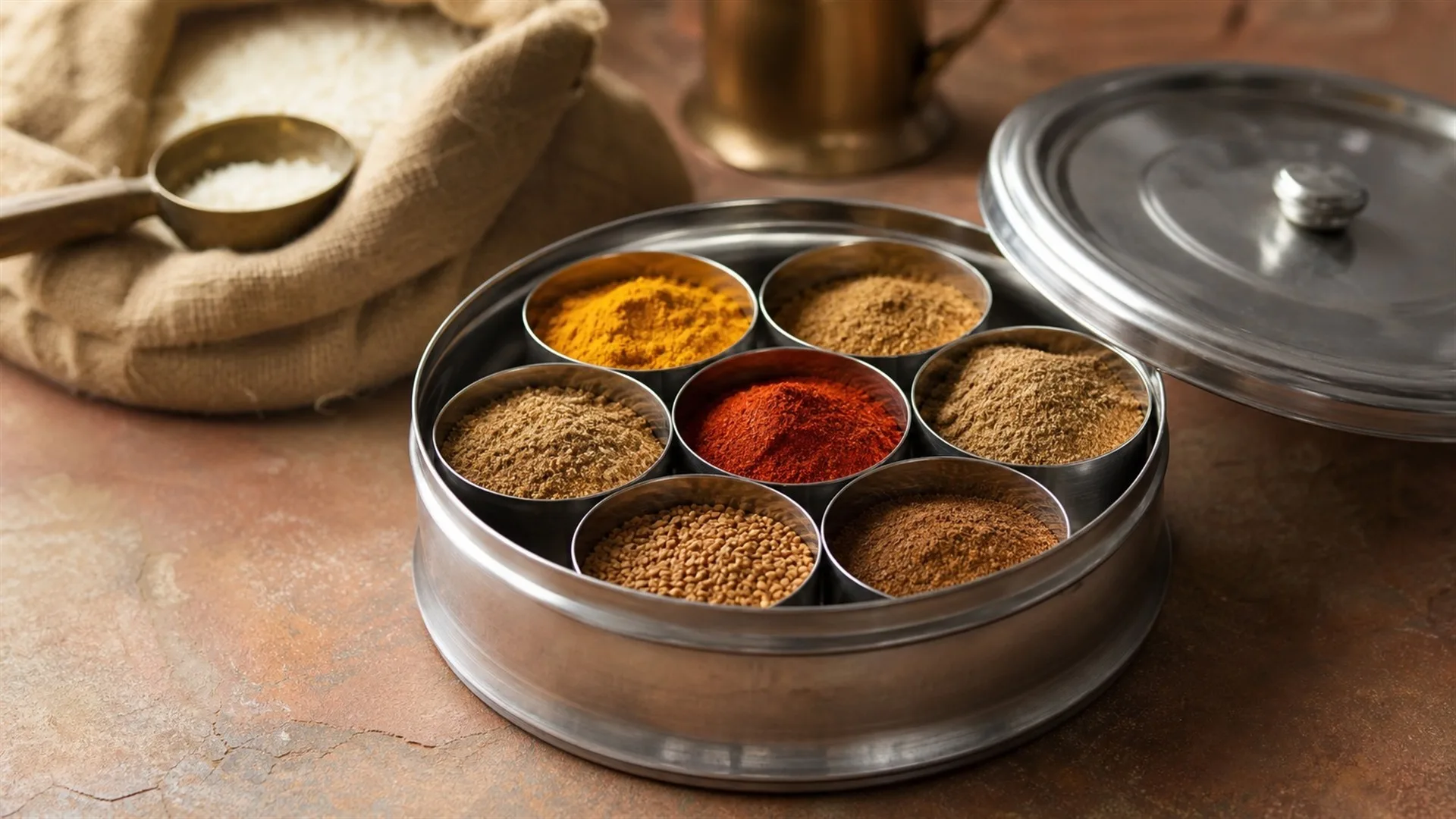
Second week of the monsoon, and your chilli powder has set into a brick. The atta smells faintly of crayons. At the back of the shelf sits a tin of ghee a relative sent two years ago, still perfectly fine, next to a jar of achaar with a white bloom you can't quite decide about. An Indian pantry runs on different rules, and the difference comes down to humidity.
What actually lasts, and what doesn't
- Ghee: 6–12 months sealed, 3–6 months opened. FSSAI ghee is 99.5% milk fat, max 0.5% moisture, which leaves almost no water for microbes to use.[1]
- Atta is the weak link: 3–4 weeks chakki-fresh, 2–3 months packaged, 6 months chilled.
- White rice, salt and sugar are effectively indefinite. Brown rice and ground spices: 6 months; whole spices, 1–2 years.[10][11]
- Stay under 70% RH. Aspergillus flavus, the aflatoxin mould, cannot grow below water activity 0.7.[3]
- The dry-spoon rule isn't superstition. A wet spoon dipped into ghee or achaar is how those jars actually turn.
- US baseline: a dry 20°C (68°F) kitchen buys you meaningfully longer on most dry goods. How much longer depends on the food — oily flours and ground masala gain least, salt and sugar were never on a clock to begin with — so treat the figures below as the humid-kitchen case rather than scaling them by a single number.
Why an Indian pantry needs its own rules
A Kochi kitchen in July and a Phoenix one are not the same place. Western storage advice is usually built around a steady 20°C (68°F) kitchen at 40–50% relative humidity. Much of India spends four months of the year above 80% RH at 28–32°C (82–90°F).
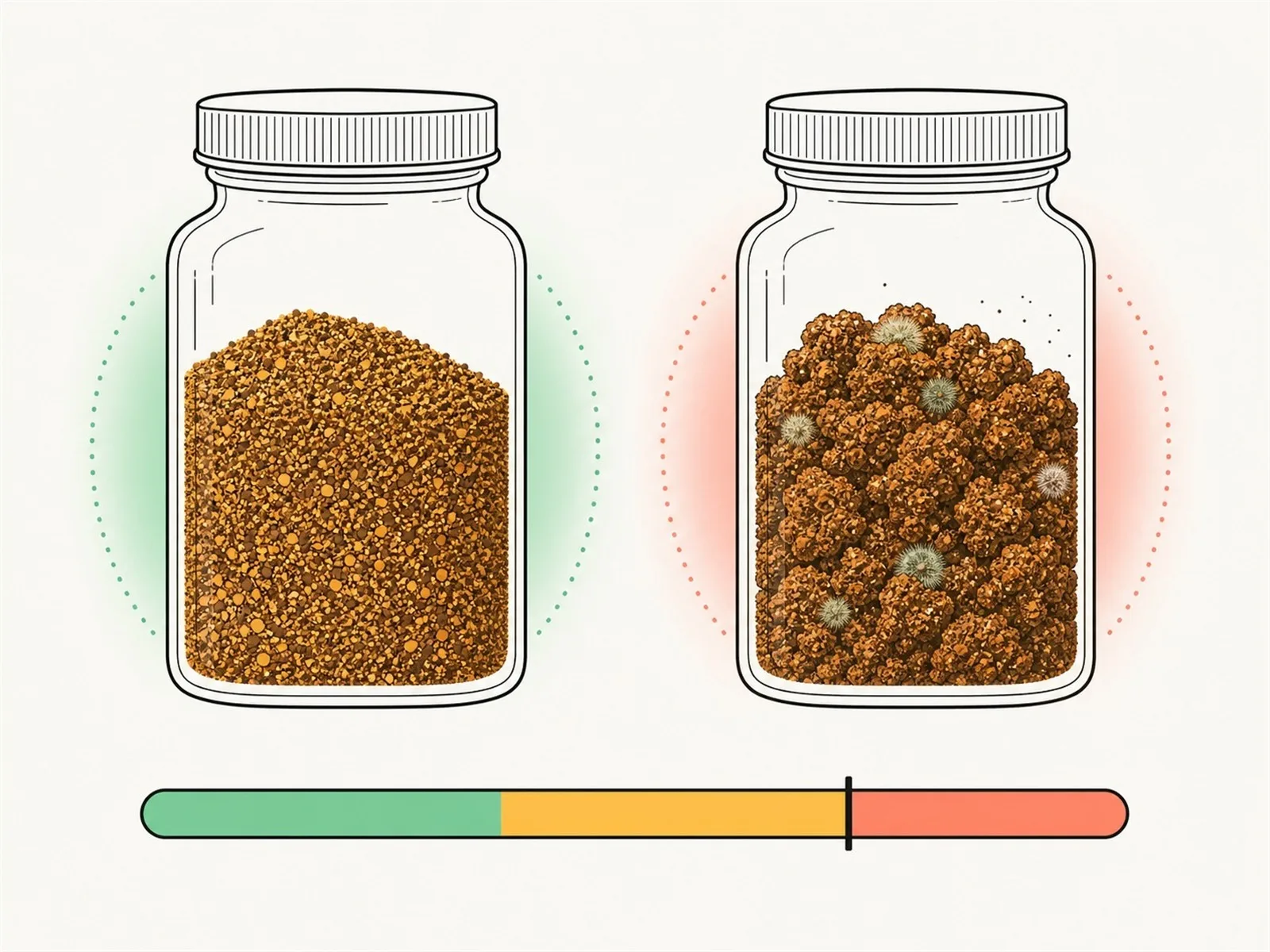
What actually decides whether something spoils is water activity, not the calendar. Most moulds need water activity near 0.80; the toughest of them manage as low as 0.60.[4] Dry goods leave the mill well below that threshold, then climb a little every week the dabba sits open on the counter. Airtight is the whole strategy.
The master shelf-life table
India baseline: an unairconditioned kitchen at 28–35°C (82–95°F). Sealed figures follow the cited sources; the opened column is our estimate.
| Staple | Sealed & dry | Opened, humid kitchen | Fails by |
|---|---|---|---|
| Ghee | 6–12 months | 3–6 months | Rancidity[1] |
| Cooking oils (mustard, groundnut) | 6 months+ | 1–3 months | Rancidity[10] |
| Atta, chakki-fresh | 4–6 weeks | 3–4 weeks | Rancidity[14] |
| Atta, packaged | 3–6 months | 2–3 months | Rancidity |
| Maida | 6–8 months | 4–6 months | Weevils[10] |
| Besan | 3–6 months | 2–3 months | Bitterness |
| Sooji, rava, rice flour | 4–6 months | 2–3 months | Weevils |
| Millet flours (ragi, bajra) | 2–3 months | 4–8 weeks | Rancidity |
| White rice | 2 years[10] | Almost indefinite if dry | Weevils[11] |
| Brown rice | 6 months | 3–4 months | Bran-oil rancidity[11] |
| Dals, whole and split | 12 months+ | 8–12 months | Hardening[10] |
| Whole spices | 1–2 years | 1 year | Aroma loss[10] |
| Ground spices, hing | 6 months | 3–4 months | Caking[10] |
| Homemade garam masala | 3 months | 6–8 weeks | Aroma loss |
| Achaar under oil | 1 year+ | 6–12 months | Mould, if water enters |
| Papad, poha, snacks | 6–12 months | 4–8 weeks | Softening |
| Jaggery (gur) | 6–12 months | 3–6 months | Weeping[15] |
| Sugar, salt | Indefinite | Indefinite | Caking only |
| Almonds, cashews | 3–6 months; ~1 year chilled[12] | 6–10 weeks | Rancidity |
| Walnuts (highest oil) | 3–6 months | 6–8 weeks | Rancidity |
| Dahi / paneer, homemade | — | 2–5 days chilled | Souring[16] |
| Fresh grated coconut | — | 2 hours; 1–2 days chilled | Fast spoilage |
Does ghee expire? Yes, but slowly
FSSAI is unambiguous on this: ghee must be at least 99.5% milk fat, at most 0.5% moisture, with free fatty acids no higher than 2.0% as oleic acid.[1] Strip out the water and the milk solids and you strip out what microbes actually need to grow.
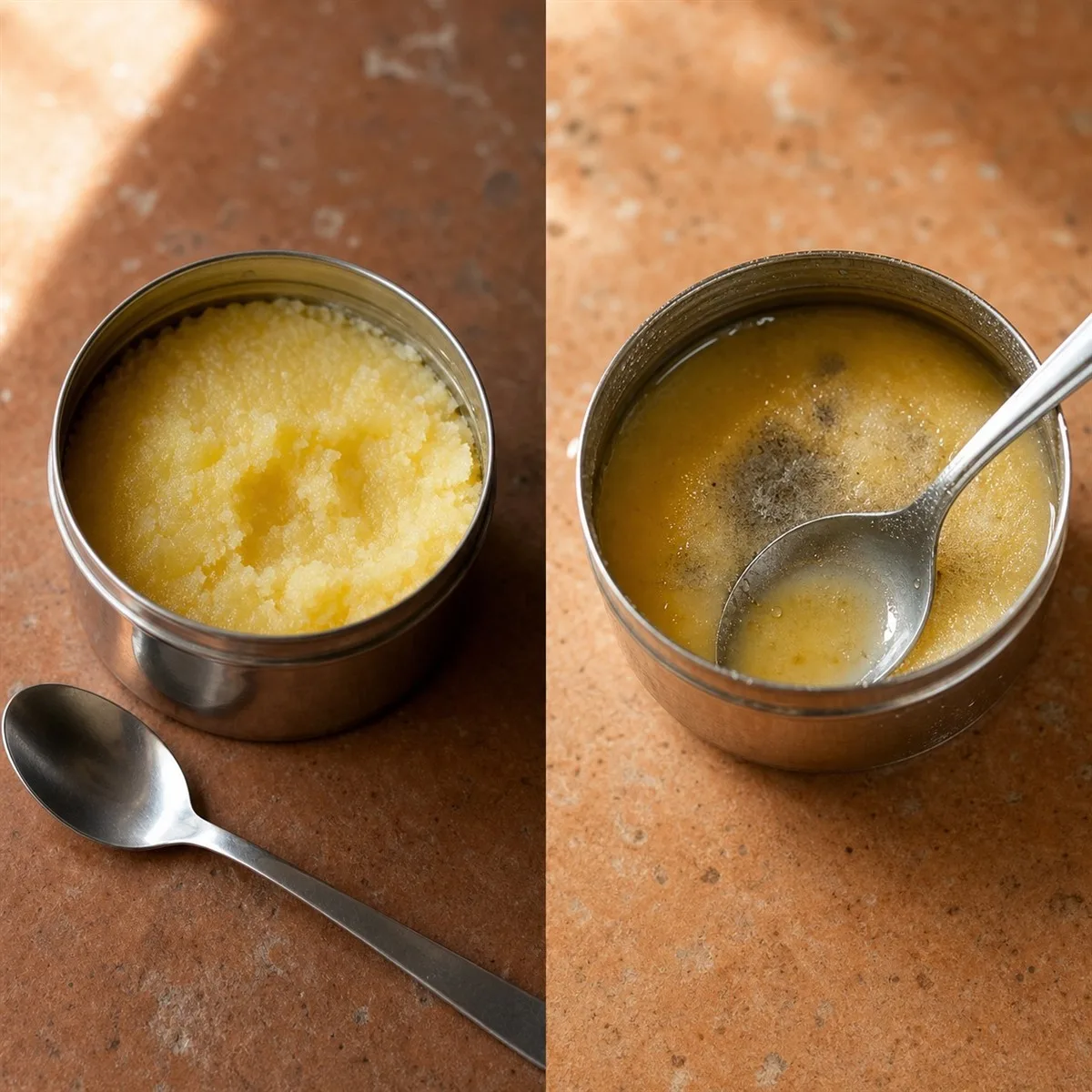
So ghee doesn't rot. It goes rancid instead, as oxygen, light and heat slowly break the fat down. What actually matters is contamination: ghee moulds only when water gets in, whether that's a wet spoon or a lid left off next to a steaming kadhai. Dry spoon, every time. A sour smell, a darkened patch, any fuzz at all — bin it.
Atta, besan and the flour hierarchy
Flour shelf life comes down to one variable: germ and bran oil. Whole-wheat flour carries lipase and lipoxygenase in the bran and germ, and milling moves roughly half the germ's fat straight into the flour. One review reports measurable rancidity within 2–14 days of milling and practical storage limits of 15–60 days, with storage at 4°C keeping fat acidity far lower.[14]
So buy atta in 2 kg lots, not 10. Maida, stripped of its germ, manages 6–8 months.[10] Besan turns bitter over time, and millet flours are the shortest-lived of the lot. See whether flour expires for more on how atta lasts in a humid kitchen.
Rice, dals and the hardening problem
Milled white rice keeps almost indefinitely as long as it's dry and sealed. Brown rice manages only six months, because the bran still carries oil that oxidises.[11] Aged basmati is the exception, deliberately held back a year or more so it cooks up drier and longer. That's ageing, not spoilage.
Dals hold 12 months or more.[10] Old dal isn't unsafe to eat. It just hardens, so it drinks more water and needs longer in the cooker. Cooked rice is a different animal — see how long cooked rice can sit out for storing uncooked rice and dals.
Spices and masalas: potency, not poison
Dried spices rarely become dangerous. They become boring instead. Whole spices hold 1–2 years; ground spices flatten out by six months.[10] Homemade garam masala, ground with no drying step behind it, is the shortest-lived of all — just 6–8 weeks.
The masala dabba earns its reputation because it's shallow, steel, opaque and only briefly opened. Its one weakness is sitting next to the hob. See do spices expire for more on storing masalas through the monsoon.
Oils and achaar: the dry-spoon rule
Keep oil in closed steel or dark glass, away from the stove, since heat and light are what drive rancidity. Our olive oil guide covers the chemistry.
On reused frying oil, FSSAI caps total polar compounds at 25%, past which the oil is legally unfit for use.[7] You can't measure that at home, so lean on FSSAI's own cues: bluish-grey smoke, tough foam, darkening, thickening. Once you see those signs the oil is done — discard it, don't cook with it. Filtering clears the crumbs, not the degradation products that made it unfit. Never top up old oil with fresh, and never pour used oil down the drain; FSSAI runs a used-oil collection route for exactly this.[7]
Achaar survives on an anaerobic barrier: a continuous layer of oil, or a strong vinegar brine, that keeps oxygen off whatever's underneath. Keep it covered, top it up as needed, and use a dry spoon. Extension guidance describes the harmless white scum that forms during active brine fermentation, which can be skimmed.[13] That is not the same thing as growth appearing on a finished jar of achaar sitting in your pantry. If you find fuzzy or coloured mould, slimy pieces, cloudy brine, bubbling, or an off smell on a finished pickle, discard it rather than scooping around it — you can't tell by looking what has grown through the oil beneath.
Weevils and moths: the freezer fix
Rice weevils, red flour beetles and Indian meal moths arrive already in the packet, which is why new atta can infest a dabba you just washed.
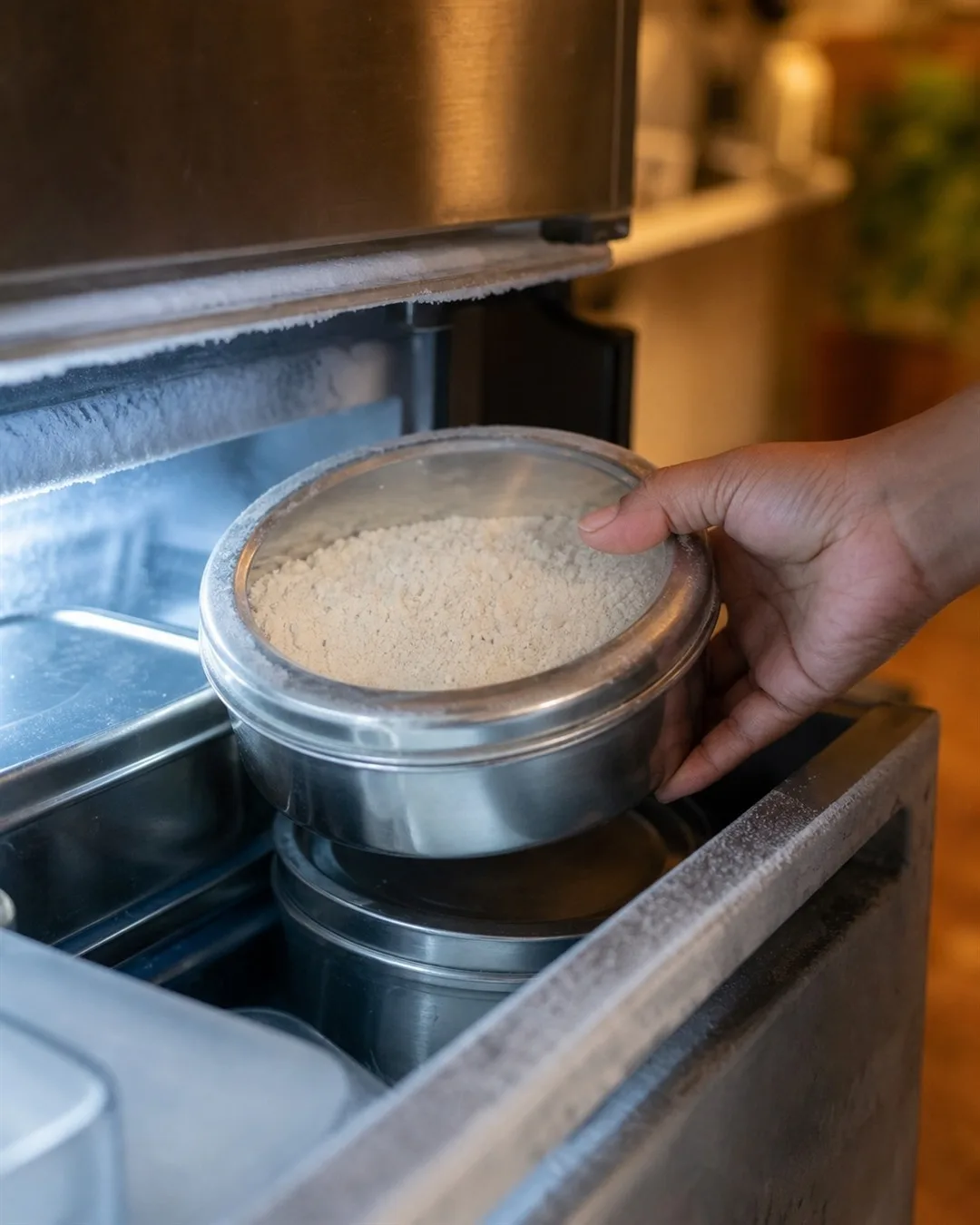
Cold works. Minnesota Extension recommends 0°F (−18°C) for at least four days to kill both insects and their eggs, or an oven at 130°F (54°C) for 30 minutes for small lots.[9] You'll see plenty of guides quoting 48–72 hours. Four days is the safer number.
Aflatoxin: the one real safety risk
Everything above is quality. This one is health. Aflatoxins come from Aspergillus flavus and A. parasiticus growing on groundnuts, maize, coconut, chillies and other spices, and WHO links large doses to acute liver damage and, over the long term, liver cancer.[5]
India regulates them tightly. Under the FSS (Contaminants, Toxins and Residues) Regulations: total aflatoxin is capped at 15 µg/kg for cereals and nuts, 30 µg/kg for spices; aflatoxin B1 at 10 and 15 µg/kg; and M1 in liquid milk at 0.5 µg/kg.[2]
That mould does have a hard floor, at least. It cannot grow or produce toxin below water activity 0.7, 70% RH, or 10°C.[3] Keep groundnuts, chillies and copra bone dry and sealed, buy in small quantities, and discard anything mouldy or shrivelled rather than picking around it.[5] Never wash and re-dry mouldy groundnuts. The toxin outlives the mould that made it.
Monsoon: humidity is the whole game
| Item | What the monsoon does | The fix |
|---|---|---|
| Ground masalas | Cake, lose aroma | Small jars, refilled from a reserve |
| Atta, besan, sooji | Clump, then turn | Half-size packs; fridge the besan |
| Papad, namkeen | Limp within days | Airtight tin; re-crisp in a pan |
| Jaggery | Weeps; needs ≤6% moisture, 43–61% RH[15] | Wrap tight, refrigerate |
| Groundnuts, dried chillies | Aflatoxin risk climbs above 70% RH[3] | Sealed jars, small lots |
Monsoon pantry checklist
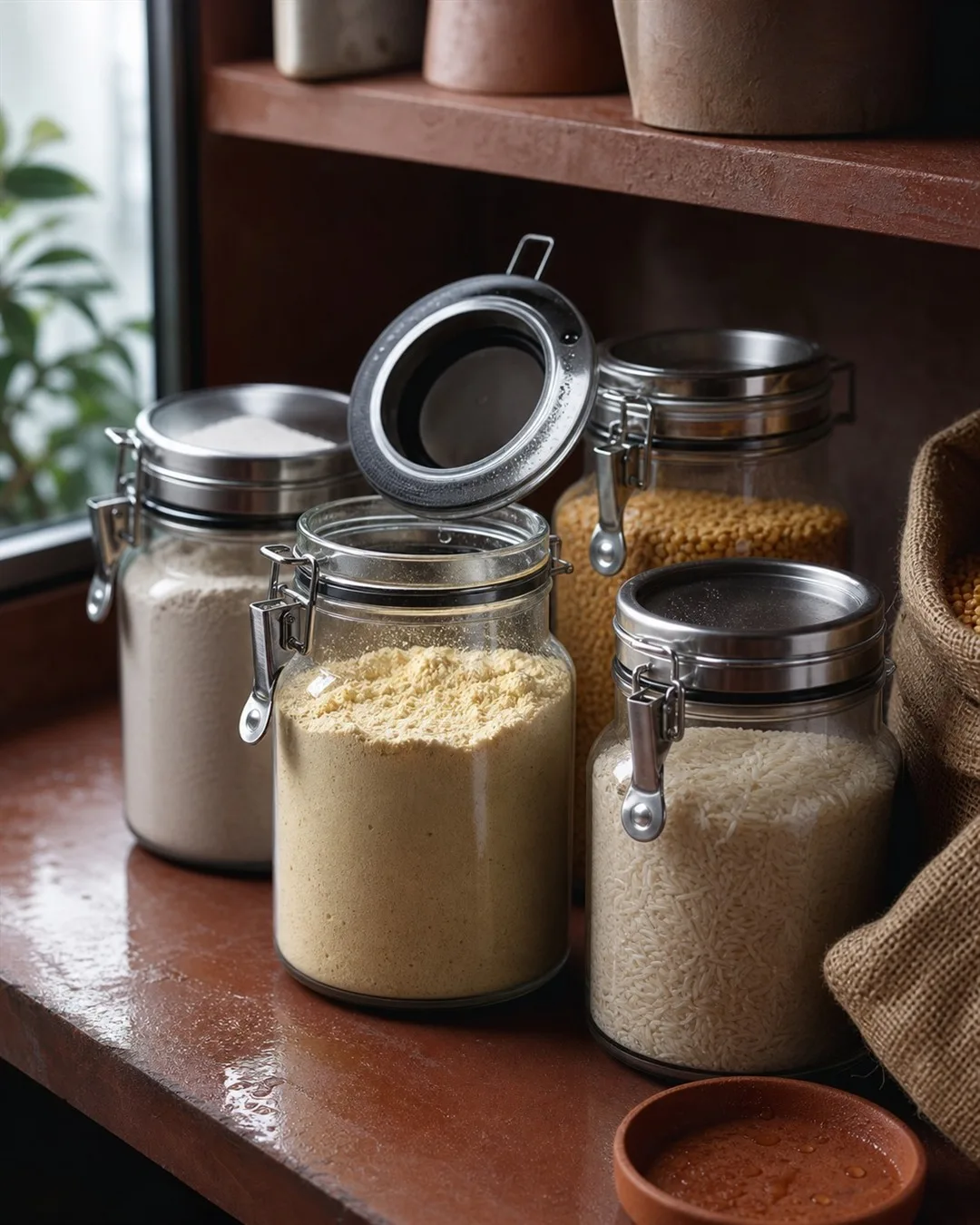
- Decant into steel or glass with gasket lids — clipped packets aren't airtight.
- Freeze new flour and grain four days before it joins the shelf.[9]
- Halve your quantities: atta, besan, masala, groundnuts.
- Wipe every dabba dry before refilling — moisture is what starts the caking.
- Audit monthly: smell the atta, check the groundnuts, top up the achaar oil.
Dairy, coconut and power cuts
Homemade dahi sours in 6–8 hours at room temperature and holds for 3–5 days chilled. Paneer is the tightest of the three: one study found untreated paneer unacceptable by day 9 at 7±2°C, though that was commercially handled paneer, so treat the homemade version as good for 2–3 days.[16]
Fresh grated coconut is the risk nobody warns you about. It's high-moisture, unpreserved and handled a lot, so treat it like cooked food: refrigerate within two hours, or freeze it. In an Indian kitchen that window is usually shorter, not longer — once the room is above 32°C (90°F), the limit drops to one hour. Chutney left out all afternoon isn't shelf-stable, however traditional. Desiccated coconut keeps about six months sealed; opened coconut milk is a plain perishable.
In a power cut, a closed fridge holds food safe for about 4 hours, a full freezer for 48 hours, a half-full one for 24 hours.[8] Discard anything perishable that's been above 4°C (40°F) for more than two hours.
FSSAI date labels: what they legally mean
| Label | Legal meaning in India | What you do |
|---|---|---|
| Best Before | End of the period the food "shall remain fully marketable and shall retain any specific qualities" claimed[6] | Quality, not safety |
| Use By / Expiry | The date after which the product "may not remain safe"[6] | A safety date — don't push it |
| Date of Manufacture | When it was packed; DD/MM/YY under three months' shelf life, month and year beyond[6] | Your best guide for atta |
| Exempt foods | Fresh unpeeled produce, wine, alcohol ≥10% ABV, vinegar, sugar-boiled confectionery, solid sugars, food-grade salt, chewing gum[6] | Chemistry, not a loophole — see foods that never expire |
Myth vs fact
| Claim | Verdict |
|---|---|
| Neem, bay leaves, dried chillies or cloves repel weevils | Folk practice. Minnesota Extension states there is "no evidence" bay leaves prevent or remove stored-food pests[9] |
| Ghee must live in the fridge | Myth. At 99.5% fat it is shelf-stable; cool, dark and dry is enough[1] |
| A white film means the achaar is ruined | Usually not. Extension guidance calls surface scum "not harmful"; slimy pieces or cloudy brine are the warning[13] |
| Solid coconut oil has gone bad | Myth. It sets below its melting point and melts back unharmed |
| You can scoop mould off a masala jar | No. WHO's rule for aflatoxin-prone crops is to discard anything mouldy, discoloured or shrivelled — not pick around it[5] |
| Sunning grain on the terrace kills insects | Partly true. It drives out adults and drops moisture; freezing kills the eggs[9] |
Frequently asked questions
Does ghee expire?
Yes, slowly. Sealed ghee keeps 6–12 months, opened ghee 3–6 months. At 99.5% milk fat and 0.5% moisture, it turns rancid rather than growing bacteria.[1] A sour, crayon-like smell means it's time to bin it. Mould shows up only if water gets in, so keep a dry spoon in the jar, always.
Does atta expire?
Faster than you'd think. Chakki-fresh atta is really a 3–4 week ingredient in a hot kitchen; packaged atta buys you two to three months. The germ oil oxidises quickly, and measurable rancidity has been recorded within 2–14 days of milling.[14] The fridge stretches that to six months.
How long does homemade masala last?
Less time than the shop-bought version. Home roasting and grinding adds moisture, and there's no packaging step to lock that back out. Treat homemade garam masala, sambar podi or rasam powder as a 6–8 week ingredient if you want it at full aroma. Grind in small batches and keep it away from the stove.
Do Indian spices expire?
They fade rather than turn dangerous. Whole spices hold 1–2 years; ground haldi and chilli powder are noticeably flat by six months.[10] The monsoon problem is caking, a sign moisture got in, and moisture in chilli powder is what raises aflatoxin risk.
Does ghee need to be refrigerated?
No. The fridge extends it and does no harm, but at 99.5% fat there's too little water for microbial growth.[1] A cool, dark cupboard away from the hob is enough on its own. Refrigerate it only if a wet spoon has ended up in the jar.
How do I get rid of weevils in rice and atta?
Freeze the packet at 0°F (−18°C) for at least four days, or heat it in a shallow tray at 130°F (54°C) for 30 minutes.[9] Then wash the shelf and decant into steel or glass with tight lids. Infestations come home in the packet.
Is old dal safe to eat?
Yes. Dry-stored dal isn't a safety risk. Warm, humid storage just hardens it, so it drinks more water and needs a longer cook — that's a texture problem, not a danger. Soak it longer. Discard only if it smells musty or shows mould.
How long can fresh grated coconut sit out?
Treat it like cooked food: refrigerate it within two hours, and within one hour if the room is above 32°C (90°F) — which covers most Indian kitchens for much of the year. Freeze it in portions if you won't use it that day. Fresh coconut is high-moisture and gets handled a lot, which makes it one of the fastest-spoiling things in the kitchen. Chutney left out all afternoon should be binned.
What is the aflatoxin limit in India?
Under the FSS (Contaminants, Toxins and Residues) Regulations, total aflatoxin is capped at 15 µg/kg for cereals and nuts and 30 µg/kg for spices, with aflatoxin B1 at 10 and 15 µg/kg.[2] At home, stay under 70% humidity and discard mouldy groundnuts.
Do salt and sugar ever expire?
Not meaningfully. Both sit far too low in water activity for anything to grow. They cake, which is texture, not safety. Indian law treats them the same way — food-grade salt and solid sugars are exempt from date marking altogether.[6] Break up the lumps.
Related: storing food better, should bread be refrigerated, the egg float test, does protein powder expire.
Bottom line
Water activity, not the calendar, decides what spoils in an Indian kitchen. Dry, sealed and cool keeps ghee, rice, dals, sugar and salt going almost indefinitely; atta, besan and homemade masala are the fast movers because their oils oxidise quickly. The dry-spoon rule, airtight steel or glass, and small quantities through the monsoon do more than any date on the packet.
Across the dry staples, one hazard stands out as a safety question rather than a quality one: aflatoxin on groundnuts, chillies and other mould-prone crops. (The perishables above — fresh coconut, reused frying oil, opened achaar, anything refrigerated — have their own safety rules, covered in their sections.) Keep them bone dry, buy small, and discard anything mouldy or shrivelled rather than picking around it — the toxin survives even after the mould is gone.
Related WillItExpire guides
Sources
- FSSAI / FAOLEX — Food Safety and Standards (Food Products Standards and Food Additives) Regulations, 2011, s.2.1.8 — Standards for Milk Fat Products (Ghee). Accessed July 2026.
- FSSAI — Food Safety and Standards (Contaminants, Toxins and Residues) Regulations, 2011 — compendium, version VIII, 01.04.2025. Accessed July 2026.
- FAO/WHO Codex Alimentarius — Code of Practice for the Prevention and Reduction of Aflatoxin Contamination in Tree Nuts (CXC 59-2005). Accessed July 2026.
- Government of Manitoba, Agriculture — Water Content and Water Activity: Two Factors That Affect Food Safety. Accessed July 2026.
- World Health Organization — Mycotoxins (fact sheet). Accessed July 2026.
- FSSAI — Compendium of Food Safety and Standards (Labelling and Display) Regulations, 2020 — Reg. 2(c), 2(u) and 5(10). Accessed July 2026.
- FSSAI / Eat Right India — Repurpose Used Cooking Oil (RUCO) Booklet — Total Polar Compounds limit of 25%. Accessed July 2026.
- FoodSafety.gov (USDA / HHS) — Food Safety During a Power Outage. Accessed July 2026.
- University of Minnesota Extension — Pantry Pests: Insects Found in Stored Food. Accessed July 2026.
- The Ohio State University Extension (Ohioline) — Pantry Food Storage, HYG-5401. Accessed July 2026.
- USA Rice Federation — How to Store Rice. Accessed July 2026.
- UC Davis Postharvest Technology Center — Commercial Storage of Whole and Diced Almonds, Pecans and Hazelnuts. Accessed July 2026.
- NC State Extension — Pickle and Pickle Product Problems. Accessed July 2026.
- Deora, N. S. — Whole Wheat Flour Stability: An Insight. Acta Scientific Nutritional Health, 2(3), 2018 — review article, journal not indexed in PubMed or Scopus. Accessed July 2026.
- Agricultural Reviews (ARCC Journals) — Jaggery Making Process and Preservation: A Review. Accessed July 2026.
- Asian Journal of Dairy and Food Research — Effect of Storage Period on Chemical, Organoleptic and Microbial Qualities of Paneer at Refrigeration Temperature. Accessed July 2026.
This article provides general information using an India baseline, with clearly labelled US-climate context. Shelf-life ranges reflect FSSAI standards, extension guidance and published research, not guarantees for any specific product or batch. Follow stricter package, manufacturer or local instructions. It is not medical advice.