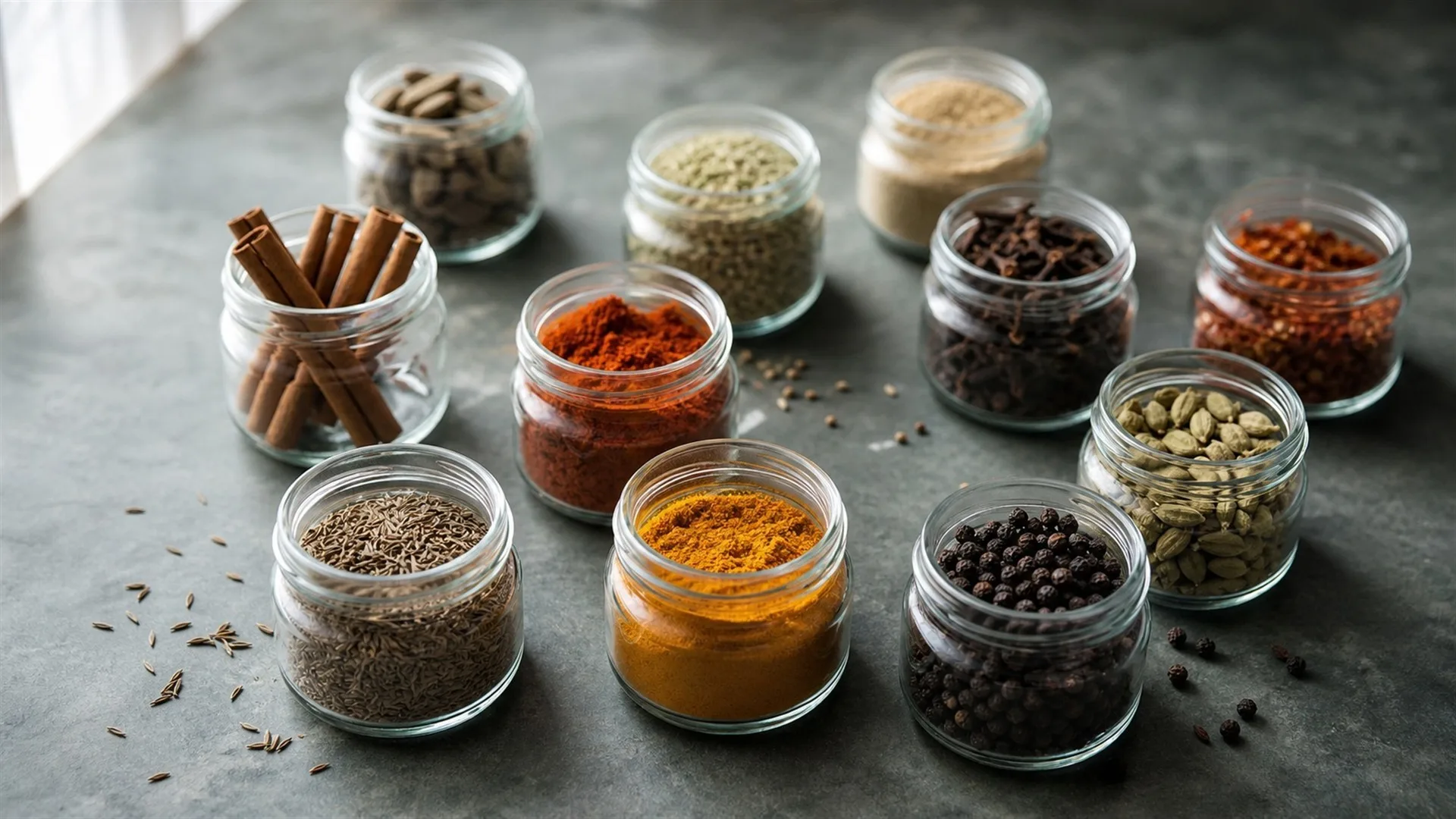
Reach into the back of the spice rack. Behind the salt there's a jar of ground coriander bought for one recipe in 2019, a tin of garam masala from a trip you barely remember, and a paprika gone the colour of old brick. Here's the split: almost none of it will make you ill, and almost none of it is doing your cooking any favours.
- Spices don't spoil — they fade. At roughly 0.50 water activity they sit well below the 0.90 that bacteria need to get going.[7]
- Whole: 3–4 years. Ground: 2–3 years. Herbs: 1–3 years. Blends: 6 months–2 years. Homemade masalas run 3–6 months.[3][5]
- "Best By" is a flavour date, not a safety date. McCormick says its products "do not spoil".[4]
- The real risks are moisture, mould and contamination at the source.
Do spices expire? Not the way milk does
Spoilage needs water, and dried spices barely have any. Kansas State Extension puts spoilage bacteria at a minimum water activity near 0.90 and moulds near 0.61; spices at ~10% moisture sit around 0.50, below where either can get a foothold.[7] That five-year-old jar of turmeric isn't dangerous just for being old.
What it loses is potency. Flavour lives in volatile aromatic oils trapped inside the plant's cells, and those oils evaporate and oxidise over time.[6] McCormick puts it plainly: its products "do not spoil," but "flavor and quality will diminish".[4]
Only salt and vanilla extract are exempt from all this[3] — see foods that never expire.
Spice shelf life at a glance
| Spice or form | Peak flavour | Still usable | Fails first |
|---|---|---|---|
| Whole spices (peppercorns, cloves, cardamom) | 3–4 years[3][5] | 5+ years | Aroma |
| Whole seeds (cumin, coriander, fennel) | 3–4 years | 4–5 years | Aroma, rancidity |
| Ground warm spices (cumin, cinnamon, ginger) | 2–3 years[5] | 3–4 years | Aroma |
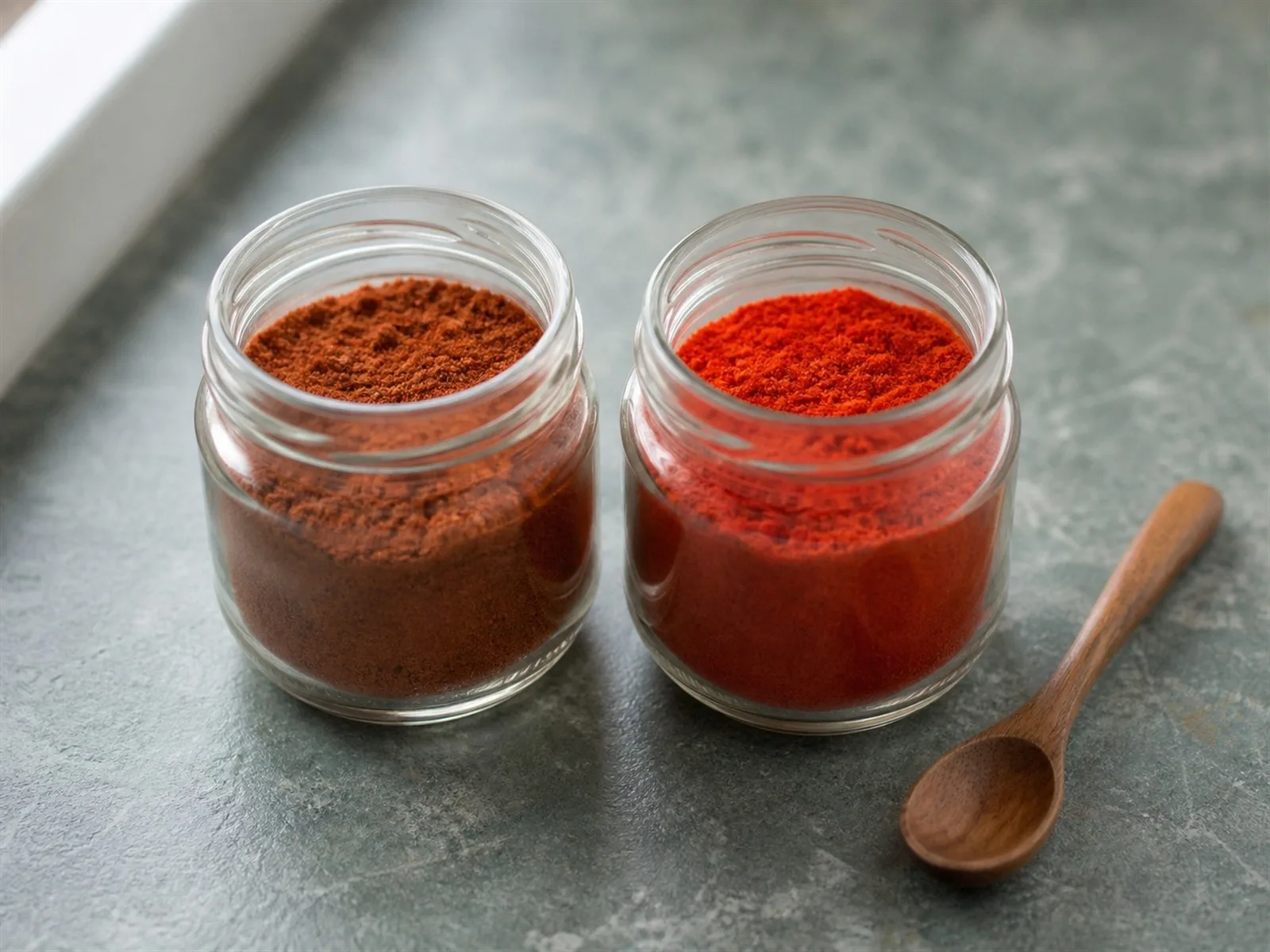
| Ground red spices (paprika, cayenne, chilli) | 1–2 years | 2–3 years | Colour |
| Ground turmeric | 1–2 years | 2–3 years | Colour, curcumin[8] |
| Dried leafy herbs (oregano, curry leaves) | 1–3 years[3] | 2–3 years | Aroma |
| Blends (garam masala, curry powder, sambar) | 6 months–2 years[3][5] | 2 years | Top notes |
| Homemade masalas | 3–6 months | 1 year | Everything, fast |
| Extracts except vanilla | 1–3 years[3][5] | 3 years | Aroma |
| Vanilla extract, salt | Indefinite[3] | Indefinite | Nothing |
Sources don't fully agree at the margins. McCormick rates ground spices at 2–4 years, NDSU Extension at 2–3. On blends, McCormick says 1–3 years and NDSU just 6 months.[3][5] When in doubt, go with the shorter number.
Why spices fade: volatile oils, oxygen and light
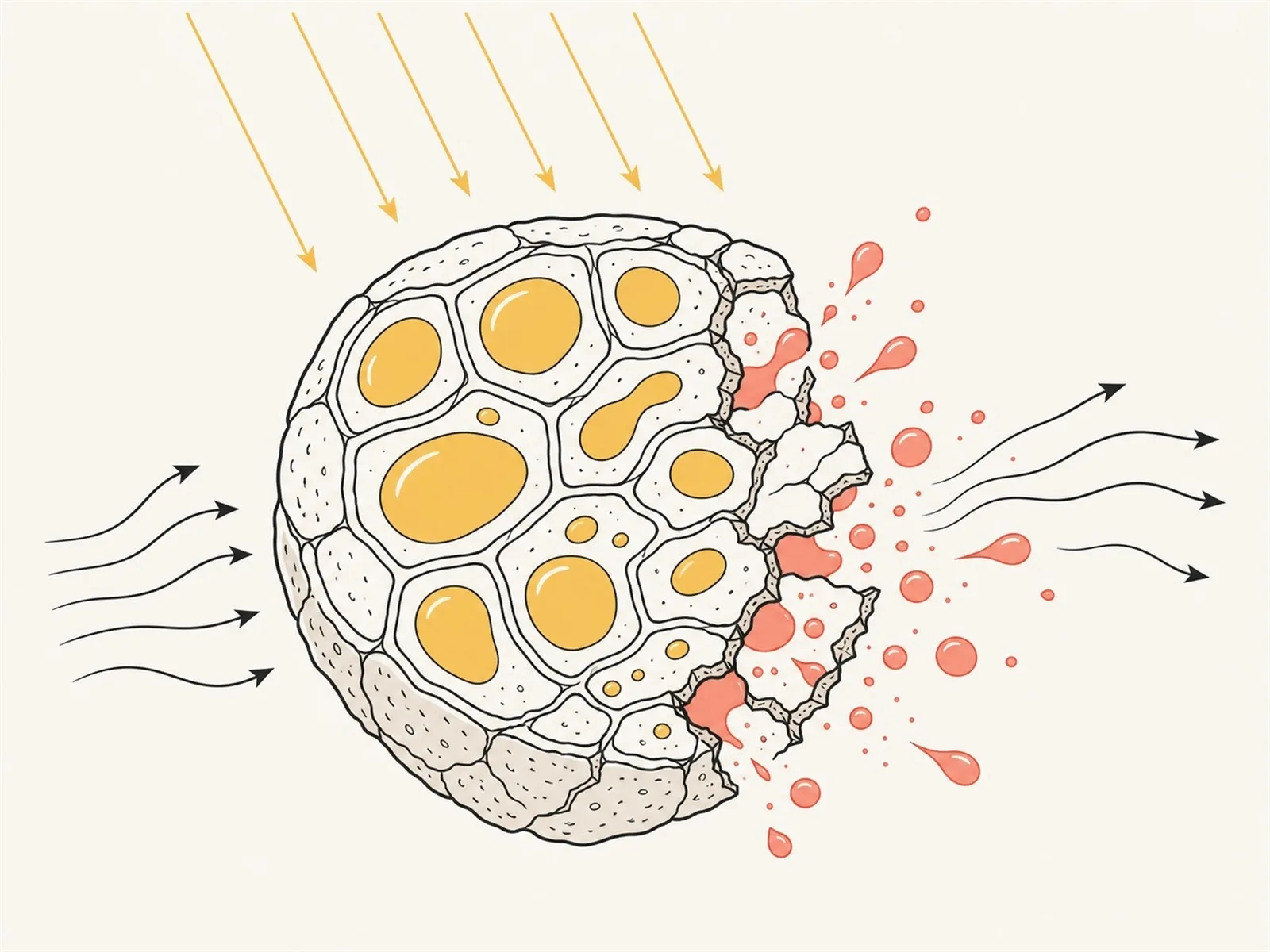
Three things do the damage, all of them physical. Aroma compounds are volatile, so some escape every time you open the jar — that's evaporation. Terpenes and seed fats react with air and dull over time, eventually turning seeds rancid, the same chemistry that ages olive oil.
Light is the one people don't expect. In a 2021 study, 24 hours under a 27 W household fluorescent lamp cut the colour intensity of turmeric oleoresin by 65.4%, and of a pure curcumin solution by 63.0%.[8] One lamp, one day. Now picture a clear jar sitting on a sunny shelf for a year.
Grinding speeds up all of it: it shatters the cell walls holding the oils in and multiplies the surface exposed to air, which is why whole spices outlast ground. Red-spice carotenoids are especially fragile, so B&G Foods advises refrigerating chilli powder, cayenne and paprika "to prevent loss of color and flavor".[10]
Are old spices dangerous? The Salmonella question
This is the part most spice articles skip. FDA analysed three years of imported spice shipments (FY2007–FY2009) and found 6.6% positive for Salmonella (95% CI 5.7–7.6%), about 1.9 times the rate for all other imported FDA-regulated foods, and 12% adulterated with filth (95% CI 10–15%), about 1.8 times the rate for other imports.[1][2] That's contamination at the source, not something growing in your cupboard. Ageing creates nothing, but Salmonella survives dryness, so whatever arrives contaminated stays that way.
Why aren't more people getting sick, then? Spices go into hot food, and FDA notes cooking "can reduce pathogen contamination depending on the length of cooking and temperature".[2] Outbreaks cluster where spice is added after the cooking is done — FDA logged 14 between 1973 and 2010, including a 1993 German paprika outbreak that ran to roughly 1,000 cases.[1]
Age isn't the variable that matters. How you use the spice is. Go carefully with raw applications — an uncooked rub, chaat masala over cut fruit. ASTA holds that every spice should undergo a validated kill step before sale.[11] Same logic as cooked rice left out.
Mould, aflatoxin and the humidity problem
Aspergillus flavus produces aflatoxins and favours chilli, black pepper, turmeric and ginger when they're stored warm and damp. A 2023 survey of spices bought in Ankara, Turkey found red pepper came off worst, averaging 3.76 µg/kg aflatoxin B1 and reaching as high as 39.12 µg/kg; five red pepper samples came in above the 5 µg/kg regulatory limit.[9]
You can't fix that once you've bought the jar. Moisture is what wakes dormant spores sitting inside, and that part you do control. If it's caked, musty or fuzzy, bin the jar rather than scrape the top.
Adulteration: what the 2024 spice scandals actually showed
Ethylene oxide, 2024. On 5 April 2024, Hong Kong's Centre for Food Safety reported ethylene oxide — an IARC Group 1 carcinogen — in four products: MDH Madras Curry Powder, MDH Sambhar Masala, MDH Curry Powder and Everest Fish Curry Masala. Vendors pulled the products and importers issued recalls.[12] On 18 April 2024, Singapore's Food Agency recalled one batch of Everest Fish Curry Masala on the same grounds.[14] FSSAI then sampled nationwide and reported on 21 May 2024 that it found no trace of ethylene oxide across 28 lab reports covering both brands.[14]
Most coverage stopped there. FSSAI didn't. It kept testing, and by early July 2024 — roughly 2,200 of 4,000 collected samples analysed — it had cancelled the manufacturing licences of 111 spice producers, mostly small firms, on quality and adulteration grounds.[15] So: specific export lots failed on ethylene oxide, the two named brands' domestic samples didn't, and the wider Indian spice supply chain still had a real problem. Note those licence-cancellation figures come from an audit still in progress at the time, not a final tally. Practical takeaway: buy sealed, properly labelled packs from an FSSAI-licensed manufacturer you can identify, keep the batch code until the jar is finished, and check FSSAI recall notices if a brand is in the news — brand size is not itself evidence of safety.
Lead chromate in turmeric. Forsyth and colleagues, in Environmental Research (2019), documented industrial lead chromate pigment added to Bangladeshi turmeric to brighten dull post-flood crops — in 7 of 9 major producing districts, with powder lead up to 1,152 µg/g.[13] A regional supply-chain problem, not a property of turmeric — but an argument for whole roots or regulated brands.
How to tell if a spice is still worth using
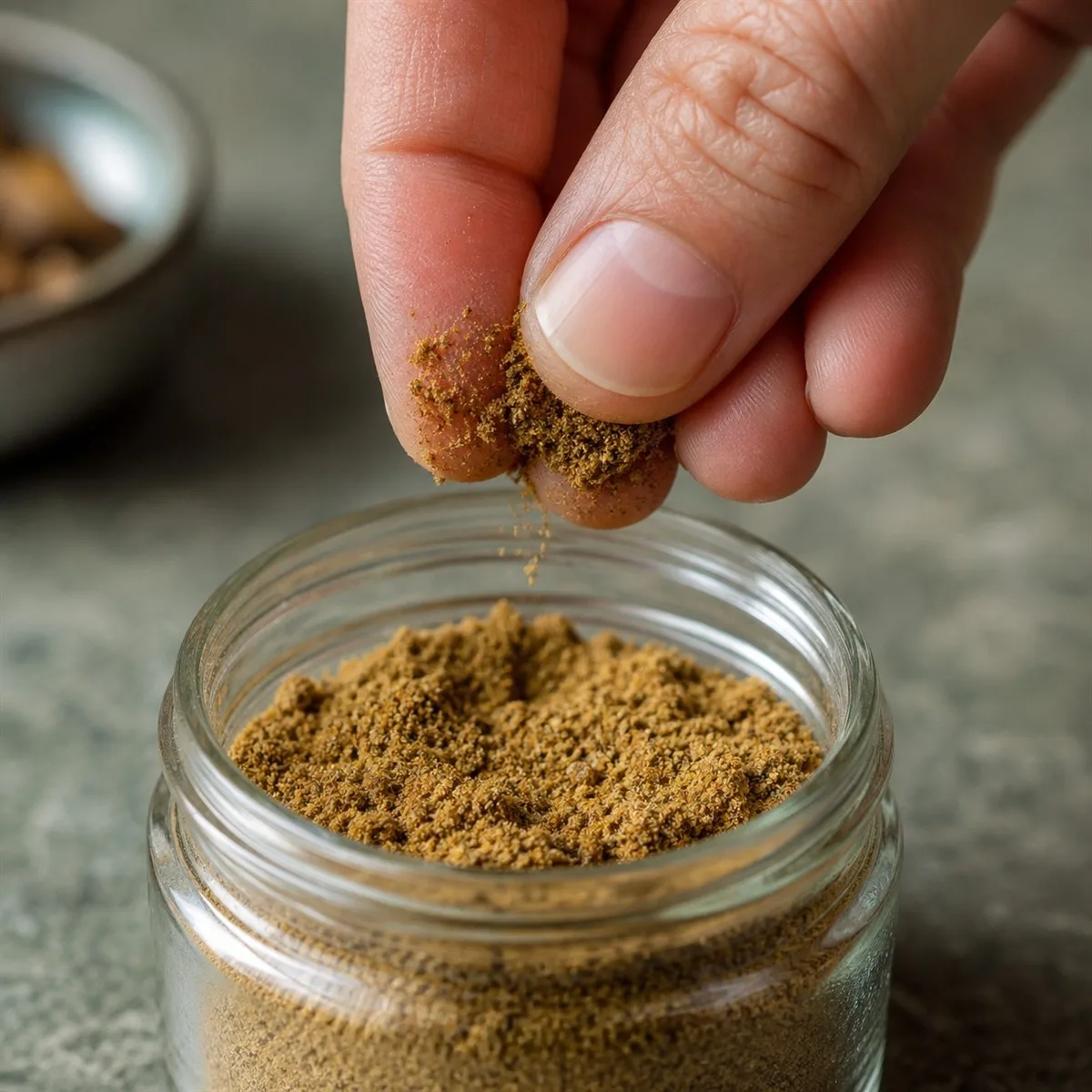
- Rub a pinch between your fingers. The warmth releases whatever's left in it.
- Sniff. A clear, specific smell means it's still alive. Vague dustiness means it's done.
- Look. Faded or greyish where it should be red, green or gold? The oils went along with the colour.
- Crush a little between your fingers or in a mortar. If crushing releases a fresh burst of aroma, there's life left; if it smells the same crushed as whole, it's spent. Judge spices by nose, not by tasting them raw — ground spices are a known Salmonella vehicle at the source, and heat in cooking is what deals with that.[1]
If a spice is tired rather than dead, doubling the quantity restores roughly the right intensity. That stops working once the aroma is gone — you're then adding bulk and bitterness, since old spice concentrates dull woody notes.
Myth vs fact
| Myth | Fact |
|---|---|
| "Spices last forever." | Salt and vanilla extract basically do.[3] Everything else is running a flavour clock — 6 months for blends, 4 years for whole. |
| "Expired spices will make you sick." | Age alone doesn't create anything dangerous; dried spices are too dry for microbial growth.[7] The risk comes from contamination at the source, or moisture you added yourself. |
| "If it still smells like something, it's fine." | Only if it smells like itself. Generic warm dustiness is degraded oils, not cumin. |
| "Toasting freshens old spices." | Partly true. Dry-toasting or blooming in hot fat drives out whatever volatiles are left and adds some Maillard browning, but it can't bring back what already evaporated. |
| "Refrigerating spices keeps them fresher." | Red spices only, and only if properly sealed.[10] Otherwise you're inviting condensation, which leads to caking and mould. |
How to store spices so they actually last
- Keep them away from the stove. The rack above the hob is the worst spot in the kitchen for this.[3]
- Keep them out of light. A closed cabinet or opaque tin beats a clear jar on an open shelf — that's decoration, not storage.
- Keep them airtight and dry. Never shake a jar directly over a steaming pot. Measure into a dry spoon instead.
- Buy whole, grind weekly. It roughly doubles your useful window.
- Freeze the fragile ones. Penn State Extension backs this, with one caveat: warm the container before opening it, or you'll get condensation forming inside.[6]
- Buy small. A 30 g jar finished in four months beats a 200 g jar dragged out over four years.
See also storing food better and wasting less and whether flour expires.
Spice cabinet audit checklist
- Empty the cabinet onto the counter. You can't audit what you can't see.
- Rub and sniff every jar. Sort into two piles: smells like itself, doesn't.
- Bin anything caked, musty or fuzzy. No scraping, no second chances.
- Check the reds separately. Brick-brown paprika goes even if it still smells fine.
- Date the survivors. Marker on the lid — month and year opened.
- Move your top ten to the front.
- Set a 12-month reminder. The annual audit is what actually makes this work.
Indian spices and hot, humid climates
A humid kitchen runs every one of the clocks above faster.
Garam masala fades quickest — ground, mixed, full of volatile top notes. Commercial packs hold 6 months to 2 years; homemade peaks at 3–6 months. Roast and grind small quantities.
Sambar and rasam powders carry lentils and coconut, so these turn rancid rather than fade — smell for a stale-nut note and refrigerate big batches. Hing is resin-based and volatile; double-seal it or the whole dabba tastes of it. Curry leaves and kasuri methi are spent far sooner than the herb rule suggests — freeze them fresh.
The masala dabba is excellent design: opaque steel, tight lid, small quantities in rotation. Its weakness is that it lives beside the hob and gets opened over steam — keep it a metre from the flame. In monsoon, move powders to the fridge or freezer, sealed, warming them before opening.
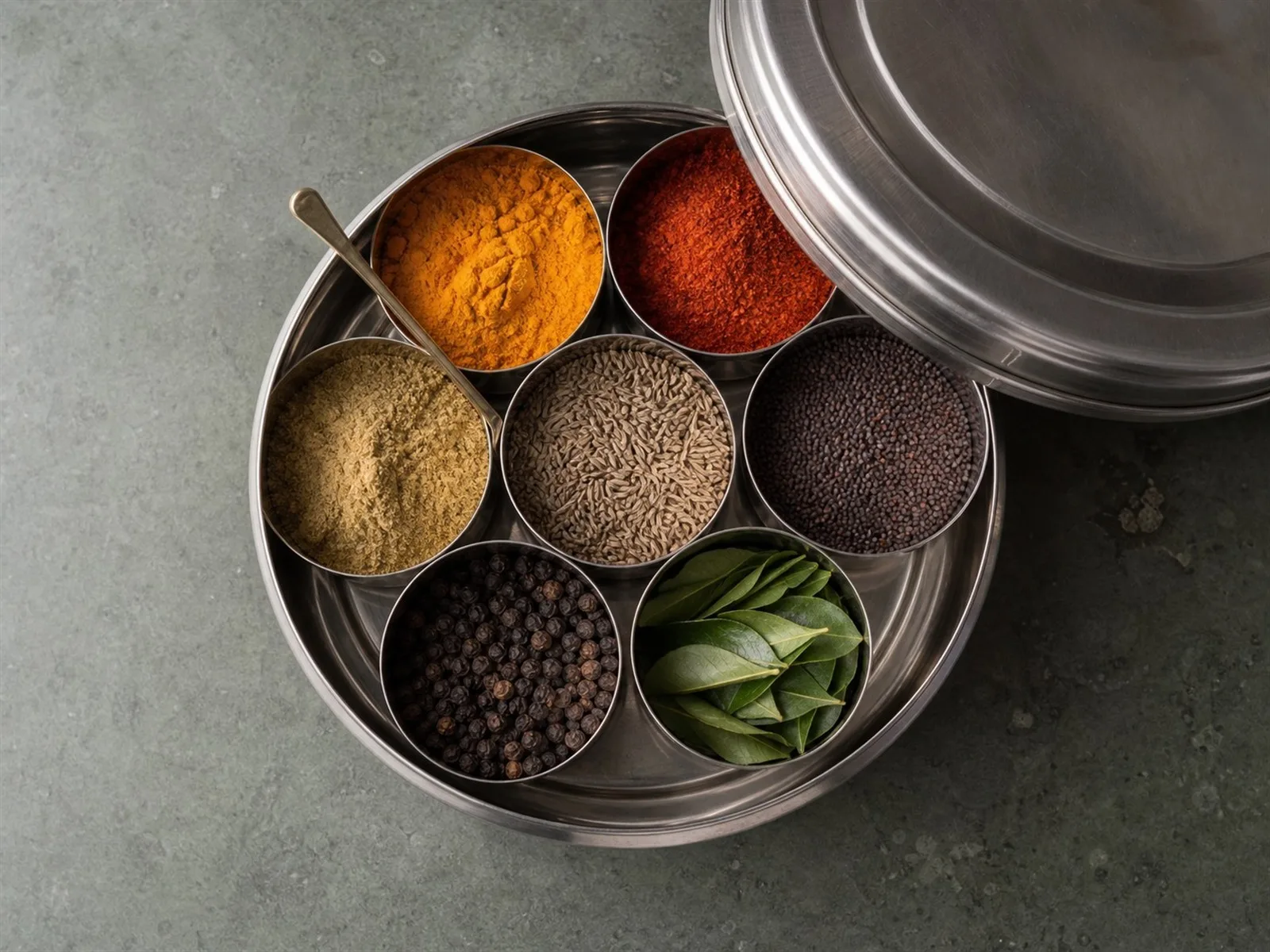
One folk practice, flagged as such: tucking rice or salt into a spice tin is tradition, not evidence-based food safety. It's harmless, but it won't rescue a jar that's already caked. Sun-drying spices to "refresh" them is worse than useless. UV light destroys the exact pigments and oils you're trying to save.[8] Our Indian pantry storage guide covers monsoon-proofing in more detail.
Frequently asked questions
Does garam masala expire?
Not in the safety sense, but it fades faster than almost anything else in your cabinet. Commercial jars hold decent flavour for 6 months to 2 years; a homemade batch peaks at 3–6 months. The volatile top notes — cardamom, clove, cinnamon — are the first to go, leaving something flat and woody behind.
How long does turmeric last?
Ground turmeric holds its colour and flavour for 1–2 years and stays usable for up to three. Colour is what goes first: turmeric pigment lost 65.4% of its colour intensity in 24 hours under ordinary household fluorescent light.[8] Keep it in an opaque container, somewhere dark.
Can you get sick from expired spices?
Very unlikely from age on its own — dried spices are too dry for bacteria to grow.[7] The actual risks are contamination that was already there when you bought it — FDA found Salmonella in 6.6% of imported spice shipments examined at the border in FY2007–09, which is import-entry screening rather than a measure of what reaches shops[1] — and mould from moisture you introduced yourself. Thorough cooking reduces the first, which is why spices stirred into a dish that then simmers are lower risk than the same spice dusted raw over a finished plate. An airtight jar deals with the second.
Do spices expire if unopened?
The clock runs slower, but it still runs. A sealed jar loses aroma to oxidation and light rather than evaporation, so treat unopened shelf life as the top end of each range: roughly 4 years whole, 3 ground, 2–3 for herbs. Keep those sealed jars out of the light too.
How can you tell if a spice has gone bad?
Rub a pinch between your fingers, then smell it right away. A specific, recognisable aroma means use it. Vague dustiness means replace it. Check colour next — faded reds and greyish greens have already lost their oils. Any caking, musty smell or visible mould, and the whole jar goes in the bin.
Should you refrigerate spices?
Mostly, no. For red spices — paprika, cayenne, chilli powder — refrigeration genuinely helps hold colour and flavour.[10] For everything else, the condensation risk outweighs the benefit, since moisture gets in the moment a cold jar meets warm air. If you do chill or freeze spices, seal them tightly and let the container warm up before you open it.[6]
How long do homemade masalas last?
Shorter than anything shop-bought, since there's no anti-caking agent and no nitrogen flush protecting them. Plan on 3–6 months at peak and up to a year before they're really gone. Blends with lentils, coconut or nuts — a lot of sambar and chutney powders fall here — turn rancid instead of just fading, so refrigerate those and make smaller batches.
Do whole spices really last longer than ground?
Yes, by a wide margin — roughly 3–4 years versus 2–3.[3][5] The reason is mechanical, not magical. An intact peppercorn keeps its aromatic oils sealed inside plant cells, with very little surface touching the air. Grinding shatters those cells and multiplies the exposed surface area, so oxidation runs far faster afterward.
What does the "Best By" date on a spice jar mean?
Quality, not safety. It marks the expected peak flavour window, not a point where the spice turns dangerous. McCormick states its products "do not spoil" and that older spices, while not harmful, "will not add the flavor that you desire".[4] In India, FSSAI-labelled packs carry a "Best Before" date that means the same thing.
Bottom line
Spices don't spoil the way perishable food does — they fade. Water activity around 0.50 keeps bacteria and mould from getting a foothold, so age by itself isn't the safety risk most people assume it is. What actually matters is how long the aromatic oils have been evaporating and oxidising, and whether contamination or moisture got in somewhere along the way.
Use the shelf-life ranges as a flavour guide, not a safety deadline: whole spices roughly 3–4 years, ground 2–3, blends 6 months to 2 years, homemade masalas 3–6 months. Trust the rub-and-sniff test over any date on the lid, buy from brands large enough to be tested, and bin anything caked, musty or visibly mouldy without a second thought.
Related WillItExpire guides
Sources
- U.S. Food and Drug Administration — Draft Risk Profile: Pathogens and Filth in Spices.
- U.S. Food and Drug Administration — Questions & Answers on Improving the Safety of Spices.
- McCormick — How Long Do Spices Last?
- McCormick — Frequently Asked Questions.
- NDSU Extension (Julie Garden-Robinson, PhD, RD) — Food Storage Guide, FN579.
- Penn State Extension (Martha Zepp) — Storing Staple Ingredients in the Kitchen.
- Kansas State Research and Extension (Kelly Getty, PhD; Rashmi Gaikwad, PhD) — Water Activity of Foods, MF3674.
- Jung, Y.N. & Hong, J. (2021) — Changes in chemical properties and bioactivities of turmeric pigments by photo-degradation, AIMS Agriculture and Food, 6(2): 754–767.
- Microorganisms (2023) — Analysis of Multi-Mycotoxins in Commonly Consumed Spices Using the LC-MS/MS Method for Assessing Food Safety Risks, 11(7):1786.
- B&G Foods (Spice Advice) — Spice Storage.
- American Spice Trade Association (ASTA) — Food Safety & Treatment Methods.
- Centre for Food Safety, Hong Kong SAR Government — CFS finds ethylene oxide in samples of prepackaged spice mix products. Press release, 5 April 2024.
- Forsyth, J.E. et al. (2019) — Turmeric means "yellow" in Bengali: Lead chromate pigments added to turmeric threaten public health across Bangladesh, Environmental Research, 179(A):108722.
- Singapore Food Agency — SFA recalls Everest Fish Curry Masala from India due to the presence of ethylene oxide at levels exceeding permissible limit, media release, 18 April 2024; and Deccan Herald — FSSAI finds no trace of ethylene oxide in samples of MDH, Everest spices in 28 lab reports, 21 May 2024.
- The Wire — FSSAI Cancels Manufacturing Licenses of 111 Spice Producers Over Adulteration Concerns, 4 July 2024.
This article provides general information using a U.S. baseline with clearly labelled hot-climate context. Shelf-life ranges reflect manufacturer guidance and published research, not guarantees for any specific product. Follow stricter package, manufacturer or local instructions. It is not food-safety or medical advice.