The tub has been in the corner of the cupboard — or the bottom of the gym bag — for longer than you'd like to admit. The date on the side has come and gone. It still looks like protein powder, still smells more or less like vanilla, and you are standing there doing the arithmetic every lifter does eventually.
Here is the honest version of the answer.
Does it expire, and when should you bin it?
Protein powder does not become unsafe the instant its printed date passes. On dry powders that date is almost always a manufacturer quality guarantee, not a safety deadline — the same "best if used by" logic regulators apply to other shelf-stable foods.[1][2] Safety comes down to three things: whether the powder stayed dry, cool and sealed; the type of powder and what's added to it; and whether you can see warning signs — damp or hard clumps, mould, insects, a swollen tub, or a strong rancid or chemical smell. Dry, intact, cool-stored powder a little past a best-before date is usually a quality judgement. Anything involving moisture, visible spoilage, or an unknown storage history should be discarded.
The keep, check or discard table
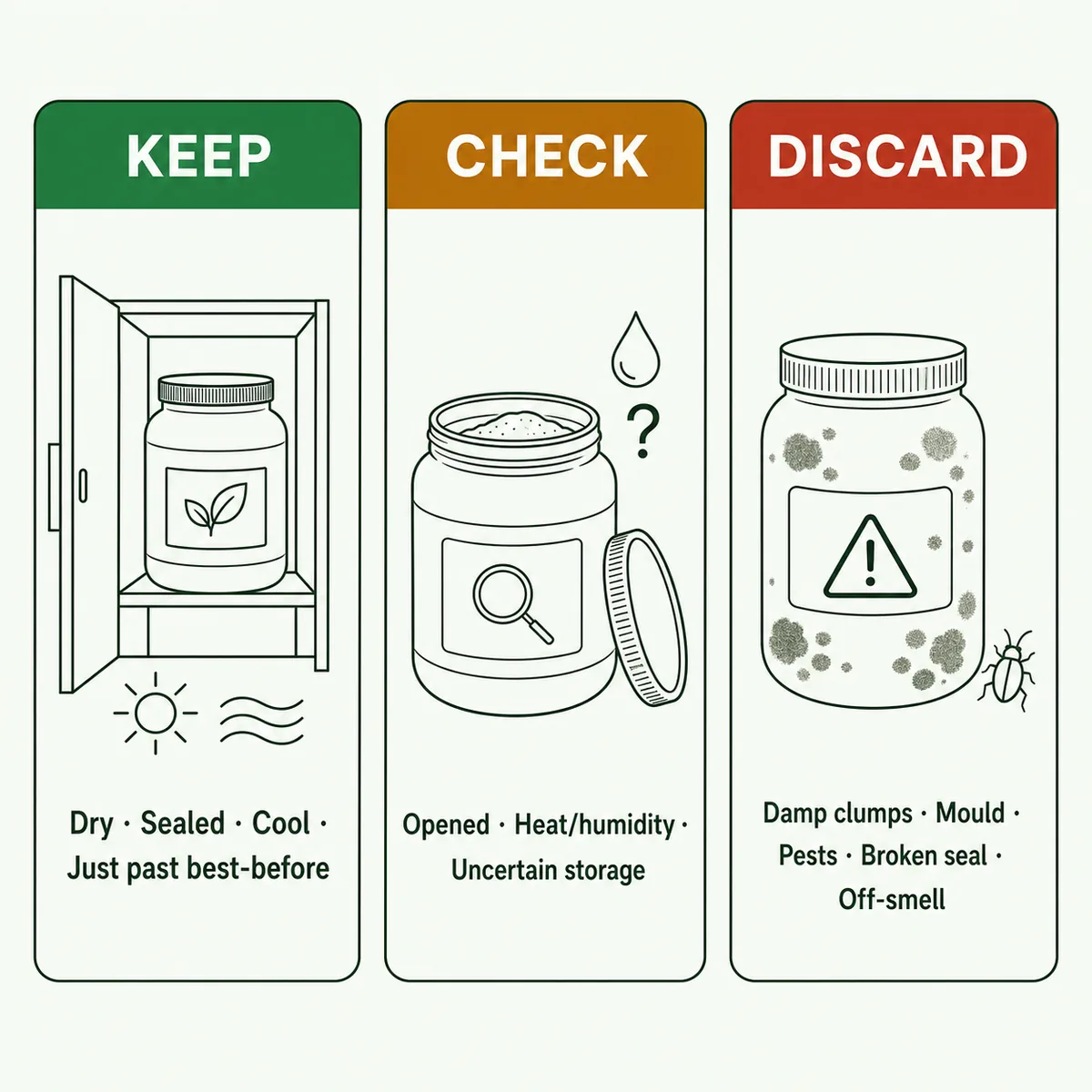
| Situation | Status | What to do |
|---|---|---|
| Unopened, just past best-before, stored cool and dry | Quality question, not automatic risk | Check seal and appearance; use judgement or ask the maker |
| Opened, modestly past date, kept dry and sealed | Often usable, quality may be lower | Inspect for damp clumps, mould, off-odour; if clear, treat as a quality call |
| Stored in heat or humidity (car, garage, tropical kitchen) | Cannot be confirmed | Extra caution; if exposure was prolonged, discard or ask the maker |
| Small, dry clumps only | Usually a quality/texture issue | Break them up; if dry, even-coloured and normal-smelling, likely fine |
| Damp, sticky or rock-hard clumps | Moisture intrusion | Discard — dry powder is not meant to be wet |
| Sour, musty, rancid, paint-like or chemical smell | Likely spoilage or rancid fat | Discard |
| Visible mould, webbing, larvae or insects | Not safe | Discard; do not sift or salvage |
| Seal broken on arrival, or swollen/leaking tub | Cannot be confirmed | Do not use; return or contact the maker |
| A wet scoop went into the tub | High risk | If the powder got damp, discard the tub |
| Already mixed into a shake with water or milk | Perishable | Refrigerate promptly; follow the 2-hour rule |
Two details do more work than people expect. Dryness is the whole game — a low-moisture powder is chemically slow to spoil, but the moment water gets in, that protection is gone. And the printed date assumes good storage. A tub that spent a summer in a hot car was never really on the timeline the number implies.
What the date on the tub actually means
Most protein powders carry a best-before (or "best by") date. That marks when the manufacturer expects peak flavour, texture and nutrient levels under proper storage — not the moment the product turns dangerous. For shelf-stable foods, U.S. regulators are explicit that these dates are about quality, not safety; with the narrow exception of infant formula, a properly stored product is generally still safe after the date until spoilage is actually evident.[1][2]
A use-by or expiration date is stricter and is reserved for products where safety can degrade — more common on ready-to-drink shakes than on dry powders. You may also see a manufacturing date (MFG) with a "use within X months" instruction, and a lot or batch code, which is the number to quote if you ever call the manufacturer.
The wording differs by region. In the UK and EU, "best before" is quality and "use by" is a safety line you should not cross — and the Food Standards Agency specifically says the sniff test is only appropriate for best-before foods, because you cannot smell the microbes that cause food poisoning.[3] India's FSSAI labelling rules similarly separate "best before" from "use by / expiry," with protein powders generally sold as packaged foods or health supplements under those rules.[4] Across all of them, the date is one input; storage conditions and spoilage signs matter at least as much.
How protein powder actually goes bad
It's dry, so microbes mostly can't grow. Protein powders are formulated at low water activity. While they stay dry and sealed, bacterial and mould growth is severely limited, so most change is chemical or physical rather than microbiological.
Until moisture gets in. A wet scoop, condensation from fridge storage, a spill, or a failed seal introduces the one thing the formula was designed to exclude. Damp clumps, fuzzy growth or a musty smell mean the powder should go.
Fats can turn rancid. Powders with real fat content — whey concentrate, many plant proteins, mass gainers, meal replacements — can oxidise, especially in warmth, producing stale, cardboard-like, oily or paint-like off-flavours. That is both a quality problem and a reason to bin it.
The Maillard reaction quietly erodes quality. In dairy powders, milk sugars react with the amino acid lysine over long storage, causing browning, flavour change and reduced lysine availability. Controlled studies on whey protein concentrate stored at elevated temperature and humidity show exactly this: rising water activity, caking, off-flavour compounds and measurable lysine loss, accelerating with heat and moisture.[5] It does not make the powder suddenly unsafe at the date — it slowly makes it nutritionally less complete.
Added extras fade first. Probiotics, enzymes and some vitamins lose potency during storage, and are often formulated to meet label claims only up to the printed date. Probiotic viability in dry powders drops fastest with higher moisture, temperature and oxygen exposure.[7] Creatine monohydrate, by contrast, is notably stable as a dry powder and degrades mainly once it's dissolved in liquid.[6] So an over-age tub may still deliver protein while quietly delivering fewer live cultures or active vitamins than the label promises.
Shelf life by product type
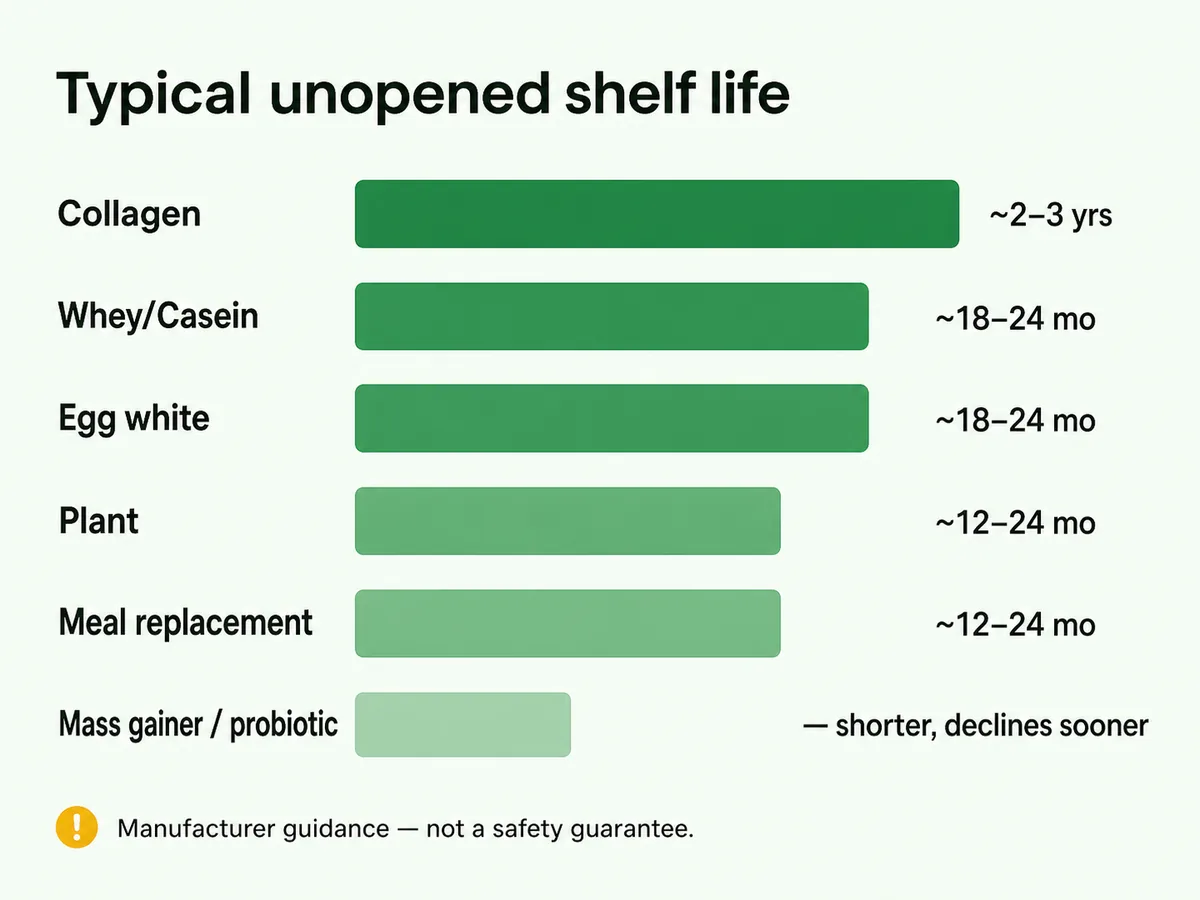
The ranges below describe common manufacturer practice and research trends. They are manufacturer guidance and quality estimates, not safety guarantees for any specific tub.
| Product type | Unopened (typical) | Main risks |
|---|---|---|
| Whey isolate / concentrate | ~18-24 months | Maillard / lysine loss; fat rancidity in concentrate |
| Casein | ~18-24 months | Maillard browning, flavour change |
| Plant (soy, pea, rice, hemp, blends) | ~12-24 months | Rancidity of plant oils, off-flavours, caking |
| Collagen peptides | ~2-3 years | Moisture clumping, minor colour change |
| Egg-white protein | ~18-24 months | Sulfurous off-odours with age |
| Mass gainers | Often shorter / similar | Rancid fats, sugar and flavour degradation |
| Meal replacements (vitamins, botanicals) | ~12-24 months | Vitamin loss, rancidity, flavour fade |
| Probiotic / enzyme powders | Viability declines before date | Loss of live cultures / enzyme activity |
| Ready-to-drink shakes | Per use-by date | Microbial growth if integrity lost |
Opened tubs are the bigger variable. Manufacturers rarely publish a precise "months after opening" figure; the practical rule is keep the lid tight, store cool and dry, and use within a reasonable window — shorter in hot, humid homes. Every open-and-close cycle is a chance for moisture to get in, so in tropical climates an opened tub's real shelf life can be well short of its printed date.
Is expired protein powder safe? Common scenarios
No article can guarantee any individual tub. These are ways to think about the usual situations, not blanket assurances.
Unopened, just past best-before, stored cool and dry. Intact seal, normal look and smell — this is usually a quality judgement rather than an automatic safety failure.
Unopened but many months past date. Flavour and nutrient degradation become likelier, and the maker may no longer stand behind it. With uncertain storage, the conservative move is to contact the manufacturer or discard.
Opened and past date. The concerns are moisture and handling. Carefully stored and only modestly out of date, risk may be low — but damp clumps, odour changes or visible spoilage override the date.
Stored in heat or humidity. Prolonged time in a hot car, sunny kitchen or humid room speeds up rancidity and Maillard change and can let condensation form inside. Because some of that is invisible, err toward caution or discard.
A wet scoop, spill or condensation. Water in a low-moisture product creates local high-risk pockets; discarding the tub is the safe call.
Transferred to another jar. Fine if the container was clean, dry and airtight and the powder stayed dry — but you've lost the lot number, so label the date and stay alert to moisture.
Already mixed into a shake. Now it's a perishable drink. Refrigerate promptly and follow the standard 2-hour rule (1 hour above 90°F / 32°C); dairy-based shakes left warm are the real hazard, not the dry powder.[8]
Can expired protein powder make you sick?
Dry, well-stored powder is low-risk. The routes to trouble are moisture-driven or handling-driven: mould (discard anything fuzzy or musty — some moulds produce toxins), bacterial growth once water and warmth are present (far more likely in a mixed shake left out than in dry powder), rancid fats (mainly off-flavour and possible stomach upset), and allergic reactions, which track the ingredient, not the date. Dirty scoops and bare hands introduce contaminants independently of any expiry.
If someone develops significant symptoms after a protein shake — especially fever, severe or bloody diarrhoea, persistent vomiting, or any symptoms in a pregnant person, young child, older adult or immunocompromised individual — treat it seriously and seek medical advice. This article cannot diagnose or rule out illness.
Does old protein powder lose protein or effectiveness?
Protein content does not drop to zero at the date, but effectiveness slides on a scale. Total protein stays broadly similar, yet usable lysine can fall with long, warm storage as the Maillard reaction runs, and solubility can drop so shakes turn gritty.[5] Added vitamins and probiotics lose potency and may only be guaranteed to the printed date,[7] while creatine in a dry blend holds up well until it hits liquid.[6] The upshot: an over-age powder may still be a fine protein source but a less complete one — more so if it was stored poorly.
Spoilage signs that matter
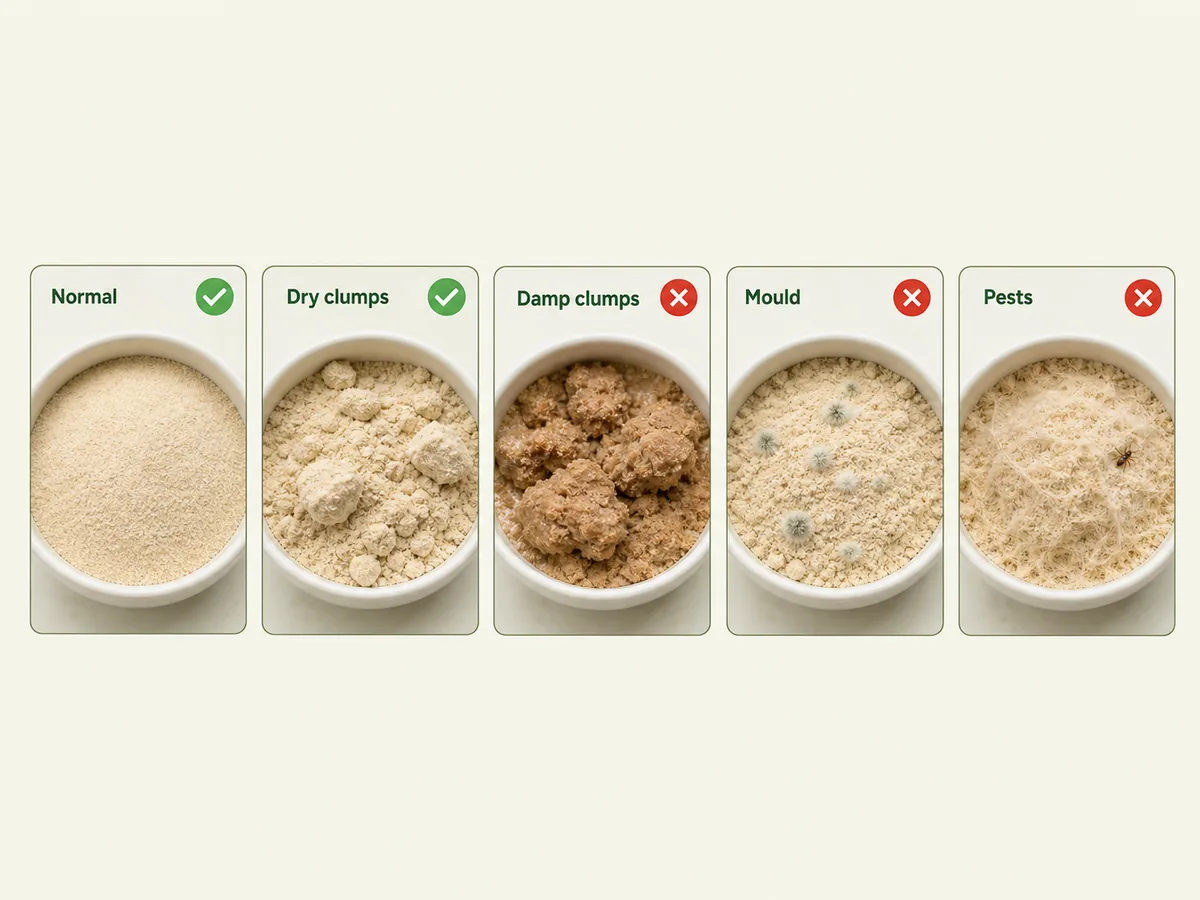
| What you notice | What it may mean | What to do |
|---|---|---|
| Slight settling, small dry clumps that break apart | Normal settling / mild humidity | If colour and smell are normal, minor quality issue |
| Sour, musty, cheesy, cardboard-like or paint-like smell | Rancid fat or spoilage | Discard |
| Bitter or off flavour in otherwise normal powder | Age-related oxidation | Quality issue; if strongly unpleasant, discard |
| Dark specks or marked colour change | Maillard browning, localised moisture, or contaminants | If it resembles mould or pests, discard |
| Fuzzy growth, webbing, larvae or insects | Spoilage or pantry infestation | Discard; check nearby dry goods |
| Wet, sticky or rock-hard clumps | Moisture exposure | Discard |
| Swollen tub or pouch, leaks, rust on the seam | Possible spoilage gas or breach | Discard; contact the maker |
| Moisture beads inside the lid | Condensation from humid / fridge storage | Treat as high-risk; discard |
Never taste powder that already looks or smells wrong. Tasting is not a safety test.
A 60-second decision checker
Broken seal on arrival, swollen or leaking, rusted seam → return or discard.
Known wet scoop, spill, condensation or leak → discard.
A cool, dry cupboard lowers risk; weeks in a hot car or humid kitchen raise it.
Best-before is a quality anchor; respect a mandated use-by.
Any one of these → discard.
Mass gainers and probiotic blends deserve extra caution after the date.
Pregnant, a child, older, immunocompromised or severely allergic → be more conservative.
Quote the lot and date to the manufacturer for product-specific advice.
Intact, dry, cool, just past best-before, no spoilage signs → likely a quality call. Uncertain storage or a delicate formula, but no clear spoilage → extra caution, ask the maker. Moisture, mould, pests, off-odour or a broken seal → discard.
Storing protein powder so it lasts
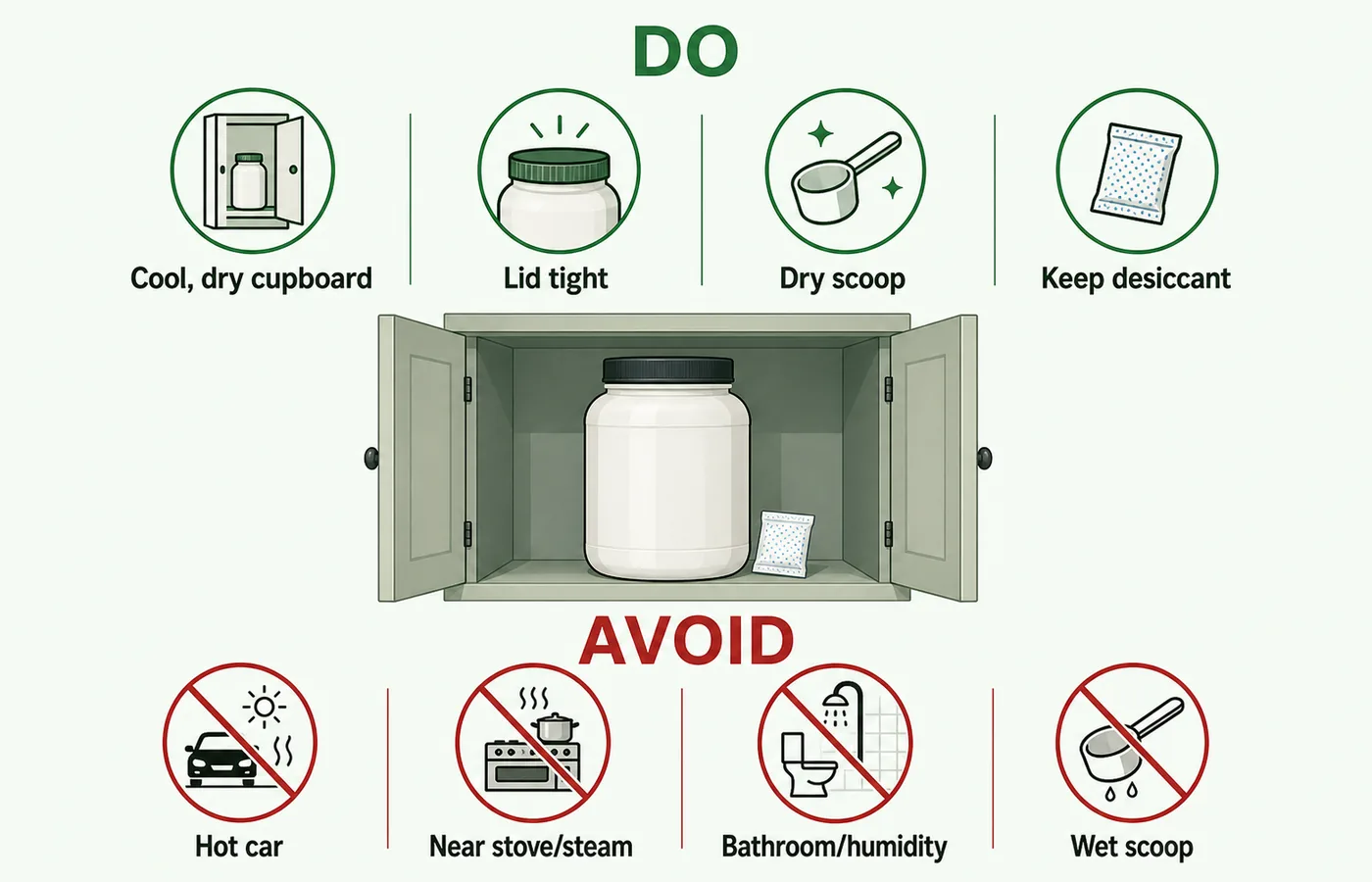
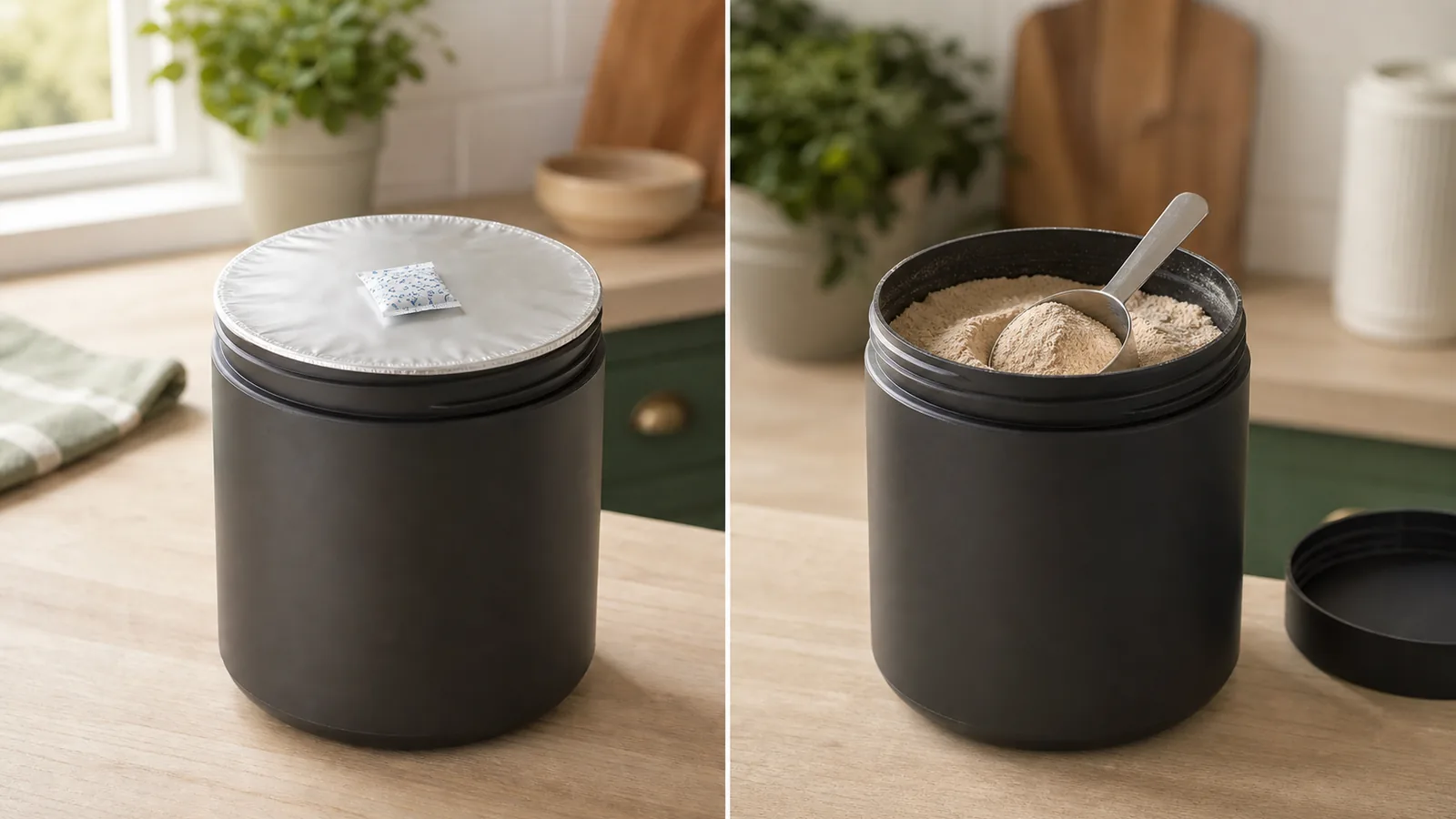
Keep it in a cool, dry cupboard away from the stove, dishwasher, kettle steam and direct sun, with the lid firmly closed and the original desiccant packet left in. Use a completely dry scoop — never dip a wet one — and avoid handling powder with bare hands.
In hot, humid regions like much of India, storage matters even more: pick the coolest, driest spot, keep tubs out of non-air-conditioned kitchens during summer, and consider smaller tubs so each one is finished before humidity has long to work. Don't routinely refrigerate an opened tub — the condensation each time you open it does more harm than the cold does good. If you decant into another container, use a food-grade, airtight, bone-dry jar and label the date and lot. Single-serve sachets cut household contamination but still depend on how the box was stored — never use a sachet that's swollen or split.
Three myths worth retiring
"The expiry date means it's now dangerous." For dry powder that date is a quality guarantee, not a safety switch.[1][2]
"If it smells fine, it's fine." A normal smell is reassuring but not proof — you can't smell every hazard.[3]
"Baking or cooking old powder makes it safe again." Heat kills many microbes but doesn't undo rancid fats or every toxin. Mouldy, damp or infested powder shouldn't be baked with either.
Frequently asked questions
Does whey protein expire?
Can I use protein powder after the expiration date?
How long does protein powder last after opening?
Makers rarely give exact months; keep it sealed, cool and dry and use within a reasonable window, shorter in hot, humid climates.
Is unopened expired protein powder safe?
Does expired protein powder lose protein?
Total protein stays similar, but usable lysine and solubility can decline with long, warm storage, so it may be nutritionally less optimal.[5]
Is clumpy protein powder bad?
Small dry clumps are usually harmless settling; damp, sticky or rock-hard clumps signal moisture and should be discarded.
How long does a mixed protein shake last?
Treat it as perishable: follow the 2-hour room-temperature rule (1 hour above 90°F / 32°C), and if refrigerating, most brands advise using it within about 24 hours.[8]
Do collagen peptides and creatine expire?
Both carry dates and are relatively stable while dry and cool; creatine in particular holds up as a powder and mainly degrades once dissolved in liquid.[6]
Bottom line
Treat the printed date as a quality anchor, not a safety verdict. Dry, sealed, cool-stored powder a little past a best-before date is usually fine to finish; the things that genuinely decide safety are moisture, storage temperature, packaging integrity, and visible spoilage.
Small dry clumps are a texture issue — dampness, mould, pests, a broken seal or a strong off-smell are reasons to discard regardless of the date, and more so for pregnant people, children, older adults and anyone immunocompromised. When you can't account for the storage history, the lot number and a quick message to the manufacturer beat any universal "X months past expiry" rule.
Related WillItExpire guides
Sources
- USDA FSIS — Food Product Dating.
- U.S. FDA — Confused by Date Labels on Packaged Foods?
- UK Food Standards Agency — Best before and use-by dates.
- FSSAI — Food Safety and Standards (Labelling and Display) Regulations, 2020.
- Journal of Dairy Science — Physical and chemical changes in whey protein concentrate stored at elevated temperature and humidity.
- U.S. FDA — GRAS Notice GRN 931: Creatine Monohydrate.
- Journal of Food Science and Technology (PMC) — Survivability and storage stability of encapsulated spray-dried probiotic powder.
- USDA FSIS — "Danger Zone" (40°F-140°F).
This article provides general information using a U.S. baseline with clearly labelled hot-climate context. Shelf-life ranges reflect manufacturer guidance and powdered-food research, not guarantees for any specific product. Follow stricter package, manufacturer or local instructions. It is not medical advice.