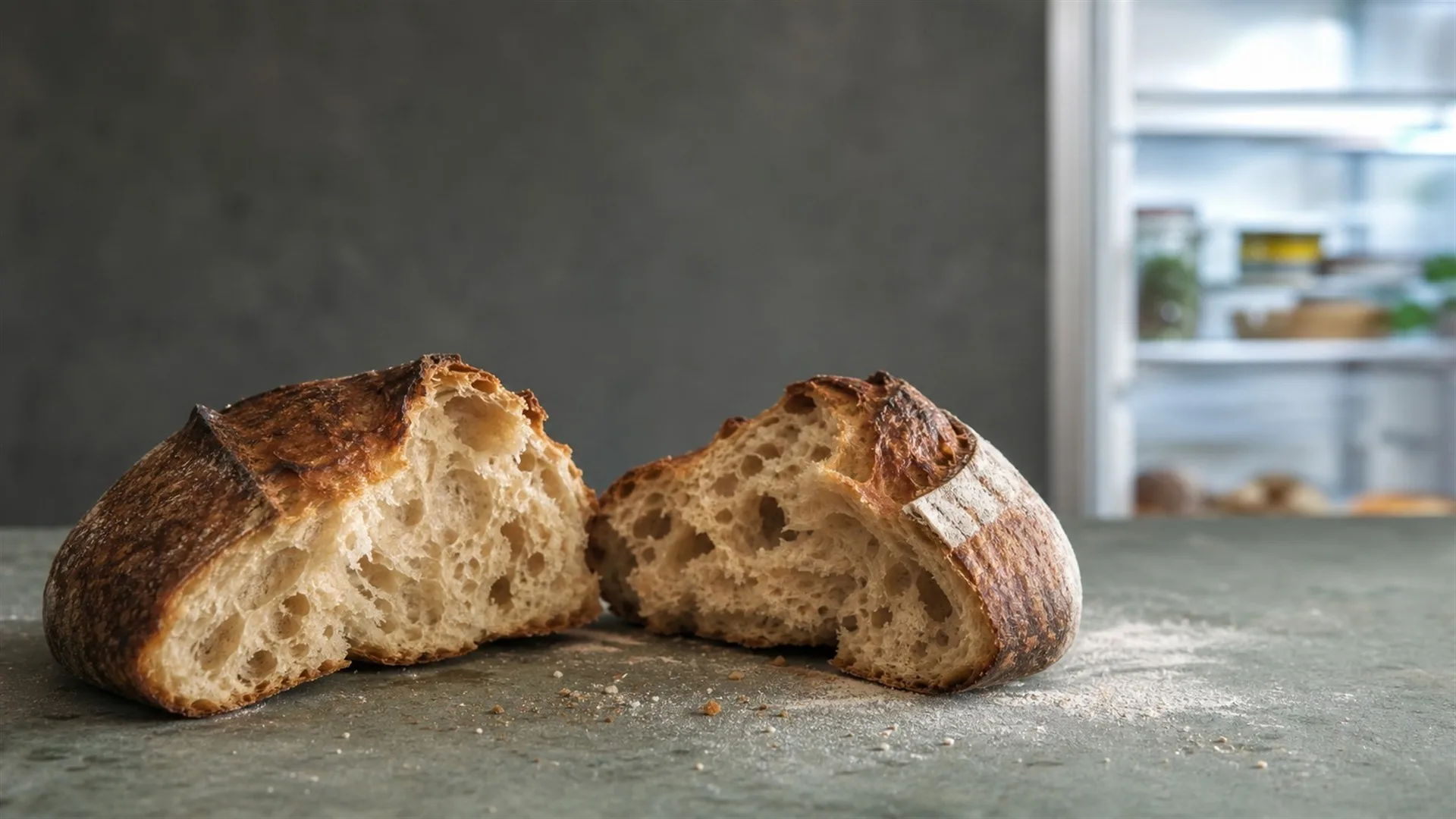
Someone in your house just put the loaf in the fridge. Someone else saw it and said something. Now you're both standing there, certain, and neither of you can explain why.
Good news: this one has a real answer, backed by X-ray diffraction studies of bread crumb. The fridge is genuinely the worst place for bread. But the person who put it there wasn't entirely wrong — and that detail matters more than most articles admit.
Should bread go in the fridge?
- No — don't refrigerate bread. Peer-reviewed testing found staling runs fastest at 40°F / 4°C — faster than room temperature or the freezer.[3]
- Counter for days, freezer for weeks. Room temp 3–7 days; freezer 3 months, indefinite for safety.[4][14]
- The fridge does slow mould — by 2–3 weeks.[4] The trade-off: stale but safe.
- Never cut mould off bread. USDA: porous foods "can be contaminated below the surface".[1]
- The "6x faster" stat is unverified. The direction is real; the multiplier isn't.
The short answer: no — unless one of three things is true
Counter if you'll eat it within a few days. Freezer if you won't. Three things override that rule:
- It contains a moist perishable filling or topping. NC State Extension says cream-filled pastries and custard pies "need to be stored in the refrigerator for safety"[4]. The same reasoning extends to moist cheese, meat, egg or fresh-fruit fillings — but not to every loaf with an ingredient in it, since a dry cheese-topped or seeded loaf isn't the same problem. Follow the package instructions where the maker gives them.
- You live somewhere hot and humid. This one's real, not a minor footnote. More on it below.
- It's gluten-free. Different starch system, no gluten network, dries and moulds fast.
Why the fridge is the worst possible temperature
Bread doesn't go stale mainly by drying out. It stales through starch retrogradation: starch molecules loosened during baking slowly recrystallise, squeezing water out of the gel around them. Amylopectin is the molecule behind it, and the crumb firms up even inside a sealed bag.
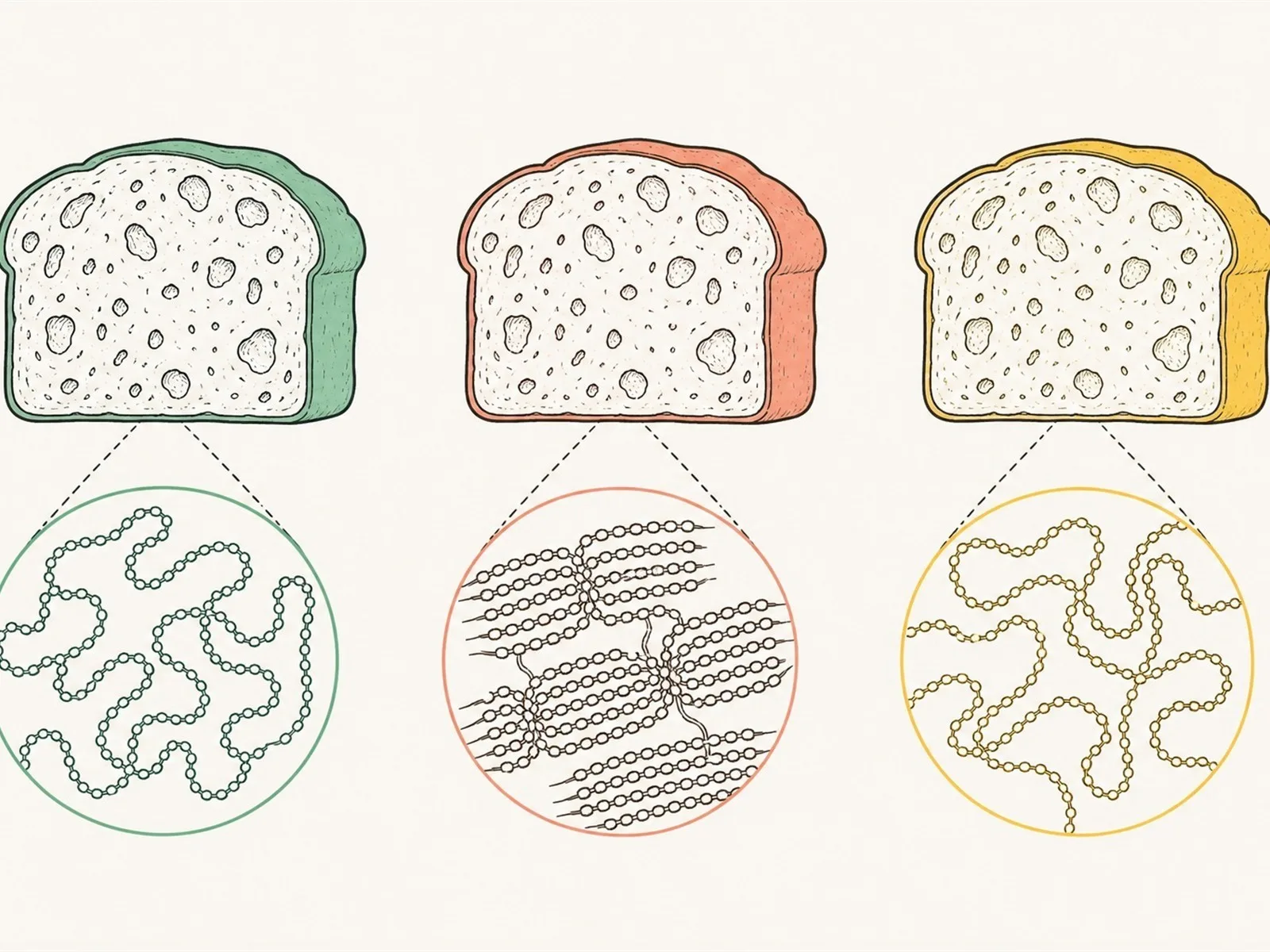
Cold doesn't slow this process evenly — it has a sweet spot. A 2011 study in Starch – Stärke stored bread at −18°C, 4°C and 25°C, tracking crystallisation by X-ray diffraction: "At 4°C the rate of starch retrogradation is the highest for the studied conditions," while at −18°C it "is maintained at an almost constant level for 23 days".[3]
Fridge-cold bread stales faster than bread left on the counter. Freezing almost stops the clock. Between 32–46°F / 0–8°C starch chains stay mobile enough to lock into crystals; below 0°F / −18°C the water freezes and migration stops.
About that "6x faster" number
You've probably read that bread stales six times faster in the fridge. We tried to source that number and couldn't — the earliest version we found is an August 2011 blog post that cites no study. The direction is real and peer-reviewed[3], but the size looks inflated. America's Test Kitchen's own testing put rustic bread at "about twice as fast as it does at room temperature".[8] Treat six times as folklore, two times as measured.
Counter vs bread box vs fridge vs freezer
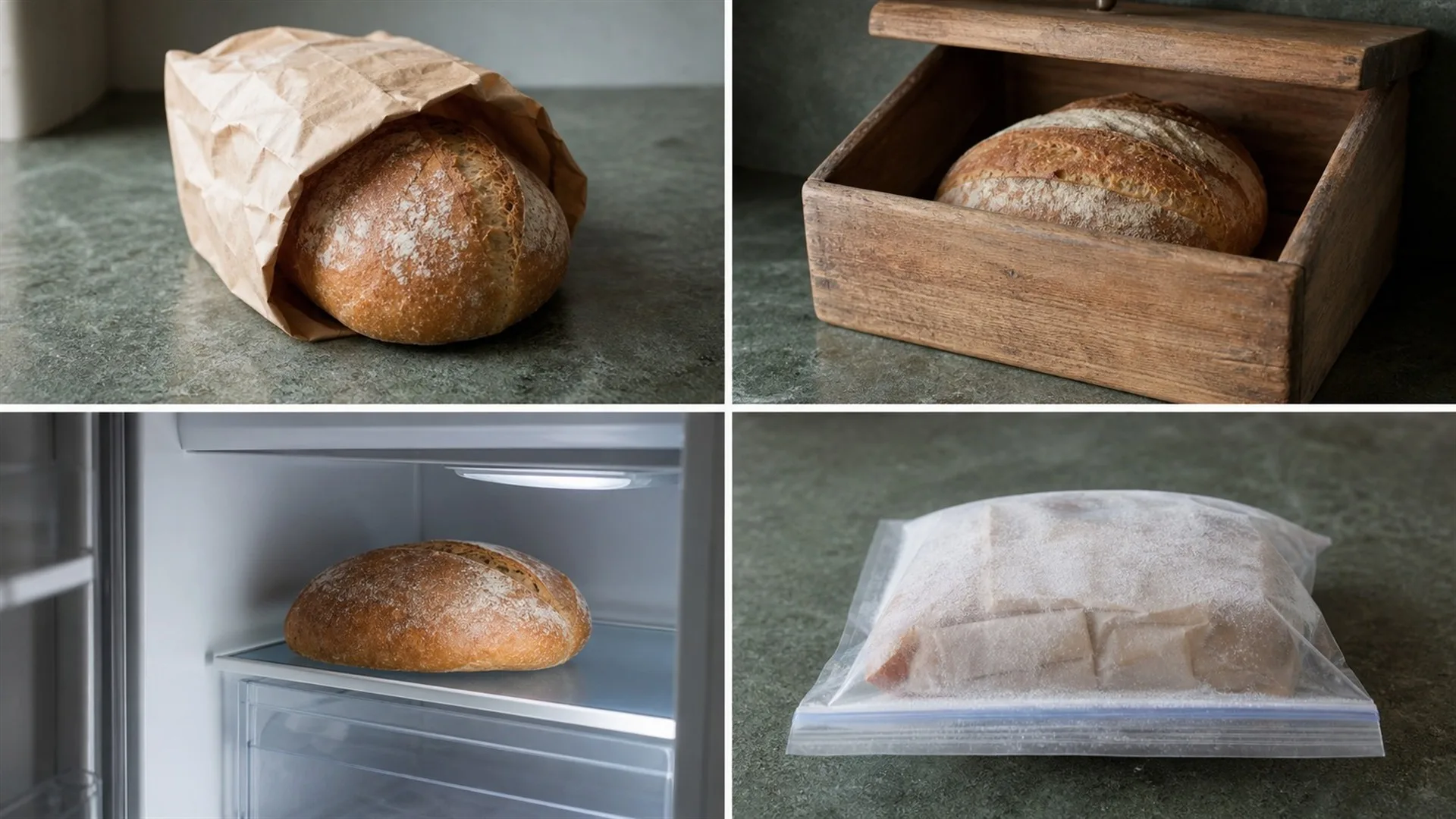
| Method | Stays soft | Mould risk | Crust | Best for |
|---|---|---|---|---|
| Counter, plastic bag | 3–7 days | Moderate | Soft, leathery | Sandwich loaves |
| Counter, paper bag | 1–2 days | Low | Stays crisp | Baguettes, sourdough |
| Bread box | 3–5 days | Low–moderate | Good compromise | Daily bread eaters |
| Refrigerator | Worst — stales fastest | Lowest; +2–3 weeks[4] | Poor | Filled breads, humid climates, gluten-free |
| Freezer (0°F / −18°C) | Best — staling halts[3] | None | Excellent after refresh | Anything beyond 3 days |
Plastic traps moisture, so you get a soft crumb and a soggy crust, but mould shows up sooner. Paper breathes, so the crust stays crisp, but the bread stales faster. A bread box splits the difference — not a gimmick, but it only buys you a day or two.
Freeze it properly — this is the actual answer
The freezer isn't a compromise. It's the correct method — the thing that actually makes "never refrigerate" practical.
- Freeze it the day you buy or bake it — you're preserving its state, not repairing it.
- Slice it first. King Arthur suggests 2–4 slices per packet, so you thaw only what you need.[7]
- Double-wrap it. Plastic or foil, then a freezer bag. One layer invites freezer burn.
- Three months for quality — safe indefinitely, but texture degrades. Gluten-free: about one month.[7]
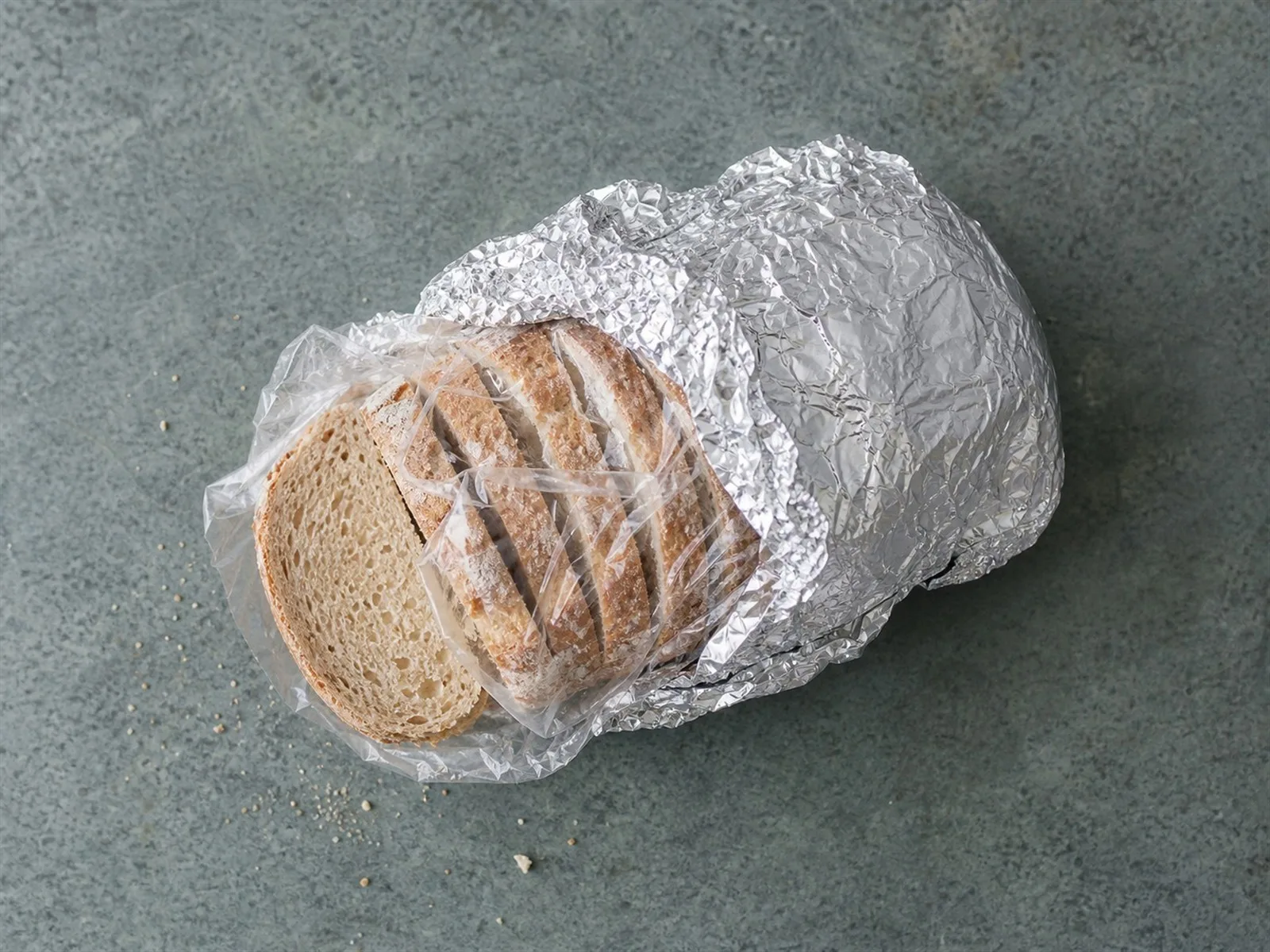
To revive it: toast slices straight from frozen. Warm a whole loaf in a 350°F / 175°C oven, tented with foil, about 10–15 minutes.[7] For a crusty loaf gone soft, run it under the tap, then bake at 300°F / 150°C for 10–20 minutes.[6] Sounds mad. Works beautifully.
Here's why it works: retrogradation is partly reversible with heat. Food writer Harold McGee explains it plainly: "staling is reversed by reheating the bread to 140°F/60°C: the temperature, we now know, at which starch gelates".[5] But a refreshed loaf stales faster the second time, so reheat only what you'll eat.
How long does bread actually last?
| Bread type | Room temperature | Freezer |
|---|---|---|
| Commercial sliced white | 5–7 days[14] | 3 months |
| Whole wheat / multigrain | 4–6 days | 3 months |
| Homemade, no preservatives | 3–4 days | 3 months |
| Artisan sourdough | 3–5 days; 1–2 for crust | 3 months |
| Enriched (brioche, challah) | 3–4 days | 2–3 months |
| Bagels | 2–3 days | 3 months |
| Flatbreads (tortilla, naan) | 3–7 days | 2–3 months |
| Roti / chapati | 1 day soft; 2–3 chilled | 1–2 months |
| Gluten-free | 2–3 days | 1 month[7] |
Mould on bread: the one rule that isn't negotiable
Do not cut the mould off soft bread. Bin the loaf.
Bread mould — usually Rhizopus stolonifer (the fuzzy black one), Penicillium, Aspergillus or Cladosporium — is more than the coloured patch. That patch is just the fruiting body. The organism sends a network of hyphae threading invisibly through the crumb, and bread's open structure gives it an easy path to spread.
USDA's Food Safety and Inspection Service is direct about this: mould has "root threads that invade the food it lives on," those roots "may be very deep in the food," and "porous foods can be contaminated below the surface".[1] Some moulds produce mycotoxins that "may have spread throughout the food".[1] You can rescue a block of hard cheese by cutting an inch around the spot. You cannot do the same with a soft loaf.
One more thing people ignore: "Don't sniff the moldy item. This can cause respiratory trouble."[1] Bin the loaf, and wash out the bread box too — spores left behind will reinfect the next one.
Why "no preservatives" bread moulds by Wednesday
Commercial bread lasts a week thanks to calcium propionate — FDA-affirmed GRAS, used since the 1930s, typically 0.1–0.3% of flour weight. It blocks the cell metabolism of mould and rope bacteria, working best below pH 5.5.[13] Potassium sorbate covers higher-pH products; cultured wheat flour is the clean-label version, same acid without an additive name.
Artisan bread skips all of it — better bread that moulds within two days. Sourdough holds out a little longer since its acidity is mildly hostile to mould, but acidity alone isn't a preservative.
Myth vs fact
| Myth | Fact |
|---|---|
| "The fridge keeps bread fresh." | It's the fastest-staling temperature there is.[3] It slows mould, not staling. |
| "Just cut the mould off." | Hyphae penetrate invisibly. USDA says porous foods are contaminated below the surface — discard the loaf.[1] |
| "Bread tags are colour-coded by day, nationwide." | No industry-wide US standard has ever been documented. Snopes rates the claim a mixture: "different producers each use their own systems rather than some industry-wide standard".[10] |
| "Frozen bread loses nutrition." | It doesn't — freezing leaves protein, fibre and minerals essentially alone. A small trial also measured a lower blood-glucose response after freezing and toasting white bread, 259 down to 157 mmol·min/L.[9] |
| "Stale bread is spoiled bread." | Staling is starch recrystallisation — a quality change, not a safety one. Stale is safe; mouldy isn't. |
| "Best By means it expires then." | USDA: "Except for infant formula, dates are not an indicator of the product's safety".[2] |
Stale bread is also one of the most useful things in your kitchen. Breadcrumbs, croutons, panzanella, French toast, bread pudding — it all starts here. See storing food better and wasting less for more.
Hot, humid climates and Indian breads
Let's be honest about something: "never refrigerate bread" is Western-climate advice, written for kitchens sitting at 68–72°F / 20–22°C. In a Mumbai monsoon — 86°F / 30°C, 85% humidity — a sliced loaf or a pav can mould in 2–3 days.
Under those conditions, refrigerate it. Stale is a texture problem your tawa can fix. Mould means the loaf goes in the bin. Better still, freeze it the day you buy it.
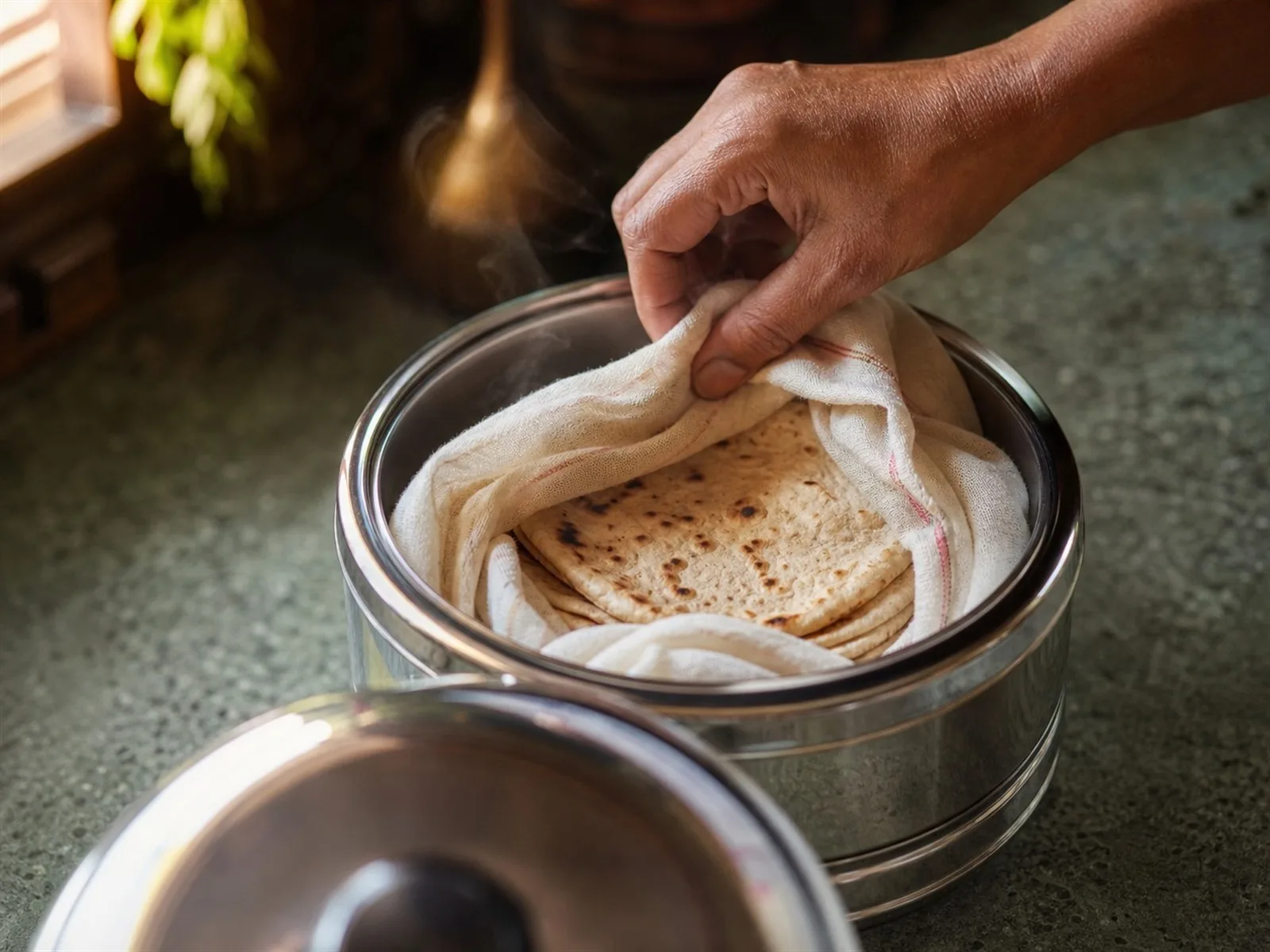
Roti and chapati play by different rules — unleavened and low-moisture. Straight off the tawa, wrap them in cotton cloth inside an insulated casserole (a hot box); the cloth absorbs steam that would make them soggy, and they stay soft 4–6 hours. Chilled airtight they keep 2–3 days — reheat on a dry tawa, 20–30 seconds a side. Naan, paratha and kulcha freeze well: interleave with parchment, double-bag, then onto a hot tawa.
On packaged Indian bread: FSSAI requires a "Best Before" date, but in humid months treat it as optimistic rather than exact. In May 2016 the Centre for Science and Environment tested 38 bread samples in Delhi and found 84% positive for potassium bromate and/or potassium iodate.[11] Bromate is an IARC Group 2B possible carcinogen. FSSAI struck it from the permitted-additives list on 20 June 2016[12] and has since restated that its use "is not allowed under any circumstances".[15] Potassium iodate remains permitted.
See our Indian pantry storage guide for more, and keep in mind that cooked rice is far riskier left at room temperature than bread is.
Frequently asked questions
How long does bread last?
At room temperature, 3–7 days depending on type. Commercial sliced bread with preservatives holds up 5–7 days; homemade without them, 3–4 days; artisan sourdough 3–5 days, though the crust softens within a day. Refrigeration extends shelf life by suppressing mould, but stales the bread faster. Freezing holds quality for about 3 months.
Can you cut mould off bread?
No. Discard the whole loaf. Bread is soft and porous, so mould's root threads spread invisibly well past the patch you can see. USDA states porous foods can be contaminated below the surface, and mycotoxins may have spread throughout. The one-inch trim rule works for hard cheese, not bread. USDA also warns against sniffing mouldy food.
Does bread expire?
Not in a legal sense. US date labels on bread are quality indicators, not safety deadlines. Bread ends one of two ways: it goes stale, a texture change that's perfectly safe, or it grows mould, which isn't. Trust your eyes over the printed date — see our list of foods that never expire for more.
Is it ever OK to put bread in the fridge?
Yes, in three cases. If it contains cheese, meat, egg, cream, custard or fresh fruit, refrigeration is a safety requirement. If you live somewhere hot and humid where loaves mould within 2–3 days, chilling is the lesser evil. And most gluten-free bread keeps better cold. Outside those three, the freezer wins every time.
How long can you freeze bread?
Indefinitely for safety at 0°F / −18°C, but plan on 3 months for quality — gluten-free about 1 month. Slice before freezing, wrap in two layers, and freeze it the day you buy or bake it. Toast slices straight from frozen, or refresh a whole loaf at 350°F / 175°C for 10–15 minutes.
Why does bread go stale faster in the fridge?
Starch retrogradation. Starch in the crumb recrystallises over time, and that runs fastest between 32–46°F / 0–8°C — exactly where your fridge sits. A 2011 study measuring bread stored at −18°C, 4°C and 25°C found retrogradation highest at 4°C. Freezing immobilises the water and effectively stops it.
Do the coloured bread tags tell you the baking day?
Not reliably, and not as a national standard. Snopes found producers each use their own systems rather than an industry-wide one, and delivery rotations differ store to store. Some bakeries genuinely do colour-code by delivery day for their own stock rotation, which is why the myth survives. Read the printed date instead.
Is it safe to eat bread past its Best By date?
Usually. USDA says that except for infant formula, dates aren't safety indicators, and a product should still be safe if handled properly until spoilage is evident. For bread, spoilage means visible mould or an off, sour-musty smell. Bread that's simply dry is stale, not spoiled — toast it or make croutons.
Should gluten-free bread be refrigerated?
Often yes — this is the main exception. Gluten-free loaves lean on rice, tapioca or potato starch plus hydrocolloids like xanthan gum instead of a gluten network. They hold less water, dry quickly and mould fast. Most brands sell them frozen or chilled for that reason. Follow the packet and freeze in slices.
Does freezing bread ruin its nutrition?
No. Freezing doesn't meaningfully degrade protein, fibre or minerals — it changes texture, not nutritional content. One small study in the European Journal of Clinical Nutrition, in ten adults, also found that freezing, defrosting and toasting homemade white bread lowered the short-term blood-glucose response from 259 to 157 mmol·min/L versus fresh, which is a resistant-starch effect. That's a single acute measurement in a handful of people, so treat it as an interesting hint rather than a reason to freeze bread for your health.
The same discipline applies across the rest of the pantry — see also does flour expire and do spices expire.
Bottom line
Don't refrigerate bread. Peer-reviewed testing shows starch retrogradation — the process that stales bread — runs fastest at 40°F / 4°C, faster than room temperature or the freezer. The counter is fine for a few days; the freezer, sliced and double-wrapped, is the real long-term answer.
Three things override that rule: a perishable filling, a hot and humid climate, or a gluten-free loaf. And regardless of temperature, mould is never a "cut around it" situation — USDA is clear that porous foods can be contaminated well below the visible patch, so a mouldy loaf goes straight in the bin.
Related WillItExpire guides
Sources
- USDA Food Safety and Inspection Service — Molds on Food: Are They Dangerous? Last updated August 22, 2013.
- USDA Food Safety and Inspection Service — Food Product Dating.
- Aguirre, J. F., Osella, C. A., Carrara, C. R., Sánchez, H. D., & Buera, M. del P. — Effect of storage temperature on starch retrogradation of bread staling. Starch – Stärke, 63(9), 587–593, 2011.
- NC State Extension, Food Safety — Storing Bread and Baked Foods. April 2020.
- Harold McGee — On Food and Cooking: The Science and Lore of the Kitchen, "Staling". Scribner, 2004.
- King Arthur Baking Company — The best way to store yeast bread. Published July 8, 2020.
- King Arthur Baking Company — How can I freeze my bread? (And defrost it, too!) Published December 20, 2023.
- America's Test Kitchen — Don't Refrigerate Baked Goods.
- Burton, P., & Lightowler, H. J. — The impact of freezing and toasting on the glycaemic response of white bread. European Journal of Clinical Nutrition, 62, 594–599, 2008.
- Snopes — Does the Color of a Bread Tag Indicate When the Loaf Was Baked? Rated "Mixture"; published April 29, 2001.
- Centre for Science and Environment (CSE), India — What's in our bread? Published May 23, 2016.
- Centre for Science and Environment (CSE), India — Bread study outcome: CSE welcomes FSSAI's ban on potassium bromate. Published June 21, 2016.
- BAKERpedia — Calcium Propionate.
- StillTasty — How Long Does Packaged White Bread Last (Pre-Sliced)?
- FSSAI (in the news, FnB News) — FSSAI restricts use of potassium bromate as food additive. February 21, 2018.
This article provides general information using a U.S. baseline with clearly labelled hot-climate context for India. Shelf-life ranges reflect manufacturer guidance, food-safety agency guidance and peer-reviewed research, not guarantees for any specific loaf. Follow stricter package, manufacturer or local instructions. It is not medical advice.