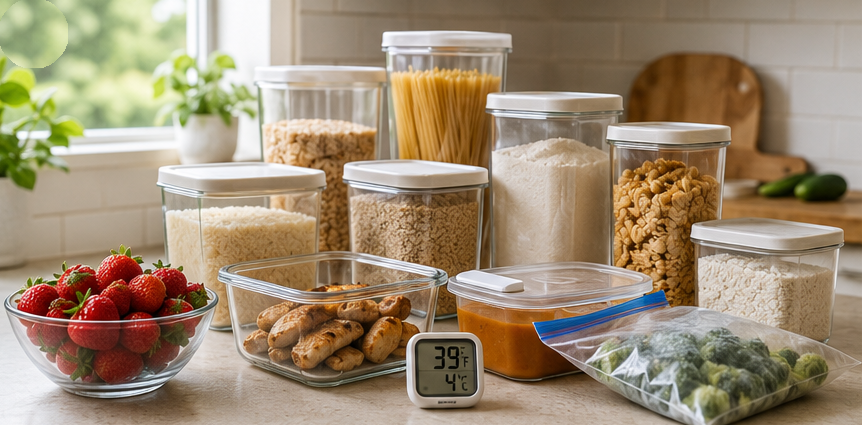
Food waste rarely happens all at once. Spinach gets pushed behind newer groceries. Cooked rice sits in an undated container. Bread turns mouldy before anyone remembers to freeze it. An open flour packet absorbs moisture. Leftovers look “probably okay,” but nobody knows when they were made.
Better food storage removes that guesswork. The goal is not a restaurant-perfect kitchen. It is a few repeatable habits that keep food visible, dated, sealed, and at safe temperatures—so you can use more of what you buy.
Five habits that make the biggest difference
- Keep the refrigerator at or below 40°F / 4°C.
- Keep the freezer at 0°F / −18°C.
- Refrigerate perishable food and leftovers within 2 hours—or within 1 hour above 90°F / 32°C.
- Use clear, food-safe containers and label them with names and dates.
- Move older food to the front and use it before newer food.
Why food gets wasted at home
Most household food waste comes from ordinary friction: food is hidden, leftovers are not labelled, the fridge is warmer than expected, dry goods are left open, or a large batch is not frozen in time. Date-label confusion also causes people to discard good food too soon—or keep high-risk food too long.
A useful storage system solves two problems together: it slows quality loss, and it gives you enough information to make a safer decision.
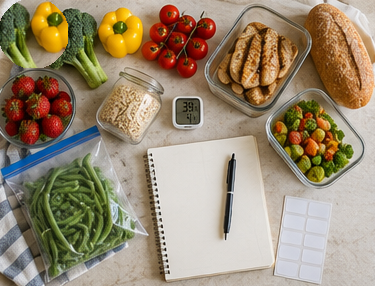
The five rules of better food storage
1. Measure your fridge temperature
Your refrigerator should stay at or below 40°F / 4°C. A fridge can feel cold while still having warm spots, so use an appliance thermometer rather than relying only on the dial. Leave enough space for cold air to circulate.
2. Keep the freezer at 0°F / −18°C
Freezing keeps food safe for much longer, although texture and flavour can still decline. Freeze food while it is fresh, wrap it well, remove excess air, and divide it into portions you will actually use.
3. Refrigerate leftovers promptly
Put cooked leftovers and other perishables in the refrigerator within 2 hours. When the surrounding temperature is above 90°F / 32°C, use a 1-hour limit. Divide large amounts into shallow containers so they cool quickly instead of leaving a deep pot on the counter.
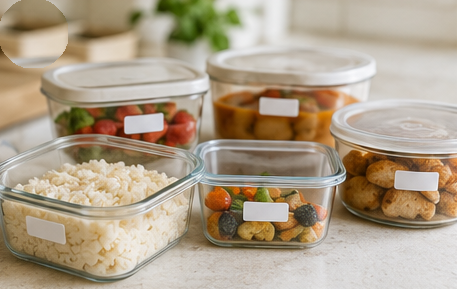
4. Label what you may forget
Write the food name and the prepared, opened, or frozen date before putting the container away. Masking tape and a marker work. The best system is the one you will use every time.
5. Use First In, First Out
FIFO means “First In, First Out.” Move older food toward the front, place new groceries behind it, group duplicates together, and check what you already have before opening another packet.
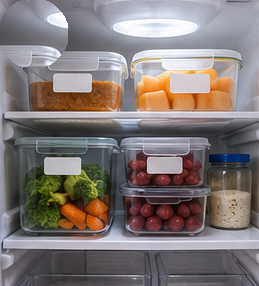
How to store food better in the fridge
Organize the fridge for visibility and separation. Keep ready-to-eat food above raw meat, poultry, and seafood; contain raw packages so leaks cannot drip onto other food.
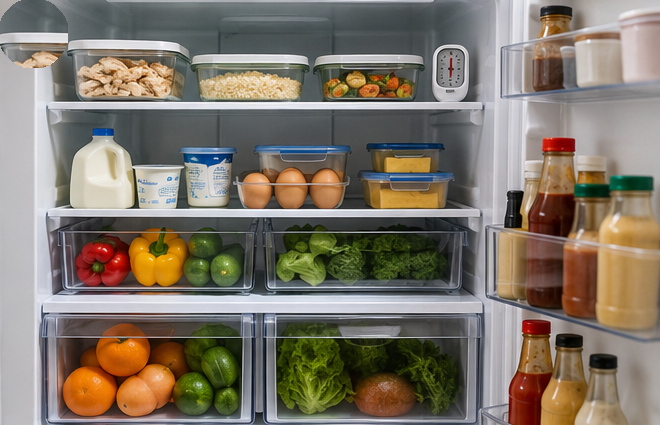
| Fridge area | Best for | Storage habit |
|---|---|---|
| Top shelves | Ready-to-eat foods, leftovers | Keep labelled and visible |
| Middle shelves | Dairy, cooked foods | Avoid overcrowding |
| Lowest shelf | Raw meat, poultry, seafood | Use a tray or sealed container to contain leaks |
| Drawers | Fruit and vegetables | Use humidity controls when available |
| Door | Condiments, drinks | Avoid highly temperature-sensitive foods |
The door is usually the warmest and most temperature-variable area. Before shopping, do a quick fridge check and plan one meal around food that needs using soon.
How to store food better in the freezer
Before taking raw food out for a meal, use our guide to defrosting meat, chicken and fish safely to choose a method and the right next action.
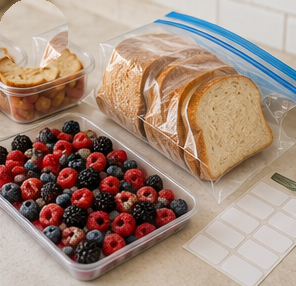
Freezing is especially useful for bread, cooked rice, cooked chicken, soups and stews, berries, herbs, sauces, and meal-size portions.
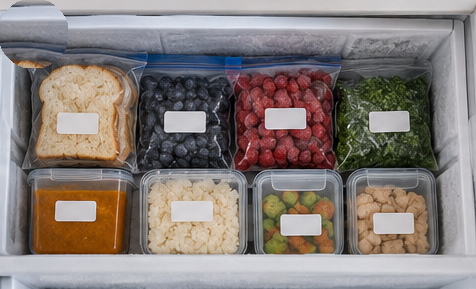
- Use freezer-safe bags or containers and remove excess air.
- Freeze bags flat when practical so they stack and thaw efficiently.
- Label each package with food name + date frozen + portion size.
- Keep a short freezer inventory on the door or in your phone.
- Use older frozen food first. Freezer burn affects quality, not safety, but badly dried food may not be enjoyable.
How to organize food in the pantry
Dry food still loses quality when exposed to heat, humidity, oxygen, or pests. Keep rice, flour, pasta, sugar, lentils, cereal, nuts, and seeds sealed in a cool, dry place away from the stove.
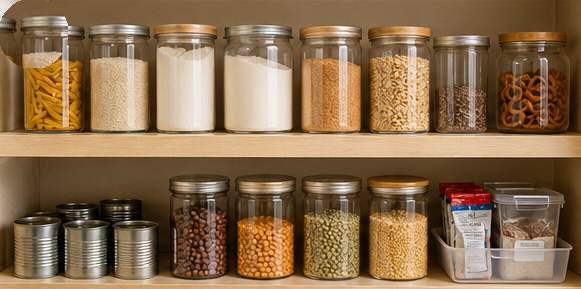
| Food | Why airtight storage helps |
|---|---|
| Rice | Reduces moisture and pest exposure |
| Flour | Limits clumping, odour absorption, and pests |
| Sugar | Keeps humidity out and reduces hardening |
| Pasta and cereal | Protects texture and deters pantry pests |
| Lentils and beans | Helps maintain quality during longer storage |
| Nuts and seeds | Slows quality loss from oxygen exposure |
Common foods and how to waste less
| Food | Better storage habit | Waste-less move |
|---|---|---|
| Cooked rice | Refrigerate promptly in shallow containers | Freeze extra portions the same day |
| Bread | Keep short-term bread sealed | Freeze extra slices in small portions |
| Strawberries | Keep dry and refrigerated | Wash shortly before eating |
| Hard cheese | Wrap properly and refrigerate | Buy smaller amounts if large blocks go unused |
| Cooked chicken | Refrigerate within the two-hour limit | Label and use within the safe leftover window |
| Leafy greens | Control excess moisture | Keep visible in the eat-first area |
| Soup | Cool in shallow containers | Freeze single-meal portions |
| Leftover pizza | Refrigerate in a sealed container | Freeze slices you will not eat soon |
Helpful tools for storing food better
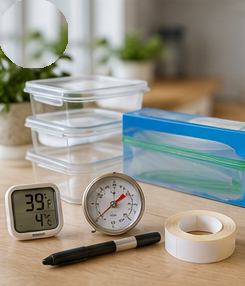
Good habits matter more than products, and no container or gadget can guarantee food safety. A few inexpensive tools can make consistent habits easier:
- Fridge and freezer thermometers to verify actual temperatures.
- Clear, food-safe airtight containers to keep leftovers visible and dry goods sealed.
- Freezer bags or freezer-safe containers sized for real meal portions.
- Masking tape, date labels, or a label maker to record food names and dates.
- Simple pantry bins to group duplicates without hiding food.
Affiliate disclosure: This section currently contains no paid placements or affiliate product links. If affiliate links are added later, WillItExpire may earn a small commission at no extra cost to you. Recommendations will support organization—not replace official food-safety guidance.
A simple seven-day plan to waste less food
Confirm the fridge is at or below 40°F / 4°C and the freezer is at 0°F / −18°C.
Gather food that should be used soon in one visible place.
Add the food name and preparation date.
Bread, cooked rice, soup, herbs, and berries are practical starting points.
Move older food forward and newer food behind it.
Record what is available and cross items off as you use them.
Plan one meal around food already in the fridge, freezer, or pantry.
Related WillItExpire guides
Frequently asked questions
What is the best way to waste less food?
Make food visible, dated, and easy to use. Keep older food at the front, label leftovers, freeze extra portions while they are fresh, and check the fridge before buying more groceries.
How long are leftovers safe in the fridge?
Many cooked leftovers should be used within 3 to 4 days when refrigerated at 40°F / 4°C or below. Handle high-risk foods carefully and discard perishables left at room temperature beyond the safe time limit.
Is freezing food a good way to reduce waste?
Yes. Freeze food while it is still fresh, use freezer-safe packaging, portion it for later meals, and label it with the name and date.
Should I throw food away after the best-by date?
Not automatically. Best-by dates often describe quality rather than safety. Consider the food type, storage conditions, handling history, package condition, and official guidance. Read the WillItExpire date-label guide.
Can I eat food if it smells fine?
Not always. Harmful bacteria may not change smell, appearance, or taste. For higher-risk food, use time, temperature, and storage history rather than smell alone.
What is the easiest food storage system?
Use clear containers, date labels, older food in front of newer food, and one small eat-first area in the refrigerator.
Trusted sources
- U.S. Food and Drug Administration — Are You Storing Food Safely?
- FoodSafety.gov — Cold Food Storage Charts
- FoodSafety.gov / USDA — FoodKeeper App
- U.S. Environmental Protection Agency — Preventing Wasted Food at Home
- Centers for Disease Control and Prevention — About Food Safety
The bottom line
To store food better and waste less, start small: measure the fridge temperature, label tonight’s leftovers, freeze one food you often lose, and move older pantry items forward. Those habits make food easier to use before it spoils—and help your kitchen work with you instead of against you.