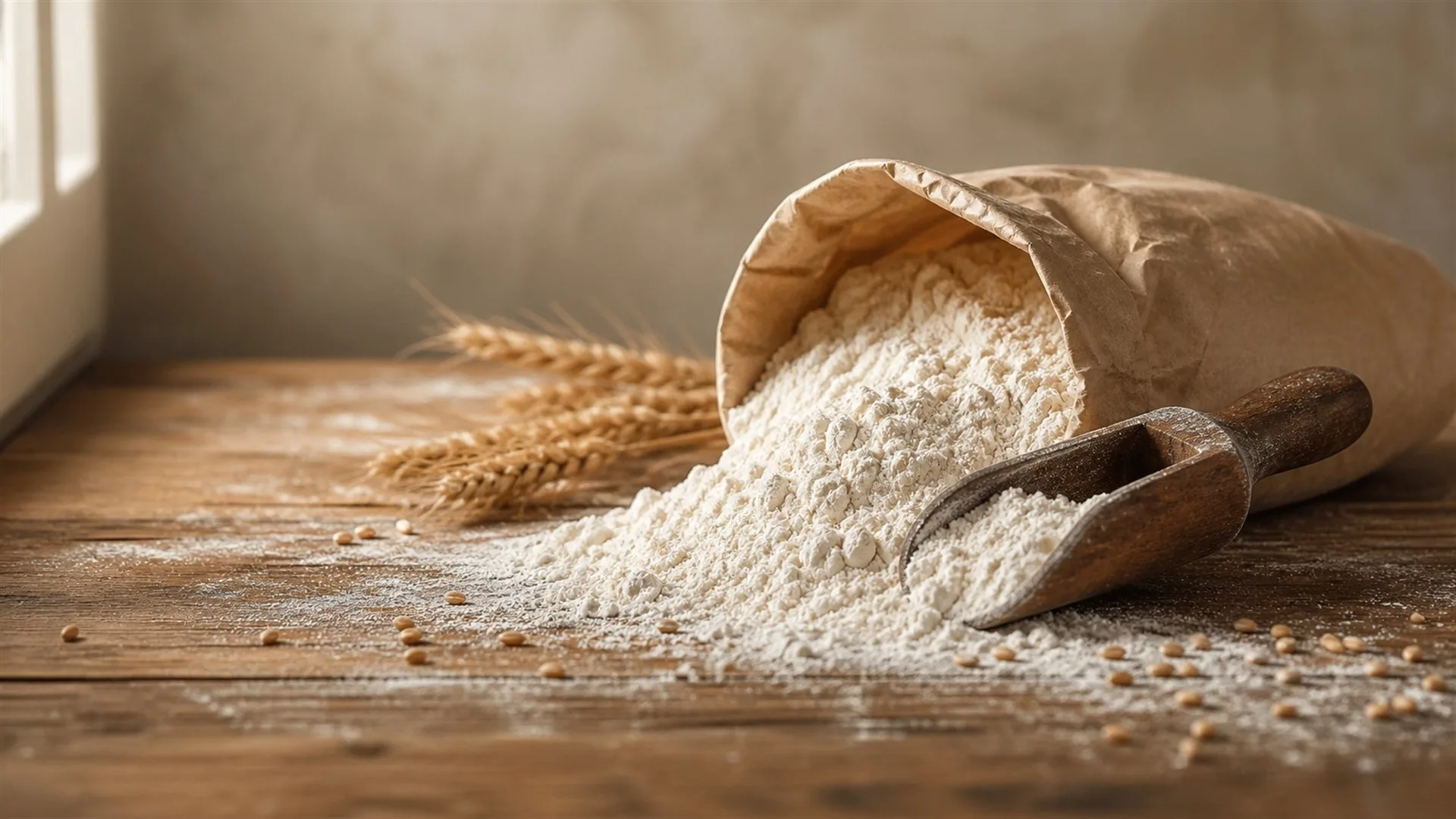
There's a bag at the back of your cupboard. Wholemeal, opened, rolled down and clipped shut sometime during the sourdough phase. The date on it is ambiguous, and the flour looks exactly like flour has always looked. Is it fine, or will it quietly ruin a loaf you spent two days making? Flour does expire. Just not on the printed date, and not in the way most people assume.
- White/all-purpose flour: 6-12 months in a cool pantry, 2 years refrigerated, and indefinitely in the freezer.[12]
- Wholemeal, atta, rye and oat flours: 1-3 months. The oil in the germ turns rancid.[13] Nut flours are fattier still but usually sold better sealed, so the table below gives them 3-6 months in the pantry.
- "Best if used by" is a quality date, not a safety date, and it isn't federally required.[9]
- Rancid flour won't hurt you. Damp, mouldy or infested flour should go in the bin.
- Don't taste raw flour or dough. It's behind several E. coli and Salmonella outbreaks.[1][2]
Does flour expire? The honest answer
Flour doesn't expire the way milk does. It goes stale first, then rancid, and only turns genuinely unsafe if it gets damp or picks up an infestation. Three separate events on three different timelines, and mixing them up is where most of the confusion starts.
The date on the bag governs none of them. U.S. product dating isn't federally required except on infant formula, and "Best if Used By/Before" simply "indicates when a product will be of best flavor or quality," according to USDA's Food Safety and Inspection Service.[9]
Stop reading the date, and start reading the flour itself. The single rule that predicts shelf life is how much oil is in it.
Flour shelf life by type
Pantry conditions assumed below: a cool, dark cupboard around 70°F (21°C), airtight container. Freezer conditions: 0°F (-18°C).
| Flour | Pantry | Fridge | Freezer | Why |
|---|---|---|---|---|
| White / all-purpose / bread / cake | 6-12 months | 2 years[12] | Indefinite[12] | Endosperm only |
| Self-raising | ~6 months | — | — | Leavening dies first |
| Maida | 6-12 months | 2 years | Indefinite | Refined wheat |
| Wholemeal | 1-3 months[13] | 6 months | 6 months[13] | Germ oil |
| Atta | 1-3 months; chakki 4-6 weeks | 3-6 months | 6 months | Whole grain |
| Rye | 3 months[13] | 6 months | 6 months[13] | Whole grain |
| Oat | 2 months[13] | 4 months | 4 months[13] | Oiliest cereal |
| Cornmeal / makki | 3 months[13] | 6 months | 6 months[13] | Germ intact |
| Brown rice | 3 months[13] | 6 months | 6 months[13] | Bran intact |
| White rice | 6-12 months | 1 year | 2 years | Bran removed |
| Besan | 2-3 months | 6 months | 6-12 months | ~7x the fat[14] |
| Sooji / rava | 6-8 months | 1 year | 1 year | Bran and germ largely removed[10] |
| Ragi, jowar, bajra | 1-2 months[13] | 2-4 months | 2-4 months[13] | Whole millet |
| Almond / nut | 3-6 months | 6-12 months | 1 year | ~50% fat |
| Coconut | 6-12 months | 1 year | 1 year | Defatted, high fibre |
Where a number in that table has no footnote, treat it as informed guidance rather than a regulated limit.
Why wholemeal dies young: the oil in the germ
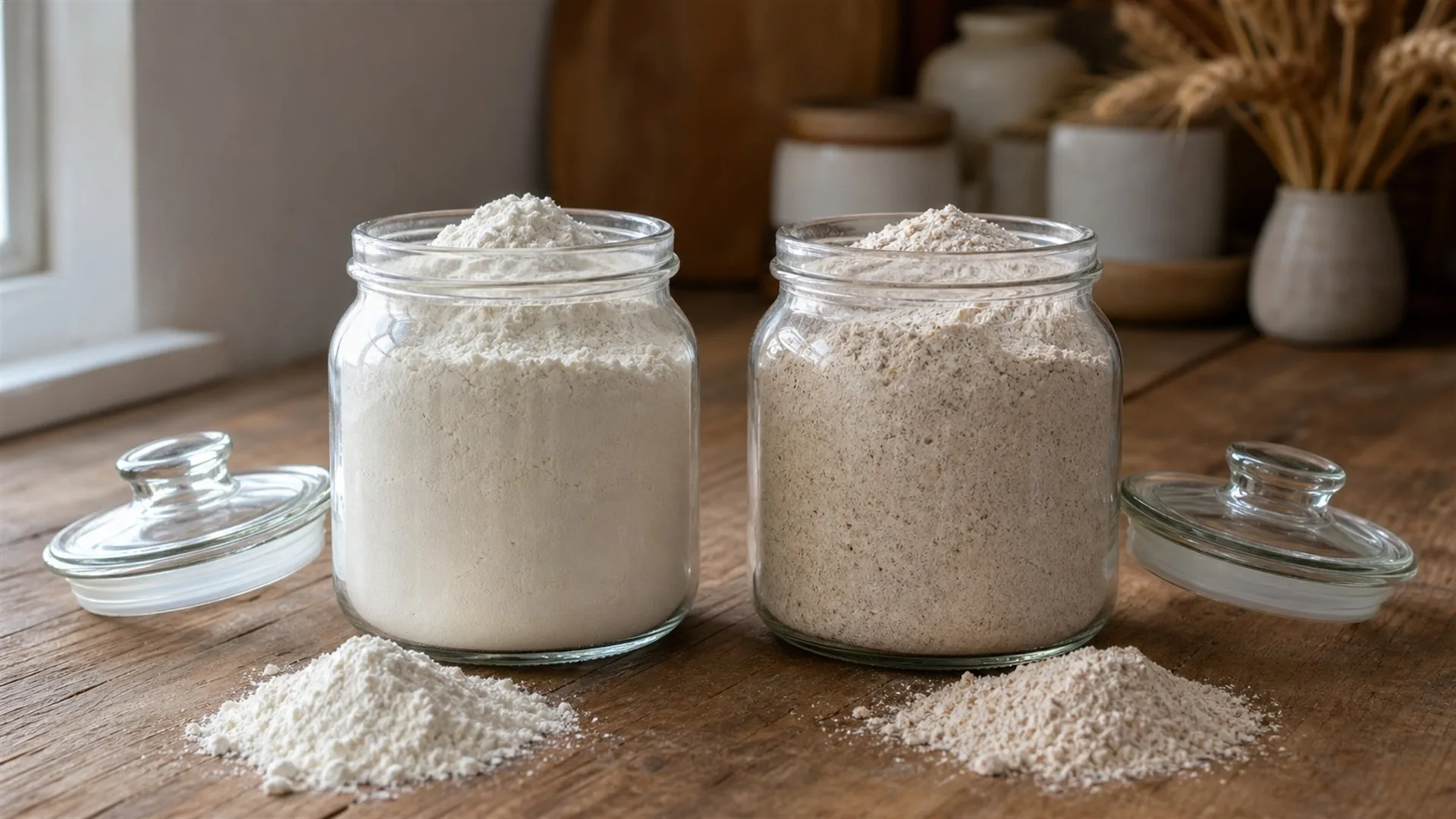
A wheat berry breaks down into three parts: bran, germ and endosperm. White flour is milled from the endosperm only, the starchy middle, which is why it keeps so long. Wholemeal keeps all three parts, and the germ is where the oil sits.
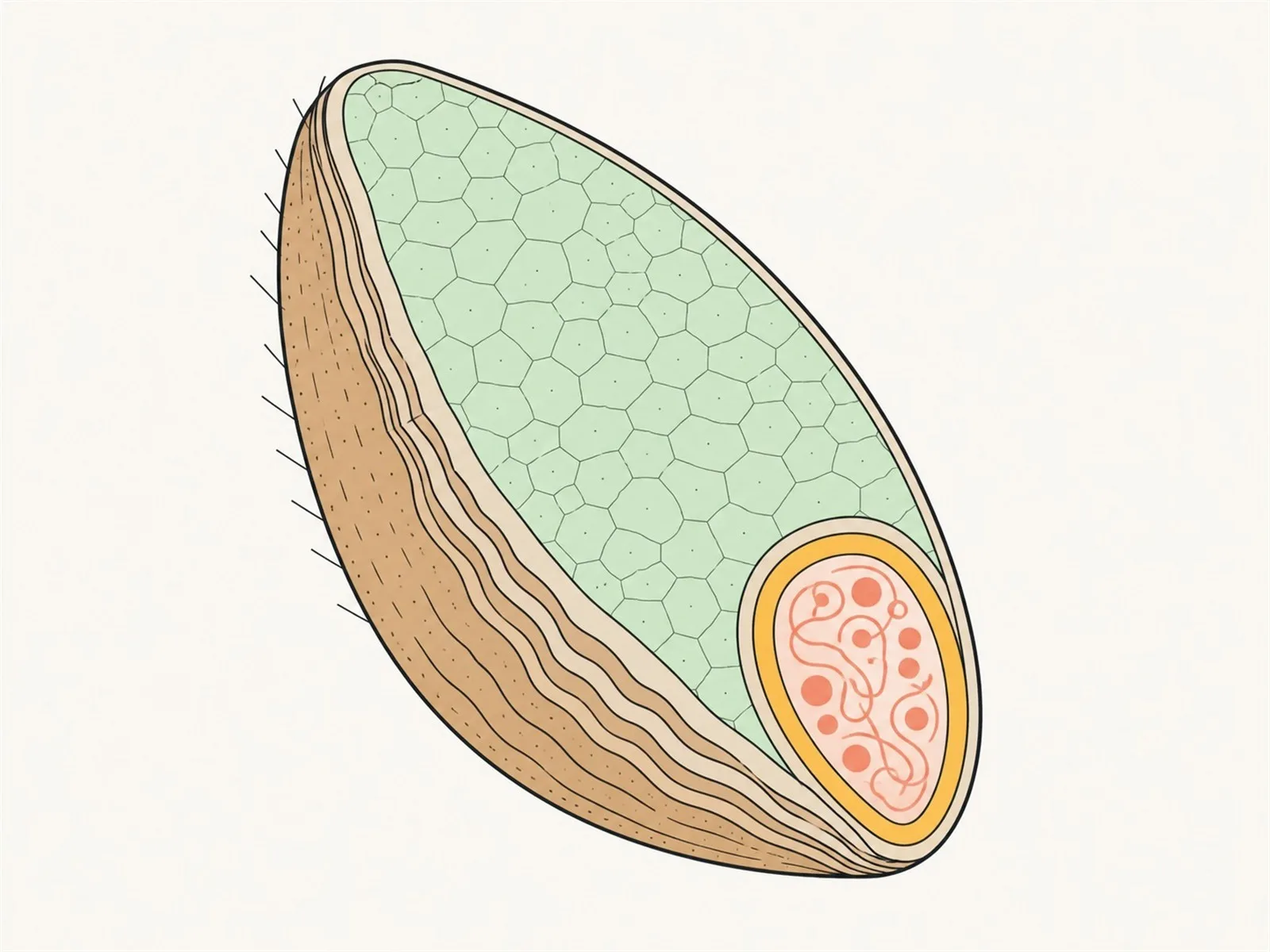
Milling ruptures those oil cells and exposes the fat to oxygen, light and the grain's own lipase enzymes. That combination is rancidity: the same chemistry that turns old olive oil sharp and bitter.
| Flour (per 100 g) | Total fat | Shelf life |
|---|---|---|
| White all-purpose | 0.96 g[14] | Longest — 6-12 months |
| Whole wheat / atta | 2.5 g[14] | ~2.6x the fat, ~4x shorter |
| Besan (chickpea) | 6.7 g[14] | ~7x the fat — 2-3 months |
That fat column explains most of what's in the shelf-life table above: wholegrain and legume flours turn long before the refined ones do, and almond flour, roughly half fat by weight, belongs in the fridge from the day you open it.
Fat isn't the whole story, though. Atta actually runs out a little faster than besan despite carrying less than half its fat, because milling the wheat germ also releases lipase, the grain's own fat-splitting enzyme. Total fat sets the outer limit on shelf life; enzyme activity and exposed surface set how fast you actually get there.
How to tell if flour has gone bad
Start with your nose. Fresh white flour smells of almost nothing. Fresh wholemeal smells faintly sweet and nutty.
Rancid flour smells specifically wrong: sharp and sour, musty, or with that odd wax-crayon or Play-Doh note people keep describing independently. Don't taste it to check. Raw flour isn't a ready-to-eat food — FDA is explicit that it can carry E. coli or Salmonella until it's been cooked,[1] and that risk has nothing to do with how old the bag is (more below). The nose is enough. Wholemeal also dulls in colour before it goes.
Then check for the two problems that have nothing to do with quality.
- Clumps that won't break under a spoon mean moisture got in.
- Webbing, moving specks, or a sweetish fermented smell mean insects or mould.
Rancid is disappointing. Damp, mouldy or infested means it goes in the bin.
Weevils, flour beetles, and what's already allowed
The FDA's defect action level for wheat flour is an average of 75 or more insect fragments per 50 grams, or an average of 1.0 or more rodent hairs per 50 grams, measured across six 50-gram subsamples.[5] Some insect fragment content is legally tolerated.
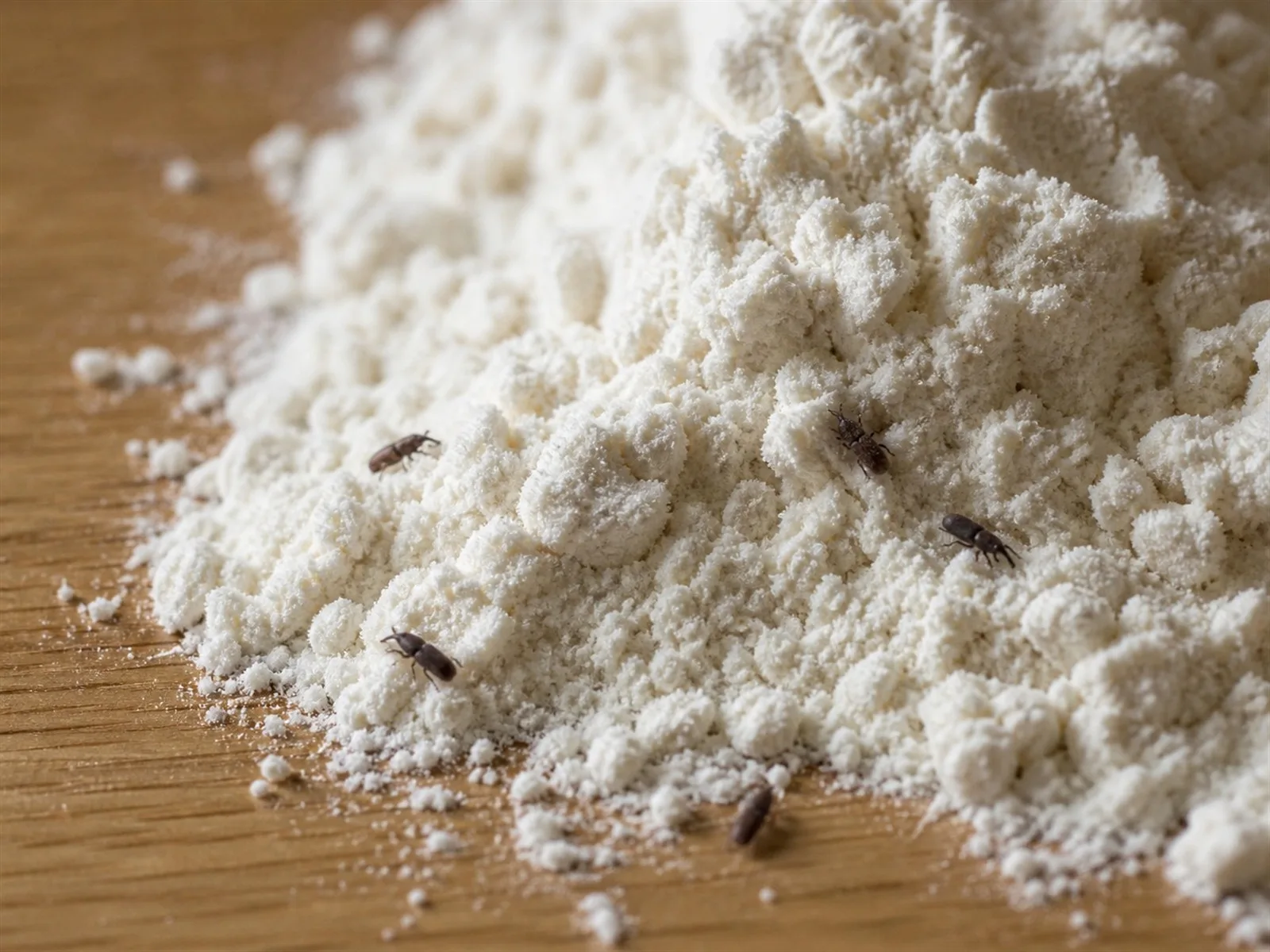
The FDA's own reasoning: these levels are "set on this premise — that they pose no inherent hazard to health," because it's "economically impractical" to process raw products entirely free of "naturally occurring, unavoidable defects."[6]
The usual culprits are red and confused flour beetles (Tribolium spp.), sawtoothed grain beetles, rice weevils (Sitophilus oryzae) and the Indian meal moth (Plodia interpunctella). That last name is good trivia: "Indian meal" was the 1800s American term for cornmeal ground from Indian corn, and has nothing to do with India.[15]
Infestations usually arrive with the bag itself, since pests get into "unopened paper, thin cardboard, and plastic, foil or cellophane-wrapped packages."[11] The fix is to freeze new flour at 0°F (-18°C) for at least four days, which kills every life stage. 130°F (54°C) for 30 minutes in the oven also works.[11] You'll see "48-72 hours" online. Entomologists say four days.
Mould, damp, and mycotoxins
Flour is shelf-stable because it's dry. Most moulds need a water activity near 0.80 to get going, and even the drought-tolerant xerophilic moulds stall around 0.60. Let moisture in and that protection disappears.
Some of those moulds produce mycotoxins. The FDA treats human food exceeding 20 parts per billion total aflatoxins as adulterated,[7] and sets an advisory level of 1 ppm for deoxynivalenol (DON, also called vomitoxin) in finished wheat products.[8]
You can't see, smell or taste any of this, and heat doesn't destroy aflatoxin. So the only real defence is preventive: keep flour dry, and throw out anything that's been damp, smells fermented, or shows fuzzy or coloured growth.
Raw flour is not a ready-to-eat food
Most people worry about the eggs in raw cookie dough. The bigger modern risk is the flour itself.
The FDA doesn't hedge on this: "Flour is a raw food. It may not look like a raw food, but it usually is." Grains "may be exposed to a variety of harmful bacteria like Salmonella and pathogenic Escherichia coli," and "processing raw grains into flour does not kill harmful bacteria."[1] There's no kill step between field and bag.
- 2016 — E. coli O121 and O26: 63 infected across 24 states, 17 hospitalised, 1 case of haemolytic uraemic syndrome, triggering a General Mills recall that expanded repeatedly.[2]
- 2019 — E. coli O26: 21 ill in 9 states, 3 hospitalised, with recalls of ALDI, King Arthur and Pillsbury products.[3]
- 2023 — Salmonella Infantis in Gold Medal flour: 14 ill in 13 states, 3 hospitalised; 7 of the 8 people interviewed had eaten raw dough or batter.[4]
Don't taste the batter, don't lick the spoon, and don't hand a toddler raw dough to play with — the FDA calls that last one out by name.[1] Baking is what actually kills the bacteria.
How to store flour properly
The paper bag is packaging, not storage. It breathes, admits moisture, and stops no insects.
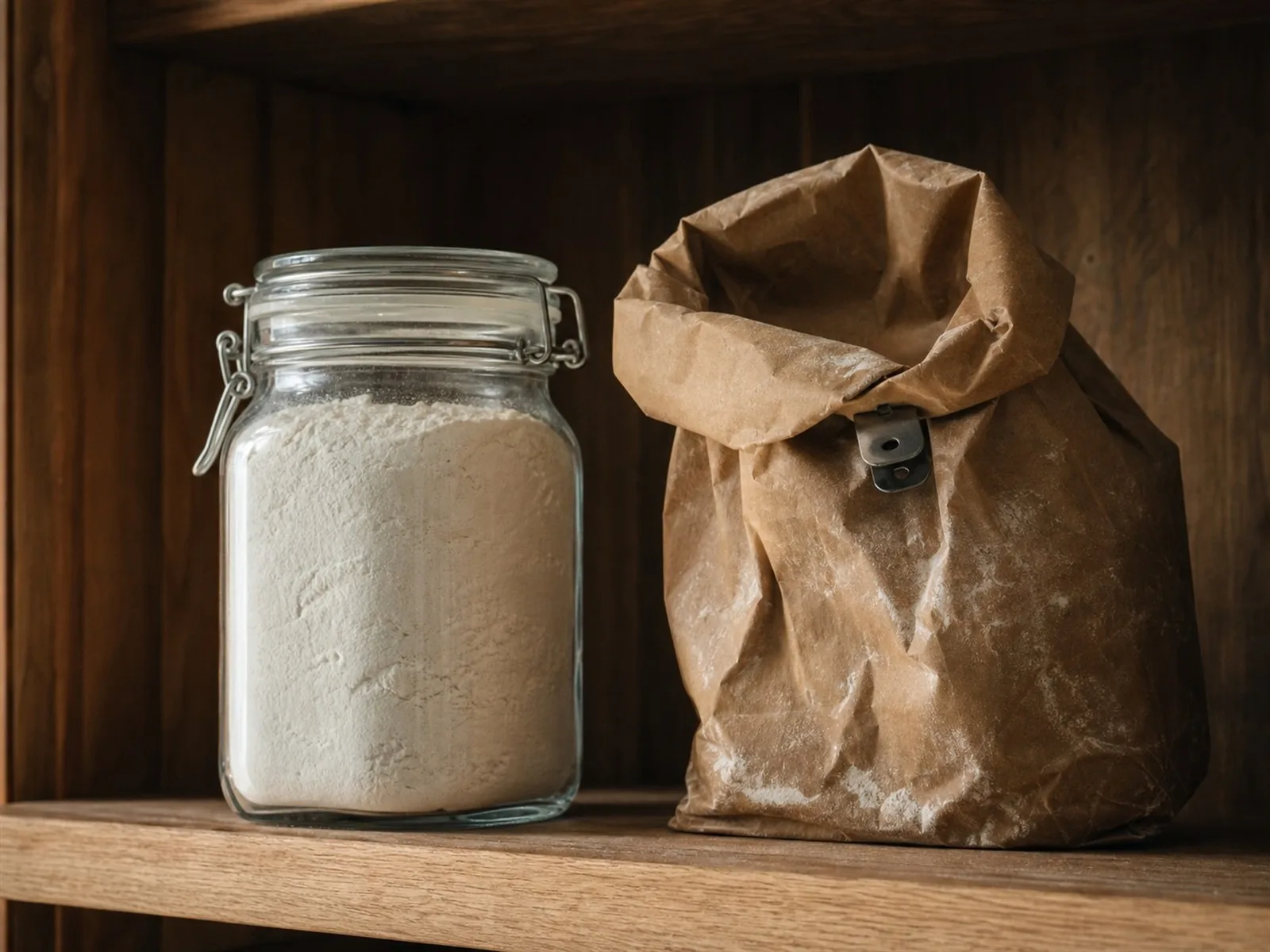
- Decant into an airtight container the day you open it. The seal matters more than the material it's made from.
- Cool, dark and dry beats everything else. Heat and light are what speed up oxidation.
- Refrigerate wholemeal, nut and other high-fat flours by default. Penn State Extension advises keeping whole wheat flour in the fridge year-round.[12]
- Freeze for the long haul. All-purpose and bread flour keep two years at 40°F (4°C) in the fridge, and store indefinitely once frozen.[12]
- Let it come back to room temperature before baking, or cold flour will blunt your leavening.[12]
Oxygen absorbers and mylar bags work for white flour long-term, but they won't stop wholegrain flour from going rancid. For more, see our guide to storing food better and wasting less and which foods genuinely never expire.
Atta, besan and Indian flours in humid climates
Indian kitchens run a harder version of this: more wholegrain flours, more legume flours, and a monsoon.
Atta is whole wheat flour, so it inherits the 1-3 month wholegrain clock. Fresh chakki-ground atta is shorter still, since it has no packaging and a freshly ruptured germ — assume four to six weeks. FSSAI caps moisture at 14% for atta and maida, 13% for semolina and 12% for besan, and requires all of them free from living insects and filth.[10] Those ceilings exist because moisture turns a storage problem into a safety one.
Besan turns fast. At roughly 6.7 g fat per 100 g it carries about seven times maida's fat,[14] hence the bitter, soapy edge of an old packet, though it runs about level with atta on the shelf. Millet flours — ragi, jowar, bajra — are the shortest-lived of the lot. Refrigerate both.
In monsoon humidity, ambient air pushes flour past a safe moisture level right through the bag, so an airtight container stops being optional. Don't just top up an old container, either: decant it, wash it, dry it, and refill.
The tradition of tucking bay or neem leaves into the flour tin turns out to have some real lab support. A 2025 study found milled neem powder caused 87.5% mortality in rice weevils, and bay laurel about 75%, at a dose of 1.5 g of powder per 100 g of wheat, measured 10 days after treatment.[16] That's a measured powder mixed through the grain, though, not two dry leaves sitting in a dabba, so treat it as a bonus rather than something you can rely on.
See also our Indian pantry storage guide and how long cooked rice can sit out.
Can you still bake with old flour?
Usually, yes. Flour past its best but not rancid bakes fine, though the gluten weakens with age, so bread may rise less. Rancid flour is the real problem — that's a flavour issue, not a smell that bakes off.
Self-raising flour fails differently: the flour itself is fine, but the leavening dies. Test it by dropping half a teaspoon of the flour itself into hot water; it should fizz. Testing loose baking powder works the same way, and for bare baking soda you use vinegar instead. No fizz means no lift. It's the same logic behind spices losing their potency or whether bread belongs in the fridge.
Myth vs fact
| Myth | Fact |
|---|---|
| "Flour lasts forever." | Only refined flour comes close. Wholegrain runs a 1-3 month clock.[13] |
| "No smell means it's fine." | Mostly true for rancidity — but mycotoxins are odourless.[7] |
| "You can sift out the bugs." | Partly true — sifting removes adults, and FDA tolerates 75 fragments per 50 g.[5] But not eggs. |
| "Raw dough is only risky because of eggs." | Flour is the underrated risk: three multistate outbreaks since 2016.[2][3][4] |
| "Best-by is a safety deadline." | It's a quality date; flour dating isn't federally required.[9] |
Frequently asked questions
Does atta expire?
Yes, and faster than most people expect. Atta is whole wheat flour, so it carries the germ and its oil, which gives it a 1-3 month pantry life instead of maida's 6-12 months.[13] Freshly chakki-ground atta is shorter-lived still. Treat four to six weeks as realistic, and keep it in the fridge.
Can you get sick from expired flour?
Rarely from age alone. Rancid flour tastes unpleasant but isn't dangerous. What can make you seriously ill is flour that's gone damp and grown mould, or raw flour of any age, since it's a raw agricultural product that occasionally carries E. coli or Salmonella.[1][2] Cooking is the safety step here, not freshness.
How long is flour good after the best-by date?
White flour is typically fine for several months past that date if you've stored it airtight, cool and dry. The date marks peak quality, not safety, and flour dating isn't federally required in the first place.[9] Wholemeal is less forgiving, so once you're past the date, smell it before every use. The date reflects what the miller guaranteed at the time, not what's happened in your cupboard since.
Does besan expire?
Yes, and it's among the quickest of all the flours to turn. Besan carries about 6.7 g of fat per 100 g — roughly seven times white flour — so it oxidises fast.[14] Expect 2-3 months at room temperature, longer in the fridge. Rancid besan smells sour and tastes bitter or soapy, and that flavour doesn't cook out even when you fry it.
Is it safe to use flour with weevils in it?
A few insect fragments aren't an emergency. The FDA's action level is an average of 75 fragments per 50 g, set on the premise that they pose no inherent health hazard.[5][6] Visible live insects or webbing are a different matter, though; that means a heavy infestation and waste throughout the bag, so bin it. You can prevent it by freezing new flour at 0°F (-18°C) for four days.[11]
What does rancid flour smell like?
Sharp, sour and musty. Most people land on stale nuts, old cooking oil, or oddly, wax crayons or Play-Doh. Fresh white flour, by contrast, smells of almost nothing. Go by smell alone — don't taste raw flour to check. FDA warns it can carry E. coli or Salmonella until it's cooked.[1] Rancid flour won't poison you, but it will ruin whatever you bake with it.
Does self-raising flour lose its power?
Yes. The flour itself outlasts the leavening blended into it. That baking powder degrades over months, especially in humid conditions, so your bakes come out flat and dense. Test it by dropping half a teaspoon into hot water and watching for vigorous fizzing. No fizz means no lift. Buy self-raising flour in small quantities for this reason.
Is eggless cookie dough safe to eat raw?
No. Removing the eggs only removes half the risk. The FDA warns against eating or tasting raw flour, dough or batter at all, because grains can carry Salmonella and pathogenic E. coli.[1] In the 2023 Salmonella outbreak, 7 of the 8 people interviewed had eaten raw dough or batter.[4] If you want to eat dough raw, buy dough that's specifically heat-treated to be edible.
Bottom line
Treat the date on the bag as a quality marker, not a safety line — outside infant formula, it isn't even federally required. White and refined flours keep 6-12 months in the pantry and effectively forever in the freezer; wholemeal, atta, nut and other high-oil flours turn in as little as 1-3 months once milling exposes their fat to oxygen.
Rancid flour just tastes bad. What actually demands the bin is dampness, mould or an infestation — and raw flour of any age, since it's an uncooked agricultural product that can carry E. coli or Salmonella. Store it airtight, cool and dry, refrigerate the high-fat flours, and don't taste the dough.
Related WillItExpire guides
Sources
- U.S. Food and Drug Administration — Handling Flour Safely: What You Need to Know. Accessed July 2026.
- Centers for Disease Control and Prevention — Multistate Outbreak of Shiga Toxin-Producing E. coli O121 and O26 Infections Linked to Flour (Final Update, 29 September 2016). Accessed July 2026.
- Centers for Disease Control and Prevention — Outbreak of E. coli O26 Infections Linked to Flour (Final Update, July 2019). Accessed July 2026.
- Centers for Disease Control and Prevention — Salmonella Infantis Outbreak Linked to Flour, March 2023 (Investigation Update). Accessed July 2026.
- U.S. Food and Drug Administration — CPG Sec. 578.450 Wheat Flour — Adulteration with Insect Fragments and Rodent Hairs. Revised 31 December 1987. Accessed July 2026.
- U.S. Food and Drug Administration — Food Defect Levels Handbook. Accessed July 2026.
- U.S. Food and Drug Administration — CPG Sec. 555.400 Aflatoxins in Human Food. Revised June 2021. Accessed July 2026.
- U.S. Food and Drug Administration — Guidance for Industry and FDA: Advisory Levels for Deoxynivalenol (DON) in Finished Wheat Products for Human Consumption. July 2010. Accessed July 2026.
- USDA Food Safety and Inspection Service — Food Product Dating. Accessed July 2026.
- Food Safety and Standards Authority of India — Food Product Standards, Chapter 2.4: Cereals and Cereal Products (Version 4, 7 May 2025). Accessed July 2026.
- University of Minnesota Extension — Pantry Pests: Insects Found in Stored Food. Accessed July 2026.
- Penn State Extension — Storing Staple Ingredients in the Kitchen. Accessed July 2026.
- Whole Grains Council — Storing Whole Grains. Accessed July 2026.
- USDA FoodData Central — Wheat flour, white, all-purpose, enriched (FDC 168894); Wheat flour, whole-grain (FDC 168893); Chickpea flour, besan (FDC 174288). Accessed July 2026.
- University of Maine Cooperative Extension — Indian Meal Moth (Home and Garden IPM Fact Sheet). Accessed July 2026.
- Hamama, H.M., Irshad, S., Abdallah, F.I. & Farag, S.M. — The protective effect of selected plant powders against the rice weevil, Sitophilus oryzae (Coleoptera: Curculionidae) in wheat grains in comparison with a model insecticide: in vivo and in silico analysis. The Journal of Basic and Applied Zoology, 2025. Accessed July 2026.
This article provides general information using a U.S. baseline with clearly labelled Indian-climate context. Shelf-life ranges reflect manufacturer, USDA and FSSAI guidance rather than guarantees for any specific bag. Follow stricter package or local instructions. It is not medical advice.