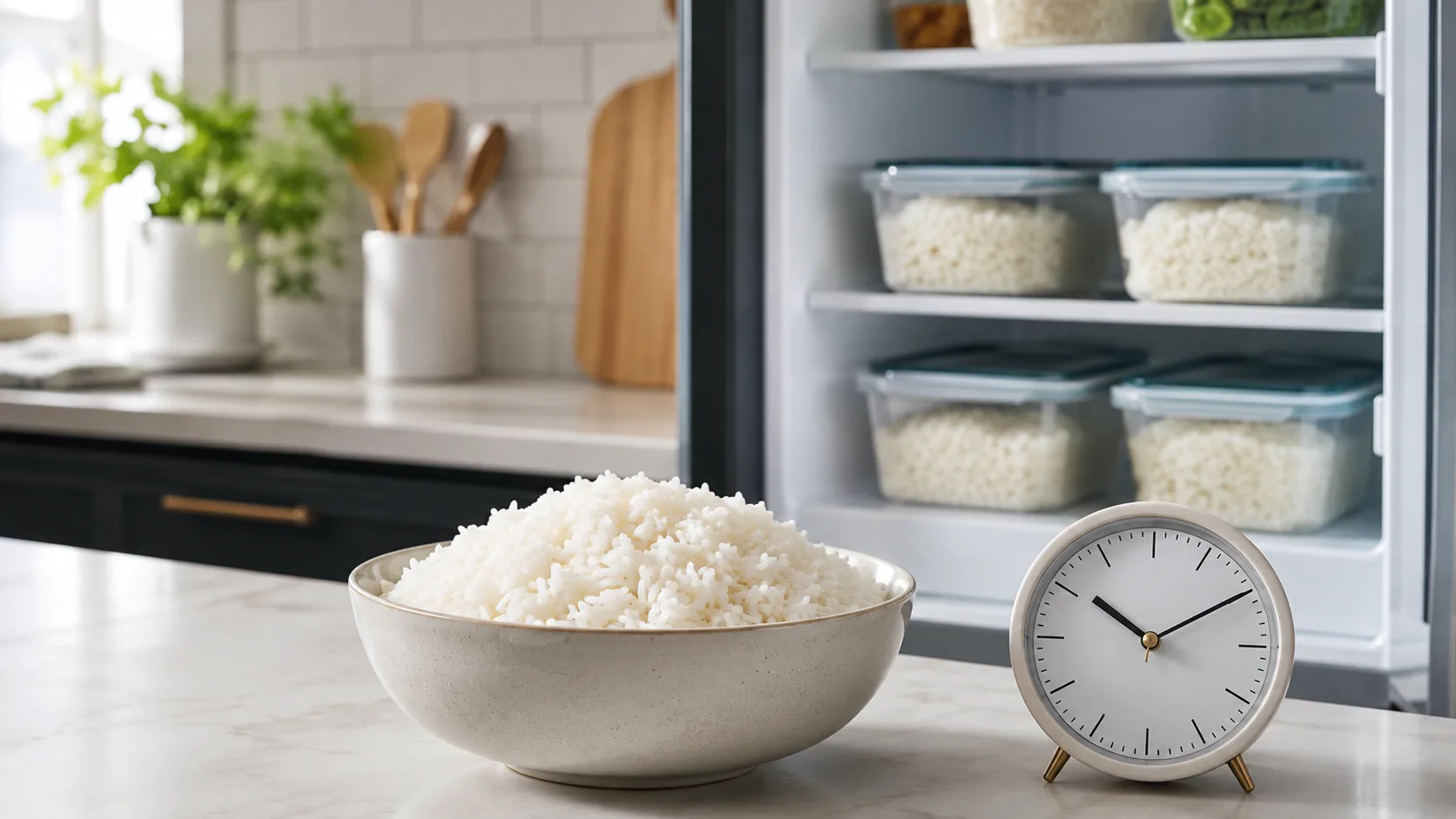
When to refrigerate or discard cooked rice
Cooked rice should be refrigerated within 2 hours at normal room temperature, or within 1 hour when the temperature is above 90°F / 32°C. At or beyond those limits, discard it. Rice left out overnight—or for an unknown amount of time—should be thrown away. Reheating cannot reliably make improperly stored rice safe.[1][2][3]
Cooked rice time-and-temperature decision table
| Situation | Conservative guidance | What to do |
|---|---|---|
| Less than 30 minutes at room temperature | Within the U.S. limit | Begin cooling or serve it now |
| 30–60 minutes at or below 90°F / 32°C | Within the U.S. limit | Refrigerate promptly in a shallow container |
| 1–2 hours at or below 90°F / 32°C | Nearing the limit | Refrigerate immediately; do not leave it out longer |
| 1 hour or more above 90°F / 32°C | Outside the hot-weather limit | Discard |
| 2 hours or more at normal room temperature | Outside the U.S. limit | Discard |
| More than 4 hours, all day or overnight | Well outside safe limits | Discard |
| Unknown length of time | Storage history cannot be verified | Discard |
| Actively held at 140°F / 60°C or above | Hot-held outside the danger zone | May be held hot, subject to equipment and manufacturer instructions |
The room-temperature clock is not reset by putting a lid on the pot, adding spices, frying the rice or reheating it later. Covering may protect rice from dust and drying, but it does not prevent Bacillus cereus from growing when the rice remains at an unsafe temperature.
Why cooked rice needs special attention
Raw rice can contain spores of Bacillus cereus. Some spores can survive cooking. If cooked rice cools slowly or remains warm at room temperature, the spores may germinate, the bacteria may multiply and some strains may produce toxins.[2][3][4]
That does not mean every bowl of rice contains a dangerous amount of bacteria. It means time and temperature control matter more than a sniff test.
Bacterial cells, spores and toxins—in plain English
- Bacterial cells are active bacteria. Thorough reheating kills many active cells.
- Spores are a resistant survival form. Some B. cereus spores can survive normal rice cooking.
- Toxins are substances produced by certain strains under suitable conditions. Some relevant toxins are heat-stable, so reheating may not neutralize toxin that formed while the rice was stored improperly.[3][4]
This is why reheating does not “rescue” rice that sat out too long.
Is “fried rice syndrome” a real diagnosis?
“Fried rice syndrome” is an informal media phrase for food poisoning often associated with Bacillus cereus and improperly handled starchy foods. It is not a formal medical diagnosis, and the risk is not limited to fried rice. Plain rice, pasta, sauces, soups and other prepared foods can also be involved.[2][8]
What if the rice was left out overnight?
Discard it.
Overnight storage at room temperature greatly exceeds both the U.S. two-hour limit and the one-hour hot-weather limit. The rice may still look fluffy, smell normal and feel warm in the centre, but none of those observations proves it is safe.[1][3]
Do not:
- refrigerate it in the morning and plan to eat it later;
- fry it with egg or vegetables;
- boil, steam or microwave it in an attempt to make it safe;
- taste a small amount to check.
Common room-temperature scenarios
Rice left out for 2 hours
At normal room temperature, two hours is the outer U.S. limit. Above 90°F / 32°C, the limit is one hour. Use a conservative approach: once the applicable limit is reached, discard the rice rather than beginning a slow cooling process.
Rice left out for 3 or 4 hours
Discard it. It has exceeded the U.S. room-temperature limit even when the kitchen feels cool.
Rice in a hot car
Above 90°F / 32°C, refrigerate or place the rice under verified temperature control within 1 hour.[1] A parked vehicle can become much hotter than the outdoor air, so a hot car is not a safe holding location.
Rice in a lunchbox
Use one of these methods:
- keep it cold at 40°F / 4°C or below with adequate frozen packs;
- keep it hot at 140°F / 60°C or above in a preheated insulated food jar;
- otherwise, count the time it spends without temperature control and apply the two-hour or one-hour rule.
A lunchbox that merely feels insulated is not proof that the rice stayed cold or hot enough.
Takeaway or restaurant rice
The safety clock does not necessarily begin when you reach home. It begins when the rice leaves verified hot or cold holding. If the restaurant storage history is unknown, transport was long, or the rice arrived lukewarm and then sat out, use a conservative decision.
Refrigerate takeaway rice promptly in a clean, shallow container rather than leaving it in a deep paper carton or tightly packed delivery tub.
Buffet or party rice
Rice may remain safe while it is continuously hot-held at 140°F / 60°C or above.[1][2] A warming tray that is switched on is not enough; the food itself must remain hot enough.
If rice has been sitting on an unheated table, apply the two-hour rule—or the one-hour rule in hot conditions. Leftovers from a buffet with uncertain holding time should be discarded.
Covered versus uncovered rice
A lid does not change the time limit. Covered rice may cool more slowly in a deep pot, which can make temperature control worse. Uncovered rice may be exposed to contamination. The solution is not to leave it on the counter: divide it into clean, shallow containers and refrigerate promptly.
Rice that still feels warm after several hours
Warmth is not reassurance. It may indicate that a large pot retained heat while passing slowly through temperatures where bacteria can grow.
How to cool cooked rice safely
The goal is to cool rice quickly without leaving it at room temperature for an extended “cooling period.”
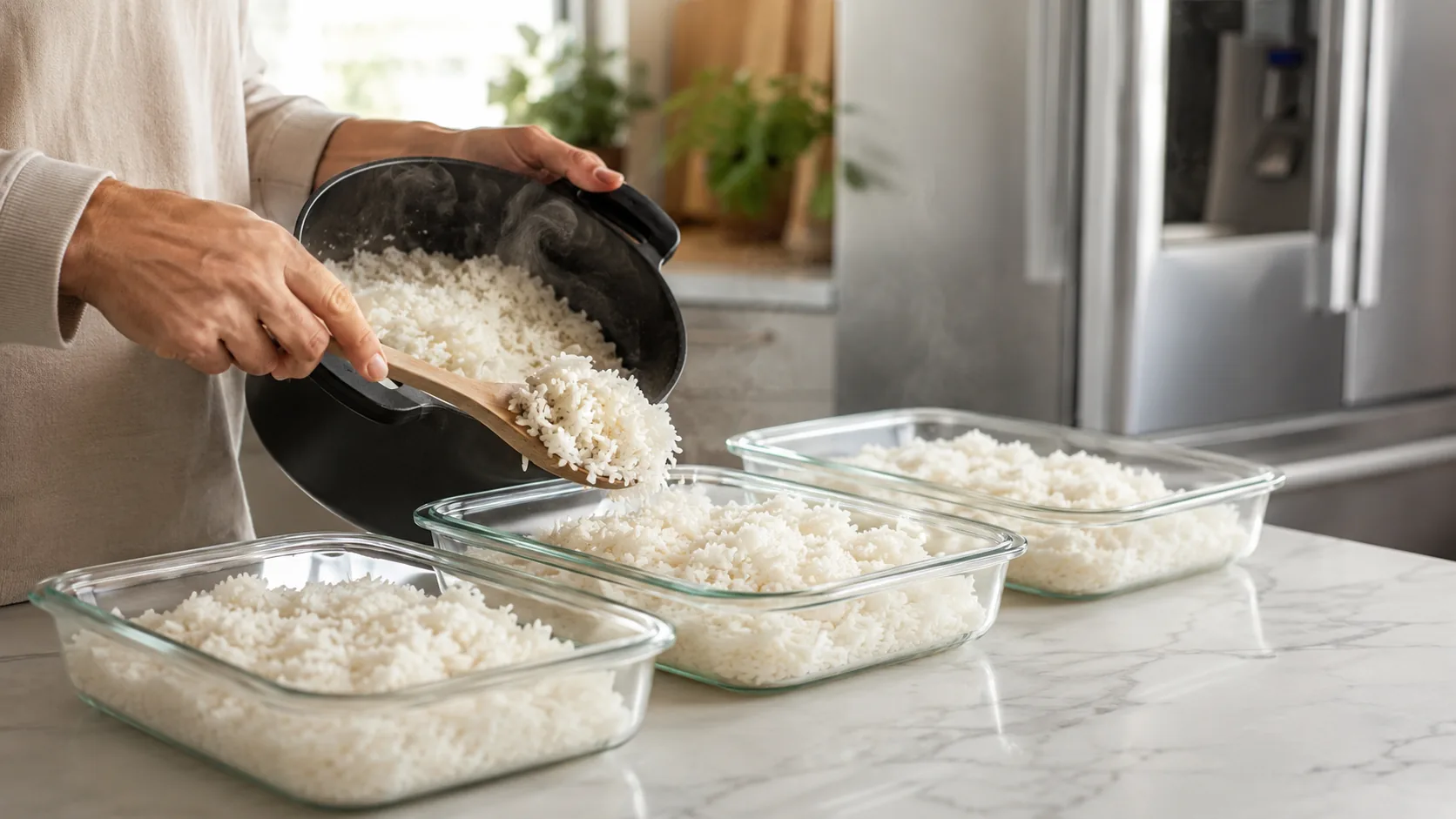
Transfer rice from the cooking pot into smaller portions.
A thin layer loses heat faster than a deep mass of rice.
A lid may be left loose or ajar while the rice cools in the refrigerator, then closed once heavy steam has subsided. Keep the container protected from drips and cross-contamination.
This prevents a safe batch from becoming an unknown batch later. See our food date-label guide for what labels do—and do not—tell you.
Can hot rice go directly into the refrigerator?
A small, shallow portion can. Federal guidance allows hot food to be refrigerated directly when large quantities are divided into shallow containers.[1][2]
The important distinction is:
- Good: a small or divided portion spread in a shallow container and placed promptly in the refrigerator.
- Not ideal: a large, deep, tightly covered stockpot placed into the refrigerator, where the centre may cool slowly and the pot may warm nearby food.
- Unsafe habit: leaving rice on the counter for hours until it reaches room temperature.
An ice-water bath around a clean container can speed cooling for a large batch. Stir with a clean utensil so heat escapes evenly, then refrigerate promptly. Do not add non-potable ice or contaminated water directly to cooked rice.
How long does cooked rice last in the refrigerator?
For WillItExpire’s conservative U.S. baseline, use refrigerated cooked rice within 3–4 days, provided it was cooled promptly and the refrigerator stayed at 40°F / 4°C or below.[1][7]
This is a storage limit, not permission to keep rice that was already mishandled. Refrigeration slows bacterial growth; it does not reverse unsafe room-temperature storage.
| Rice or rice dish | Conservative refrigerator guidance | Important qualification |
|---|---|---|
| Plain white, brown, basmati, jasmine or wild rice | 3–4 days | Assumes prompt cooling and continuous refrigeration |
| Fried rice | 3–4 days | Use the shortest limit of rice, egg, meat, seafood or vegetables |
| Biryani | 3–4 days | Meat, egg, seafood, dairy and gravy components may justify using it sooner |
| Coconut rice | 3–4 days | Refrigerate promptly; coconut ingredients do not make it shelf-stable |
| Sushi rice | Follow local or product-specific guidance | Vinegar may inhibit growth, but recipe acidity varies |
| Takeaway rice | Up to 3–4 days only if handling history is known | Use sooner when the pre-purchase holding time is uncertain |
Some national authorities use shorter limits. New Zealand advises refrigerating cooked rice and eating it within 2 days.[4] UK consumer guidance is also more conservative. Follow stricter local, package, restaurant or manufacturer instructions.
Quality versus safety
Rice may become dry and firm in the refrigerator before the storage limit. Dryness is usually a quality issue caused by moisture loss; it is not, by itself, proof of danger.
The opposite is also important: rice can remain soft and smell normal while being unsafe because of its earlier time and temperature history.
Can cooked rice be frozen?
Yes. Freeze rice only after it has been cooled safely.
FoodSafety.gov states that food kept continuously frozen at 0°F / −18°C or below can remain safe indefinitely; freezer time recommendations are mainly about quality.[7] For good rice texture, WillItExpire recommends using frozen rice within about 1–2 months as a best-quality target.
For best results:
- portion rice before freezing;
- use shallow containers or flat freezer bags;
- remove excess air;
- label the cooking date;
- freeze only rice that was handled safely before freezing.
Safe thawing methods
Thaw rice:
- in the refrigerator;
- in the microwave as part of immediate reheating;
- or directly from frozen in a microwave, covered pan or steamer.
Do not thaw cooked rice for hours on the counter.
Rice cooker keep-warm mode
A rice cooker can safely hot-hold rice only when the food itself remains at 140°F / 60°C or above under the U.S. baseline.[1][2]
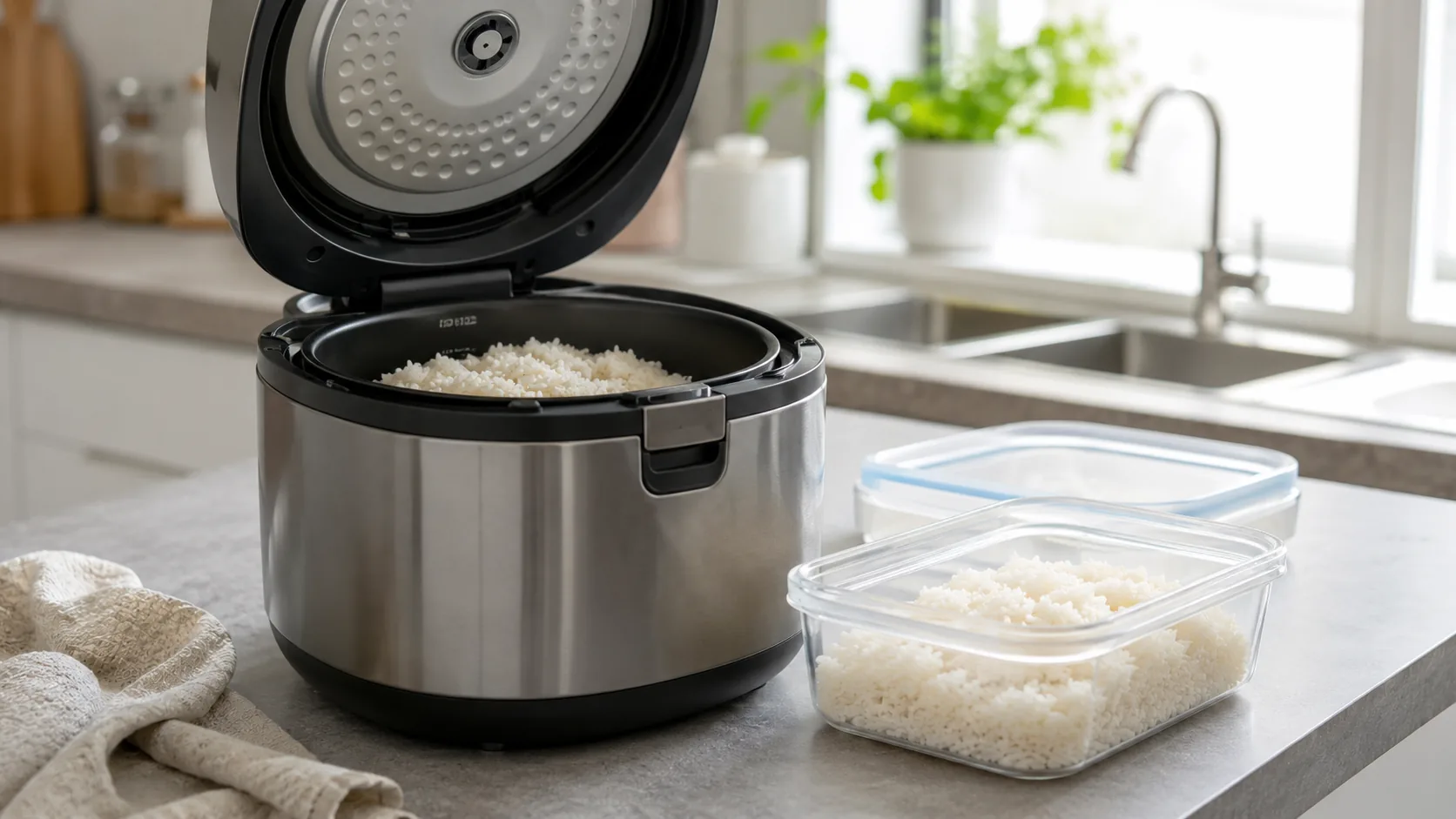
Keep-warm setting active
Rice may remain hot-held when:
- the cooker is functioning correctly;
- the rice temperature is maintained at or above 140°F / 60°C;
- the manufacturer permits that holding duration;
- the rice is not repeatedly contaminated by utensils or hands.
Not every model maintains the same temperature. Follow the cooker manual when it gives a shorter maximum time.
Cooker switched off but still closed
Once active hot holding stops, do not assume the insulated cooker remains safe. Start the room-temperature clock when the rice is no longer being maintained above the safe hot-holding temperature.
Cooker unplugged overnight
Discard the rice. A closed lid and residual warmth do not replace verified temperature control.
Does the timer prove the rice stayed safe?
No. A timer records elapsed time; it does not verify the rice temperature. A delayed-start timer may also leave ingredients sitting before cooking, depending on the appliance and recipe. Follow the manufacturer’s specific safety instructions.
How to reheat cooked rice safely
Only reheat rice that was cooled and stored safely.
Under U.S. guidance, heat leftovers to 165°F / 74°C throughout.[1][2] Steam alone is a useful visual clue, but a clean food thermometer provides better verification when a thick or mixed rice dish is being reheated.
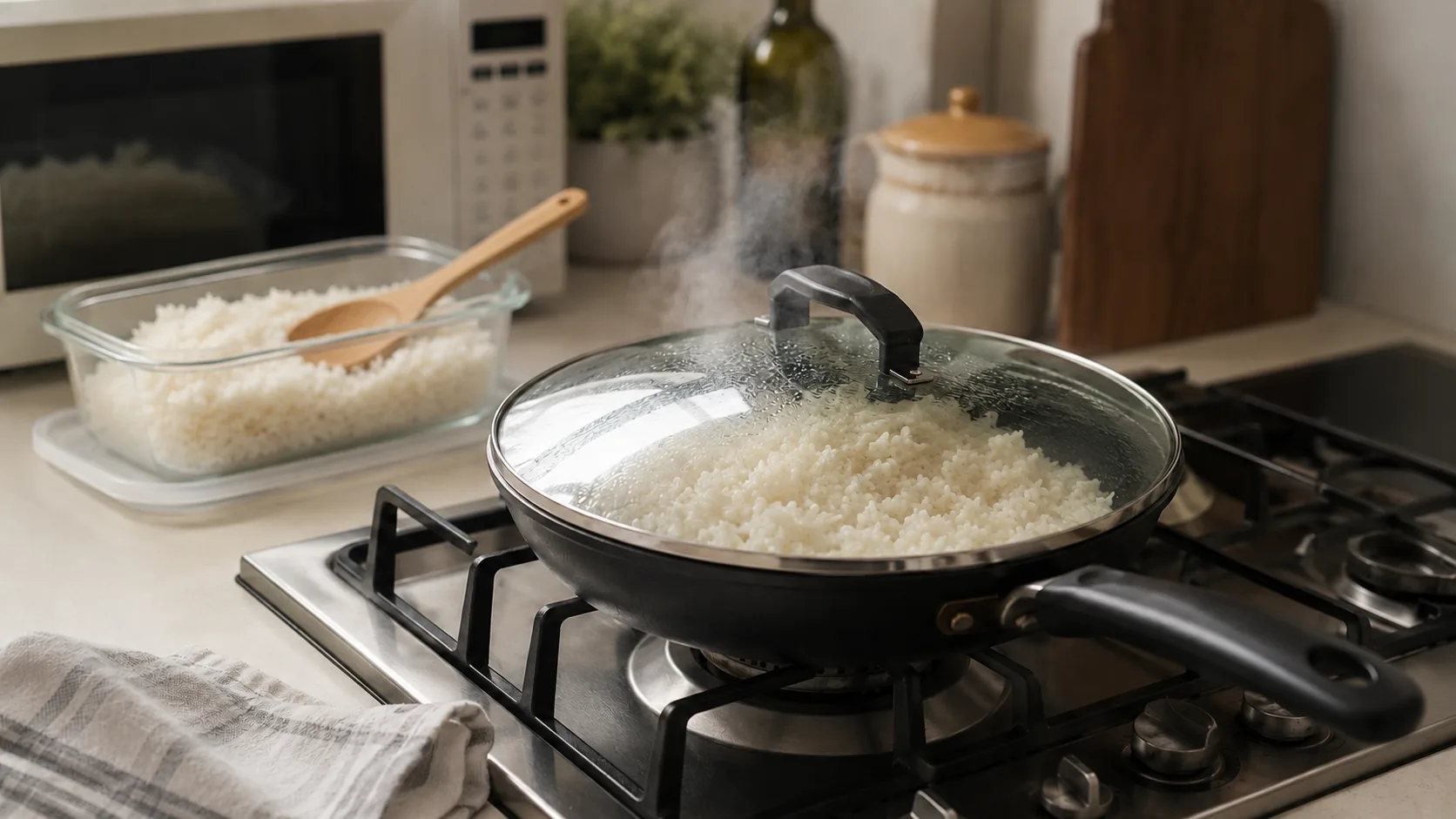
Microwave
- Add a small splash of water.
- Cover with a microwave-safe lid that allows steam to vent.
- Heat, stir thoroughly and heat again.
- Check several areas because microwaves can leave cold spots.
- Follow any standing-time instruction.
Stovetop or steaming
- Add a small amount of water.
- Cover the pan.
- Stir and break up dense clumps.
- Heat until the rice is steaming throughout and reaches 165°F / 74°C.
Reheating from frozen
Rice can be reheated directly from frozen. Loosen the portion, add moisture, cover and stir during heating so the centre becomes fully hot.
Can rice be reheated more than once?
U.S. consumer guidance focuses on rapid cooling, cold storage and reheating to 165°F / 74°C. UK guidance generally advises reheating rice only once. A practical conservative habit is to reheat only the portion you will eat, because every warming-and-cooling cycle creates another opportunity for time-temperature abuse.
Repeated reheating does not create safety when the first storage step was unsafe.
Plain rice versus biryani, fried rice and other mixed dishes
The two-hour and one-hour room-temperature limits apply to all of these dishes.
Mixed rice may contain additional hazards:
- fried rice: egg, meat, seafood and vegetables;
- biryani: meat, egg, gravy, dairy or fried onions;
- curd rice: yogurt or other dairy;
- coconut rice: coconut milk, grated coconut or tempering ingredients;
- seafood rice: highly perishable seafood;
- rice pudding: milk and egg.
Use the shortest applicable refrigerator limit and follow stricter package or restaurant instructions. Spices, oil, salt, vinegar or frying do not automatically make a rice dish safe at room temperature. For uncooked storage guidance, see basmati rice (raw).
India and hot-climate guidance
FSSAI advises keeping prepared food either cold below 5°C / 41°F or hot above 60°C / 140°F, and reheating cooked food thoroughly.[5]
For homes in India and other hot climates:
- use the one-hour rule whenever the surrounding temperature is above 90°F / 32°C;
- count time spent in a hot car, delivery bag, lunchbox, kitchen or power cut;
- divide biryani and large rice batches before refrigeration;
- use a refrigerator thermometer rather than relying only on the control dial;
- during an outage, keep the refrigerator closed and apply our food-safety guidance for power outages before keeping leftovers;
- when the temperature history is uncertain, discard the rice.
Humidity does not create a separate official time limit, but hot, humid kitchens often make the one-hour rule more relevant.
Spoilage signs: when rice must be discarded
Discard cooked rice if you see:
- visible mould;
- a sour, fermented or otherwise unusual odour;
- slimy or unusually sticky texture unrelated to the recipe;
- unexplained discolouration;
- contamination from raw food, pests or dirty utensils;
- a damaged, leaking or questionable storage container.
Dry or hardened rice is usually a quality problem, not automatically a safety problem. However, no spoilage sign can override an unsafe time history.
Symptoms associated with Bacillus cereus illness
FoodSafety.gov describes two common patterns:[2]
- a vomiting pattern beginning about 30 minutes to 6 hours after eating;
- a diarrheal pattern beginning about 6–15 hours after eating.
Symptoms may include nausea, vomiting, watery diarrhoea and abdominal cramps. Illness often lasts about 24 hours, but severity varies.
Drink fluids and rest. Contact a healthcare professional if you cannot drink enough to prevent dehydration, symptoms are severe, or the ill person is in a higher-risk group.[2] This article does not diagnose food poisoning or replace medical care.
Who should use extra caution?
Young children, older adults, pregnant people and people with weakened immune systems are generally more vulnerable to serious foodborne illness.[9]
For these readers:
- do not use rice with uncertain storage history;
- avoid stretching the refrigerator limit;
- follow stricter local or manufacturer instructions;
- discard rice from buffets, takeaway containers or lunchboxes when holding conditions cannot be verified.
Regional guidance comparison
| Region | Main guidance relevant to cooked rice |
|---|---|
| United States | Refrigerate within 2 hours, or 1 hour above 90°F / 32°C; keep hot food at 140°F / 60°C or above; reheat leftovers to 165°F / 74°C.[1][2] |
| United Kingdom | Cool rice as quickly as possible, refrigerate promptly, use within the shorter UK window and reheat no more than once.[6] |
| New Zealand | Eat immediately, keep above 60°C, or refrigerate and eat within 2 days.[4] |
| India | FSSAI gives general prepared-food guidance: store cold below 5°C or hot above 60°C and reheat thoroughly.[5] |
WillItExpire uses U.S. guidance as the default baseline. Readers should follow stricter local rules, package instructions and appliance guidance. Read how WillItExpire evaluates food-safety sources.
Myth versus fact
Frequently asked questions
Can I eat rice left out for 3 hours?
No under the U.S. baseline. Discard cooked rice that has been at room temperature for 2 hours or more—or 1 hour or more above 90°F / 32°C.[1]
Can I eat rice left out for 4 hours?
No. It has exceeded the U.S. room-temperature limit.
Can I eat rice left out overnight?
No. Discard it even if it was covered, still feels warm or smells normal.
Can I put hot rice in the fridge?
How long does cooked rice last in the fridge?
Use it within 3–4 days under WillItExpire’s conservative U.S. leftover guidance, assuming it was refrigerated promptly and held at 40°F / 4°C or below.[7] Follow shorter local or product-specific guidance.
Can reheated rice make you sick?
Yes, when the rice was cooled or stored improperly. The main risk is not reheating itself; it is toxin formation before reheating.
Does reheating rice kill Bacillus cereus?
Is rice safe in a cooker on keep warm overnight?
Only when the cooker continuously maintains the rice at a verified safe hot-holding temperature and the manufacturer allows that duration. If the temperature or appliance behaviour is uncertain, do not rely on the setting name alone.
Does vinegar make sushi rice safe at room temperature?
Properly acidified sushi rice may inhibit bacterial growth, but recipes and measured acidity vary. Home-prepared sushi rice should not be assumed shelf-stable. Follow validated recipe, local and product guidance.
Bottom line
At normal room temperature, cooked rice has a 2-hour limit. Above 90°F / 32°C, the limit is 1 hour. Rice left out overnight or for an unknown time should be discarded.
Cool leftovers quickly in shallow containers, refrigerate at 40°F / 4°C or below, use within 3–4 days under the conservative U.S. baseline, and reheat properly stored rice to 165°F / 74°C.
When the storage history is uncertain, throw it out.
Related WillItExpire guides
Sources
- FoodSafety.gov — 4 Steps to Food Safety.
- FoodSafety.gov — Bacteria and Viruses: Bacillus cereus.
- Government of Western Australia — Safe cooling of cooked rice.
- New Zealand Ministry for Primary Industries — Bacillus cereus bacteria in rice and other starchy food.
- Food Safety and Standards Authority of India — Food Safety at Home (PDF).
- Torbay Council — Advice on how to handle rice safely (PDF; reflecting UK food-safety guidance).
- FoodSafety.gov — Cold Food Storage Chart.
- Singapore Food Agency — Fried Rice Syndrome.
- FoodSafety.gov — People at Risk.
This article provides general food-safety information using a U.S. baseline with clearly labelled regional comparisons. Follow stricter local, package, restaurant or appliance instructions. It is not medical advice.