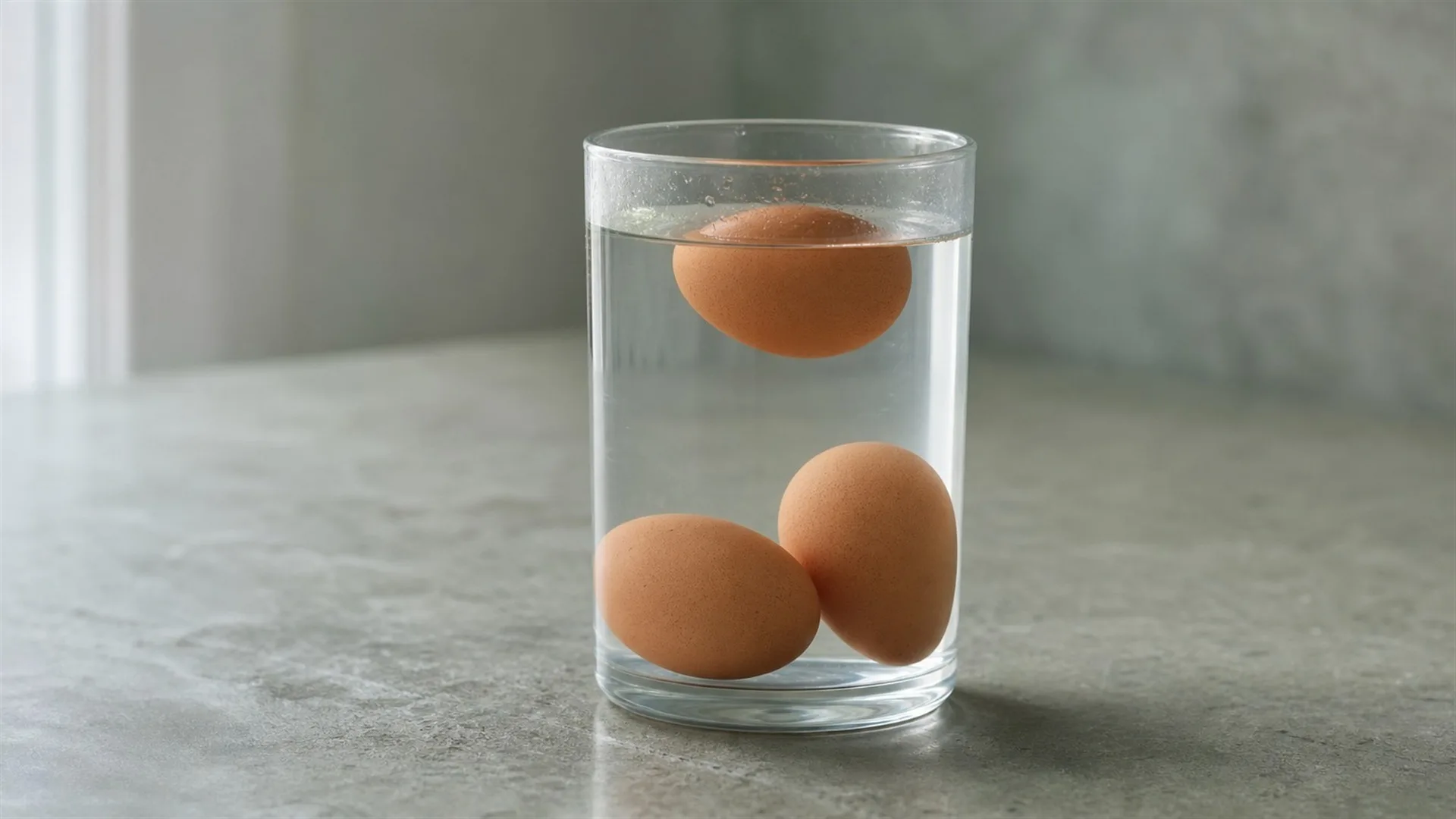
You fill a bowl with cold water, tip in an egg from the back of the fridge, and watch it bob upright. Somewhere online you learned that means rotten, so into the bin it goes. You may have just binned a good egg. An egg that sinks is not automatically safe either. So what does the float test actually tell you?
Does a floating egg mean it's bad?
- A floating egg is old, not automatically bad. USDA says it "may be perfectly safe to use."[1]
- It measures age only — it can't detect Salmonella, which sits just fine in eggs that sink.[1][5]
- Eggs float because the air cell grows as moisture and CO₂ escape through roughly 7,000 shell pores.[9]
- Refrigerated shell eggs keep 3 to 5 weeks in the fridge.[1]
- Better freshness/spoilage checks: crack it onto a plate, then smell it. Those checks still cannot prove microbial safety.
Does a floating egg mean the egg has gone bad?
No. It means the egg is old.
USDA's Food Safety and Inspection Service is direct about it: "An egg can float in water when its air cell has enlarged sufficiently to keep it buoyant. This means the egg is of poor quality, but it may be perfectly safe to use."[1]
The float test flags poor quality. It says nothing about safety, and an egg laid yesterday can already carry Salmonella Enteritidis, deposited inside before the shell even formed.[1] A freshness check isn't a safety check, no matter how convincing the bowl of water looks.
Why eggs float: the air cell, explained
A freshly laid egg holds almost no air. A hen's body runs at about 106°F (41°C), and as the egg cools afterward, its contents shrink more than the rigid shell around them, pulling air in at the blunt end to form the air cell.[9]
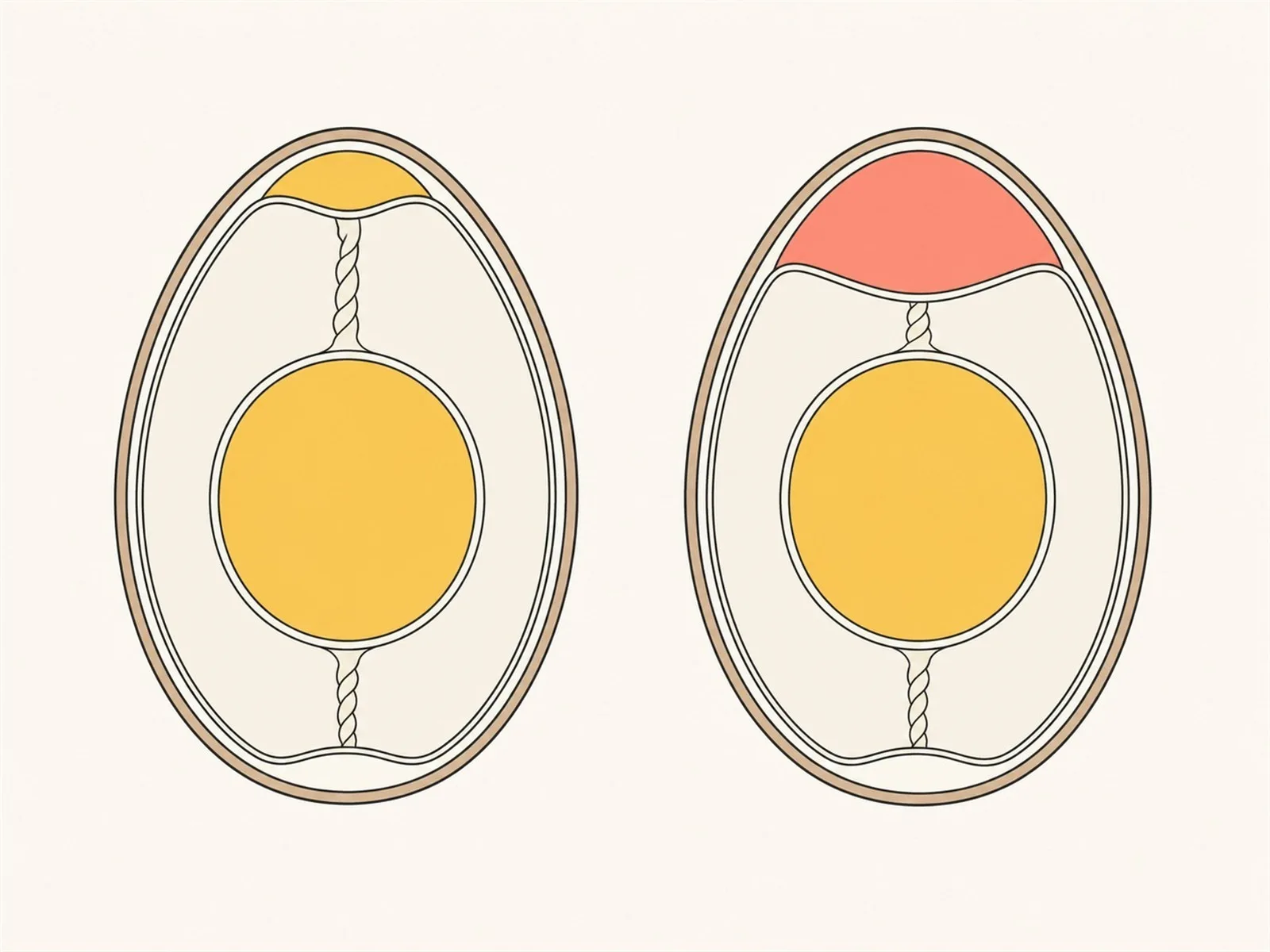
Then the slow leak starts. A shell carries roughly 7,000 pores, and CO₂ and water vapour escape through them continuously.[9] Every gram of water that leaves gets replaced by air, which weighs far less. Once the egg's overall density drops below that of water, it tips upright, then eventually lifts clear of the bottom. A floating egg has simply been losing moisture for a while.
Graders check the same thing with a light held to the shell: air cell depth sets the grade, 1/8 inch or less for AA.[4]
At a glance: how long eggs really last
| Egg form | Fridge at 40°F / 4°C | Freezer | Room temperature |
|---|---|---|---|
| Raw eggs in shell | 3-5 weeks | Never freeze in shell | Max 2 hours once chilled; 1 hour above 90°F / 32°C |
| Raw whites / yolks | 2-4 days | Whites 12 months; yolks poorly | Not recommended |
| Hard-boiled, shell on or peeled | 1 week | Do not freeze | Max 2 hours; 1 hour above 90°F / 32°C |
These timings come from USDA FSIS and FDA.[1] FDA's own advice is to use raw shell eggs within 3 weeks for best quality.[2]
What the float test actually tells you — and what it can't
| What you see | What it means | What it does NOT mean |
|---|---|---|
| Sinks flat on its side | Very fresh, small air cell | Not proof it is Salmonella-free |
| Sinks, tilts upright | A few weeks old; great for boiling | Not "going off" |
| Stands on end | Older egg; position alone does not determine safety. Cook thoroughly. | Not proof of spoilage |
| Floats clear of the bottom | Real moisture loss; poor quality | Not automatically spoiled |
| Floats and reeks when cracked | Genuinely spoiled — discard | — |
A foul smell or abnormal appearance is a reason to discard, but smell and appearance are not safety clearance. Storage history and refrigeration matter. Sinking and smelling fine tells you the egg isn't obviously spoiled; it doesn't tell you the egg is free of Salmonella, which is odourless and invisible.[1] No look-and-sniff check substitutes for cooking it properly.
Myth vs fact
| Myth | Fact |
|---|---|
| "A floating egg is rotten." | It is old. USDA says it "may be perfectly safe to use."[1] |
| "The float test tells you if an egg is safe." | It reads the air cell. Salmonella has no effect on buoyancy.[1] |
| "You can't eat an egg past the carton date." | USDA gives refrigerated eggs 3-5 weeks[1] and says eggs kept in their carton are good four to five weeks beyond the pack date.[15] |
| "A cracked egg is fine if cooked hard." | Don't use cracked raw eggs. Eggs that crack during boiling are safe.[1] |
| "Washing eggs at home makes them safer." | The opposite: wash water can be "sucked" in through the pores.[1] |
Three better freshness/spoilage checks
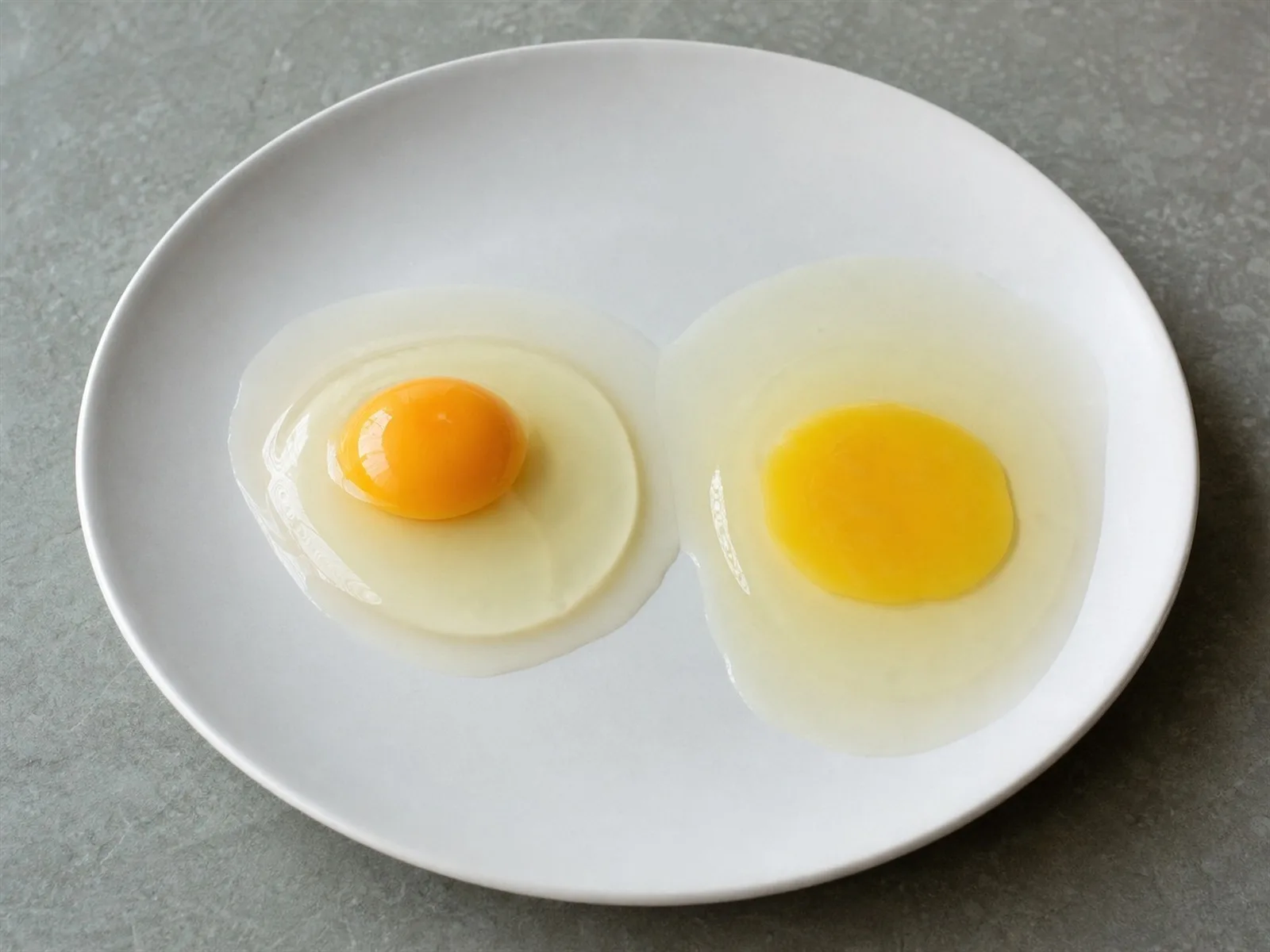
1. Crack it onto a plate. This is break-out grading, the same method graders use, done on a flat surface, and it's the most informative test you have. A fresh egg gives a tight, domed yolk sitting on a mound of thick white. In Grade AA "the thick albumen is in the shape of an egg and the yolk sits off the plate." An old one spreads out: by Grade B "the yolk is flattened, and the thick albumen is almost all gone."[10] USDA's own standards call Grade B whites "weak and watery" and the yolks "enlarged and flattened."[4]
2. Smell it. FSIS doesn't hedge here: "A spoiled egg will have an unpleasant odor when you break open the shell, either when raw or cooked."[1]
3. Check the colour. A little cloudiness is actually a sign of freshness, just dissolved CO₂. Whites gone pink, iridescent or greenish, or showing black or green fuzzy patches, mean bacterial or mould spoilage. Discard.
How to read the code on a US egg carton
Two codes sit on every USDA-graded carton, and neither one is the sell-by date.
- The Julian pack date is three digits, 001 to 365, "the consecutive day of the year in which the eggs were packed into the carton."[3] So 042 means 11 February. USDA says eggs kept in their carton in the fridge stay good four to five weeks beyond that date.[15]
- The plant code is a number "preceded by a 'P' with three or four digits," something like P-1234.[3] It's what recall notices reference.
The printed dates are softer than most people assume. "EXP" and "Sell By" dates "can be no more than 30 days from the packing date," while "Use by" and "Best before" "may not exceed 45 days."[1] None of that is a safety cliff, which is the same principle behind foods that never expire.
Why American eggs live in the fridge and European ones don't
In London, Rome or Mumbai, eggs sit on an unrefrigerated shelf. That's not carelessness. It's a different, coherent system built around a different choice made earlier in the chain.
US eggs are washed before packing, which strips the cuticle (sometimes called the "bloom") that normally seals those 7,000 pores. Because of that, US rules require shell eggs held at an ambient 45°F (7.2°C) or less.[5] The EU went the other way. Commission Delegated Regulation (EU) 2023/2465 — which replaced Regulation (EC) No 589/2008 — keeps the same core rule: Class A eggs shall not be washed or cleaned, precisely because washing damages that barrier.[11] With the cuticle intact, EU eggs are deliberately kept out of the cold: Class A eggs must not be held in premises artificially maintained below 5°C (41°F). The regulation does not count up to 24 hours below 5°C during transport, or up to 72 hours on retail premises, as chilled storage.[11] Separately, the EU egg-hygiene rules in Regulation (EC) No 853/2004 set the date of minimum durability at not more than 28 days after laying.[11]
An unwashed, unrefrigerated egg loses moisture faster than a washed, chilled one, so at the same age it floats sooner.
Salmonella: the risk no float test can see
Salmonella remains a leading cause of foodborne illness in the US.[7] Older USDA and FDA risk work estimated roughly 1 in 20,000 eggs carried Salmonella Enteritidis before the Egg Safety Rule; that figure is historical context, not a current prevalence claim.[5][8] FDA's Egg Safety Final Rule was intended to cut egg-associated illnesses substantially.[6] The practical takeaway is unchanged: the float test cannot see this risk, so cook eggs thoroughly.
SE gets into an egg one of three ways: inside the hen before the shell even forms, from faecal contact as the egg is laid, or through the pores afterward.[1] No amount of washing or float-testing catches the first route.
Heat is the actual defence. Cook eggs until the white and yolk are firm, and cook egg dishes to 160°F (71°C).[1][2] It's the same logic behind how long cooked chicken lasts: time and temperature decide safety, not appearance. Runny yolks carry real risk for children, older adults, pregnant women and anyone immunocompromised, so use pasteurised eggs for those dishes.[2]
Hard-boiled eggs, cracked eggs, freezing and storage
The float test doesn't work on hard-boiled eggs. The white has set and the air cell is fixed in place, so a boiled egg can float simply because it was already old when you cooked it. Go by the calendar instead: refrigerate within 2 hours, or 1 hour above 90°F / 32°C, and eat within a week.[1][2]
Cracked eggs. Don't buy them, but an egg that cracks during hard cooking is still safe to eat.[1]
Freezing. Never freeze raw eggs in the shell; they burst. Raw whites keep for up to 12 months.[1]
Storage. Keep eggs "in their carton and place them in the coldest part of the refrigerator, not in the door."[1] The door swings into warm air dozens of times a day, and those temperature swings age eggs fast. Store them pointed end down: keeping the air pocket up holds the yolk centred and cuts the risk of it rupturing.[14] More on this in store food better, waste less.
Hot-climate and India-specific advice
Buying eggs from an open crate in a Chennai or Delhi market at 35°C, none of the US timelines above really apply.
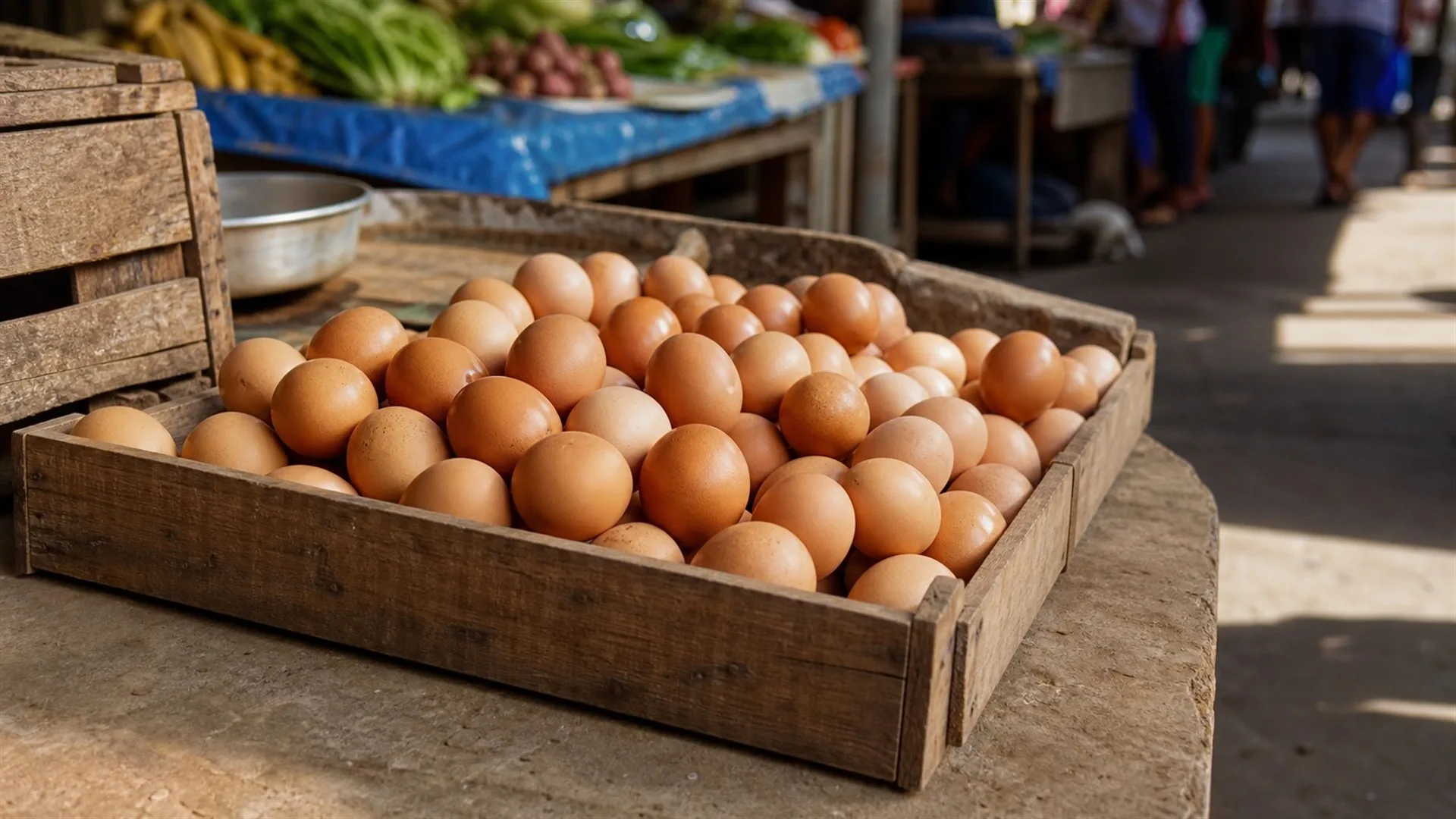
The effect has actually been measured, and it's large. In a study in the Asian-Australasian Journal of Animal Sciences, eggs stored for 10 days lost 0.55% of their weight at 5°C, 1.18% at 21°C and 3.67% at 29°C. Haugh units, the standard measure of albumen quality, fell from 91.3 to 72.6 at 21°C and from 87.6 to 60.9 at 29°C. At 5°C there was no decline at all.[12]
Those figures show that warmer storage speeds moisture loss and quality decline; they are not a rule that equates one warm day with one refrigerated week. FSSAI's 2018 guidance note makes a related point about texture, addressing the "plastic egg" rumour directly: that rubbery, papery texture is just an old egg that has lost moisture, not a fake one.[13]
- Buy small and often, a week's worth rather than a month's.
- Refrigerate at home even if the shop didn't, then keep them cold from there on.
- Don't wash before storing — wetting the shell helps bacteria through the pores. Wipe light dust off dry, just before use. An egg that is visibly dirty, stained or cracked is one to reject at the point of buying, not to clean up at home.[13]
- Expect earlier floating. An egg kept at 30-35°C loses moisture several times faster than a chilled one, so it floats sooner, and it may still be perfectly edible when it does.
For the rest of a hot-climate kitchen, see our Indian pantry storage guide and the companion piece on whether flour expires.
Frequently asked questions
Do floating eggs mean bad eggs?
No. A floating egg is simply an old egg. USDA FSIS explains that an egg floats once its air cell has grown large enough to make it buoyant, and that means poor quality, not automatically unsafe. Crack it into a bowl, take a look, give it a smell, then decide. Bear in mind that looking and smelling only catches spoilage — Salmonella gives off no smell at all, so cook eggs until white and yolk are firm regardless.
Is the egg float test accurate?
It's accurate for age and useless for safety. What it measures is moisture lost through the shell, which does track how long the egg has been sitting around. It can't detect Salmonella, since that's invisible and odourless, and it can't see spoilage bacteria that are already inside. Treat it as a rough age check, nothing more.
How long are eggs good for after the sell-by date?
USDA gives raw shell eggs three to five weeks in the refrigerator, and says eggs kept in their carton stay good four to five weeks beyond the carton's pack date, which is usually well past any printed sell-by. US expiration dates can't run more than 30 days from packing, and best-before dates can't exceed 45 days including packing. Both of those are quality markers, not safety cutoffs.
How can you tell if an egg is bad without water?
Crack it onto a flat plate. A fresh egg has a tall, domed yolk and thick white. An old one spreads out thin and flat. Then smell it: a rotten egg gives off an unmistakable sulphur smell. Pink, iridescent or green whites, or any fuzzy patches, mean it's time to discard.
Can you get Salmonella from an egg that sinks?
Yes. Salmonella Enteritidis can be deposited inside an egg before the shell even forms, from a hen that shows no sign of illness at all. USDA risk assessors put it at roughly 1 in 20,000 eggs, an estimate FDA cited in its 2004 rulemaking and so a pre-Egg-Safety-Rule figure rather than today's rate. Heat is the protection either way: cook until the whites and yolks are firm, or to 160°F (71°C).
How long do hard-boiled eggs last in the fridge?
One week, whether peeled or still in the shell, as long as you refrigerate within two hours of cooking, or one hour when the air temperature is above 90°F (32°C). Peeled eggs have lost the shell barrier and dry out faster, so keep them sealed. Don't freeze them. And the float test is no use here at all, since the white is already set and the air cell is fixed.
Do eggs need to be refrigerated?
In the United States, yes, because commercial eggs are washed, which strips the protective cuticle. US rules require shell eggs held at 45°F (7.2°C) or less, and home fridges should sit at 40°F (4°C) or below. EU Class A eggs are unwashed and deliberately kept unchilled at retail instead. The rule that matters either way: once an egg has been chilled, keep it chilled.
Is it safe to eat eggs that have been left out overnight?
If they'd already been refrigerated, no. Condensation forms on a cold egg sitting in a warm room, and that moisture on the shell helps bacteria move through the pores. Refrigerated eggs should not stay at room temperature for more than two hours, or one hour when the air temperature is above 90°F (32°C). Farm or European eggs that were never refrigerated in the first place are a different case entirely.
Bottom line
A floating egg is an old egg, not necessarily a bad one — USDA says it may still be perfectly safe to use. The float test only measures moisture lost through roughly 7,000 shell pores; it can't detect Salmonella, which can already be inside an egg that sinks.
Crack a doubtful egg onto a plate and inspect it for spoilage. USDA's refrigerator window for raw shell eggs is 3 to 5 weeks. Discard eggs with a foul smell, discoloured or fuzzy whites, or a compromised shell — and also when their storage history is unknown or refrigerated eggs were left warm for more than two hours, or more than one hour above 90°F / 32°C. A normal smell or a sinking egg is not proof of safety; cook eggs until the white and yolk are firm.
For item-specific storage times, start with the raw eggs guide, then use search for related egg dishes.
Related WillItExpire guides
Sources
- USDA Food Safety and Inspection Service — Shell Eggs from Farm to Table. Last updated 20 November 2024.
- U.S. Food and Drug Administration — What You Need to Know About Egg Safety. Last updated 5 March 2024.
- USDA Agricultural Marketing Service — Questions and Answers: USDA Shell Egg Grading Service.
- USDA Agricultural Marketing Service — United States Standards, Grades, and Weight Classes for Shell Eggs.
- U.S. Food and Drug Administration / Federal Register — Prevention of Salmonella Enteritidis in Shell Eggs During Production. Published 22 September 2004.
- U.S. Food and Drug Administration — Egg Safety Final Rule.
- Centers for Disease Control and Prevention — About Salmonella Infection. Last reviewed 4 October 2024.
- Schroeder C.M. et al. — Estimate of Illnesses from Salmonella Enteritidis in Eggs, United States, 2000. Emerging Infectious Diseases (CDC), Vol. 11, No. 1, January 2005.
- Penn State Extension — The Parts of the Egg.
- National 4-H Poultry & Egg Conference, University of Kentucky — Market Eggs: Interior Egg Grading by Broken Out.
- European Union official texts: Commission Delegated Regulation (EU) 2023/2465, especially Article 4 on washing, chilling and the transport/retail temperature exceptions (repealing Regulation (EC) No 589/2008); and Regulation (EC) No 853/2004, Annex III, Section X, Chapter I, point 4, which fixes the date of minimum durability at not more than 28 days after laying.
- Jin Y.H., Lee K.T., Lee W.I., Han Y.K. — Effects of Storage Temperature and Time on the Quality of Eggs from Laying Hens at Peak Production. Asian-Australasian Journal of Animal Sciences, Vol. 24, No. 2, 2011, pp. 279-284.
- Food Safety and Standards Authority of India (FSSAI) — Guidance Note on Safety and Quality of Eggs. 14 August 2018.
- BBC Science Focus — Should eggs be stored pointed end down? Updated 12 July 2023.
- U.S. Department of Agriculture — A Carton of Eggs: A True Baker's Dozen.
This article provides general information using a U.S. baseline with clearly labelled hot-climate context. Storage times reflect USDA and FDA guidance and published research, not guarantees for any specific egg. Follow stricter package, carton or local instructions. It is not medical advice.