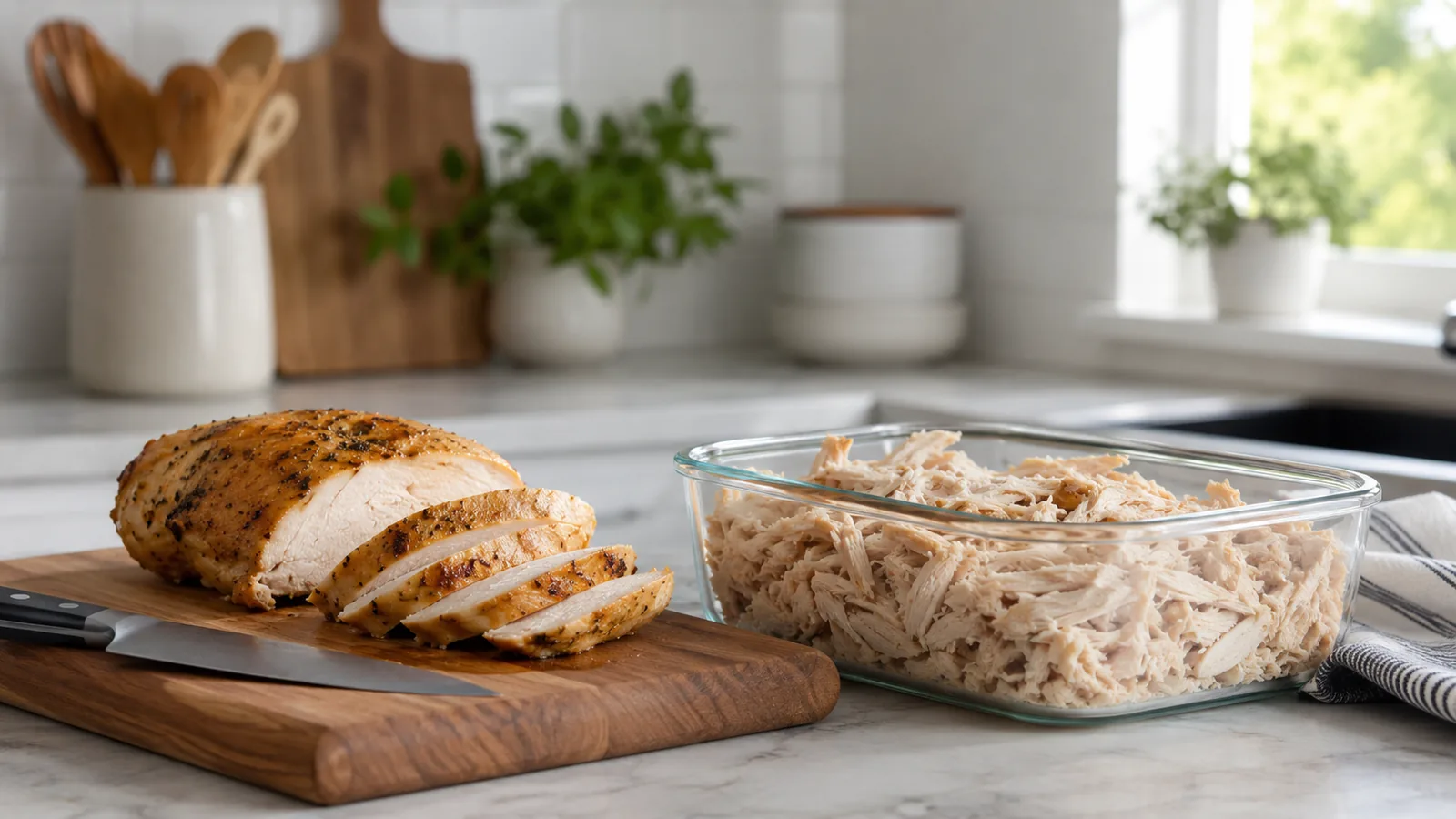
It is Thursday. The chicken you roasted on Sunday is still in the fridge, still smells like chicken, still looks like chicken. You are standing at the open door doing the arithmetic every household does eventually — and the honest answer is that your nose is not qualified to settle it.
Here is what is.
How long cooked chicken keeps, and when to bin it
Cooked chicken keeps 3 to 4 days in a refrigerator at 40°F / 4°C or below. Get it into the fridge within 2 hours of cooking, or within 1 hour if the room is above 90°F / 32°C. Reheat leftovers to 165°F / 74°C. Chicken past four days, or with a storage history you cannot account for, should be discarded.[1][2][3]
The keep, chill or discard table
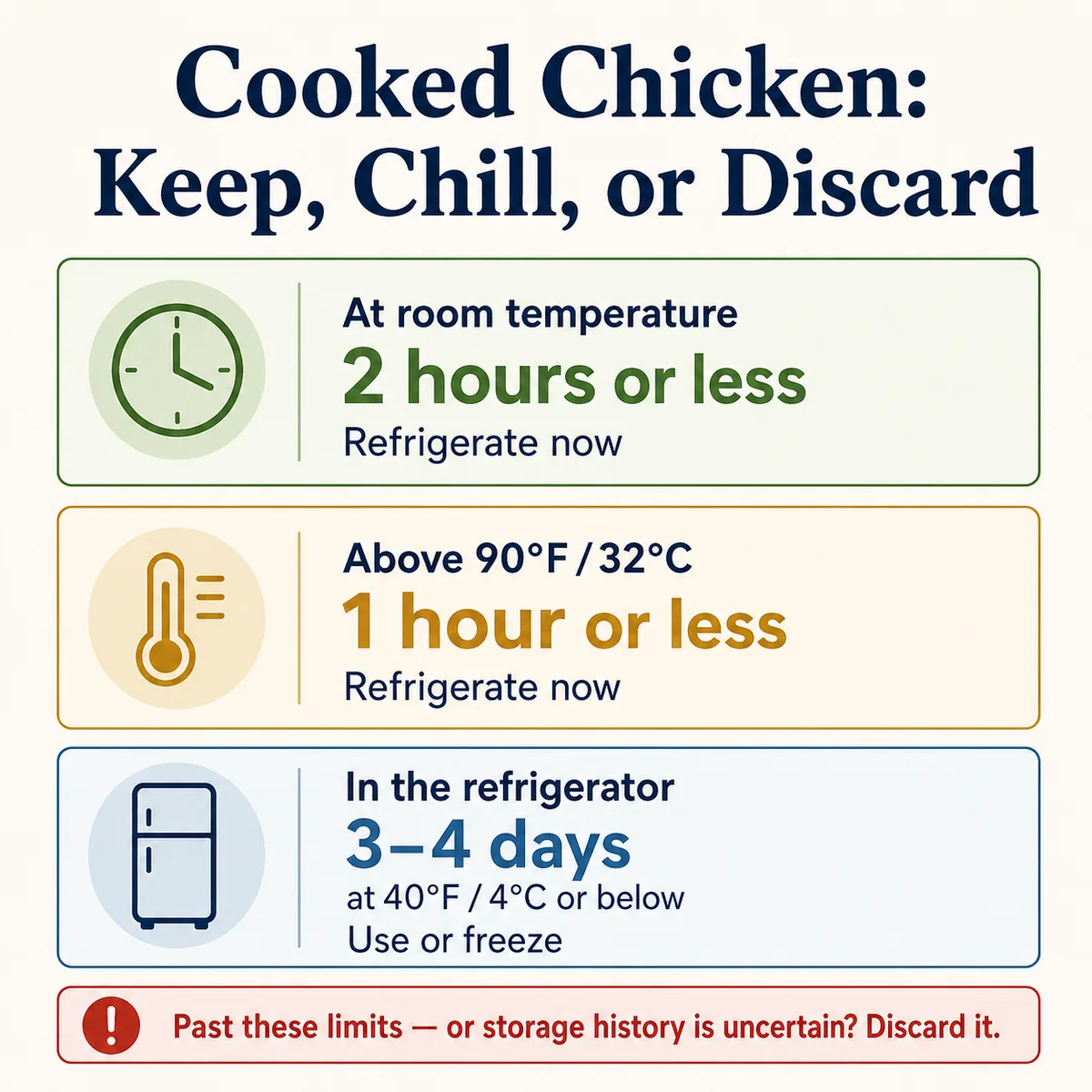
| Situation | Status | What to do |
|---|---|---|
| Under 2 hours at room temperature | Within the limit | Serve, or refrigerate now |
| 2 hours or more at room temperature | Outside the limit | Discard |
| 1 hour or more above 90°F / 32°C | Outside the hot-weather limit | Discard |
| Left out overnight, covered or uncovered | Well outside the limit | Discard |
| Days 1–2 in the fridge at 40°F / 4°C | Within the limit | Eat cold, or reheat to 165°F |
| Days 3–4 in the fridge at 40°F / 4°C or below | At the limit | Eat or freeze within 3–4 days, only if handled safely |
| Day 5 and beyond | Past the recommendation | Discard |
| Rode home in a warm car or delivery bag | Counts toward the 2-hour clock | Refrigerate now; discard if 2 hours passed |
| Unknown history | Cannot be verified | Discard |
| Held hot at 140°F / 60°C or above | Above the danger zone | May be held hot per equipment instructions |
Two details do more work than people expect. The clock counts total time out of refrigeration, not the longest single stretch — the twenty minutes on the counter after cooking, the drive home, and the hour it sat out at dinner all add to the same total. And putting a lid on it changes nothing: a cover keeps dust off, but it does not slow bacteria down.
Why cooked chicken has a shorter clock than you'd think
Most people file chicken risk under Salmonella and Campylobacter. Those are real, but they are raw-stage problems, and cooking to 165°F handles them.
The leftover stage has a different villain. Clostridium perfringens is one of the most common causes of foodborne illness in the U.S., and its favourite habitat is exactly what you just made: meat and poultry cooked in a large batch, then cooled slowly.[4][5]
The mechanism is simple and slightly unfair. C. perfringens forms spores that survive normal cooking temperatures. As the food cools through the danger zone — 40°F to 140°F / 4°C to 60°C — those spores germinate and the bacteria multiply fast. A deep pot of chicken curry cooling on the stovetop can sit in that zone for hours while the surface feels perfectly cool to the touch.[4][5]
This is why how you cool chicken matters as much as how long you keep it. The four-day count assumes the chicken got cold quickly. If it did not, four days was never the number.
Cool it properly — the part everyone skips
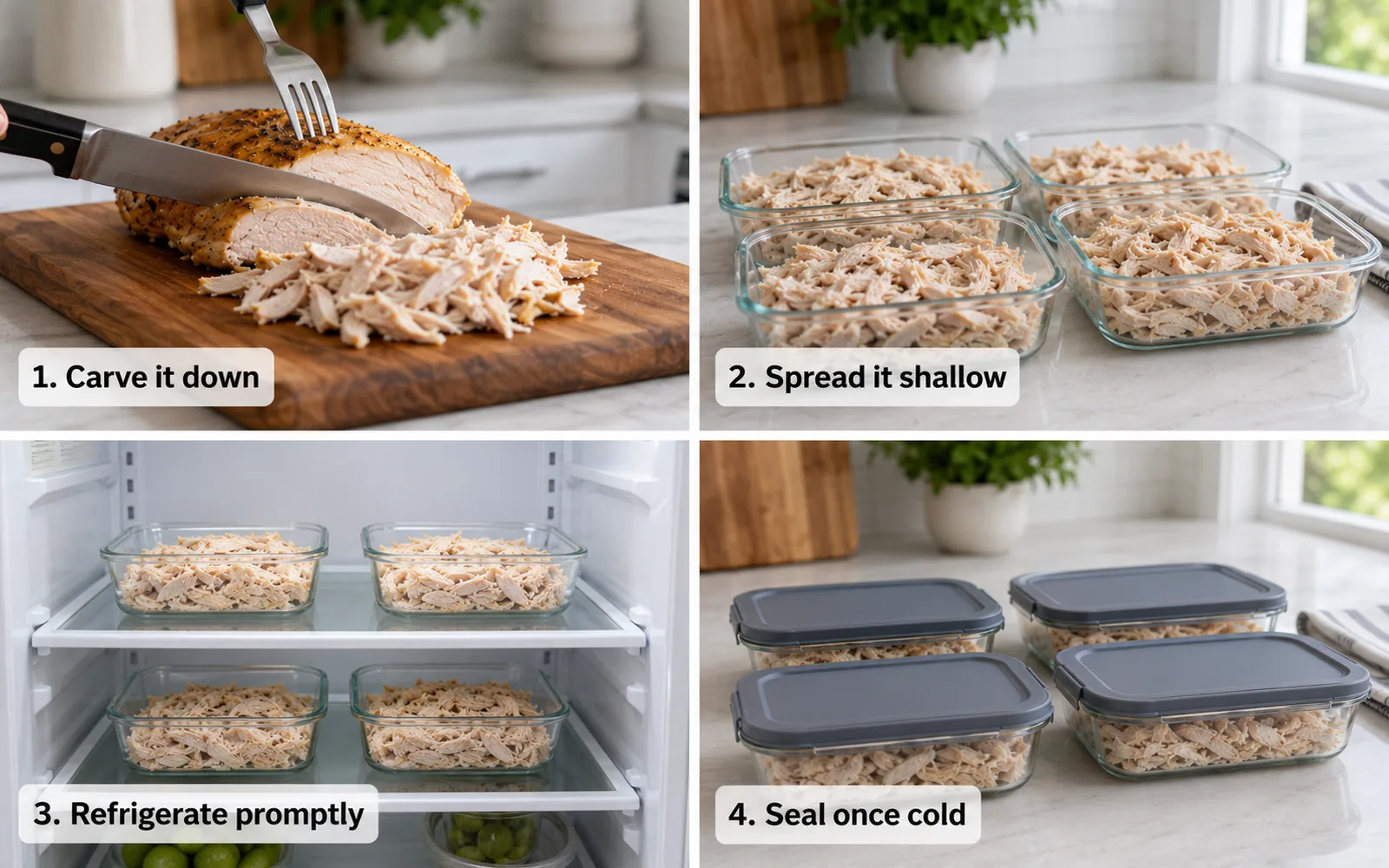
A whole bird cools from the outside in and takes far too long. Break it up first.
Aim for two inches deep or less. Depth, not volume, is what traps heat.[5]
Two shallow containers beat one deep one every time.
Modern refrigerators handle warm food. Waiting for it to cool on the counter is the mistake, not the fix.
Stacked or crammed, they insulate each other. Seal the lids once the chicken is properly cold.
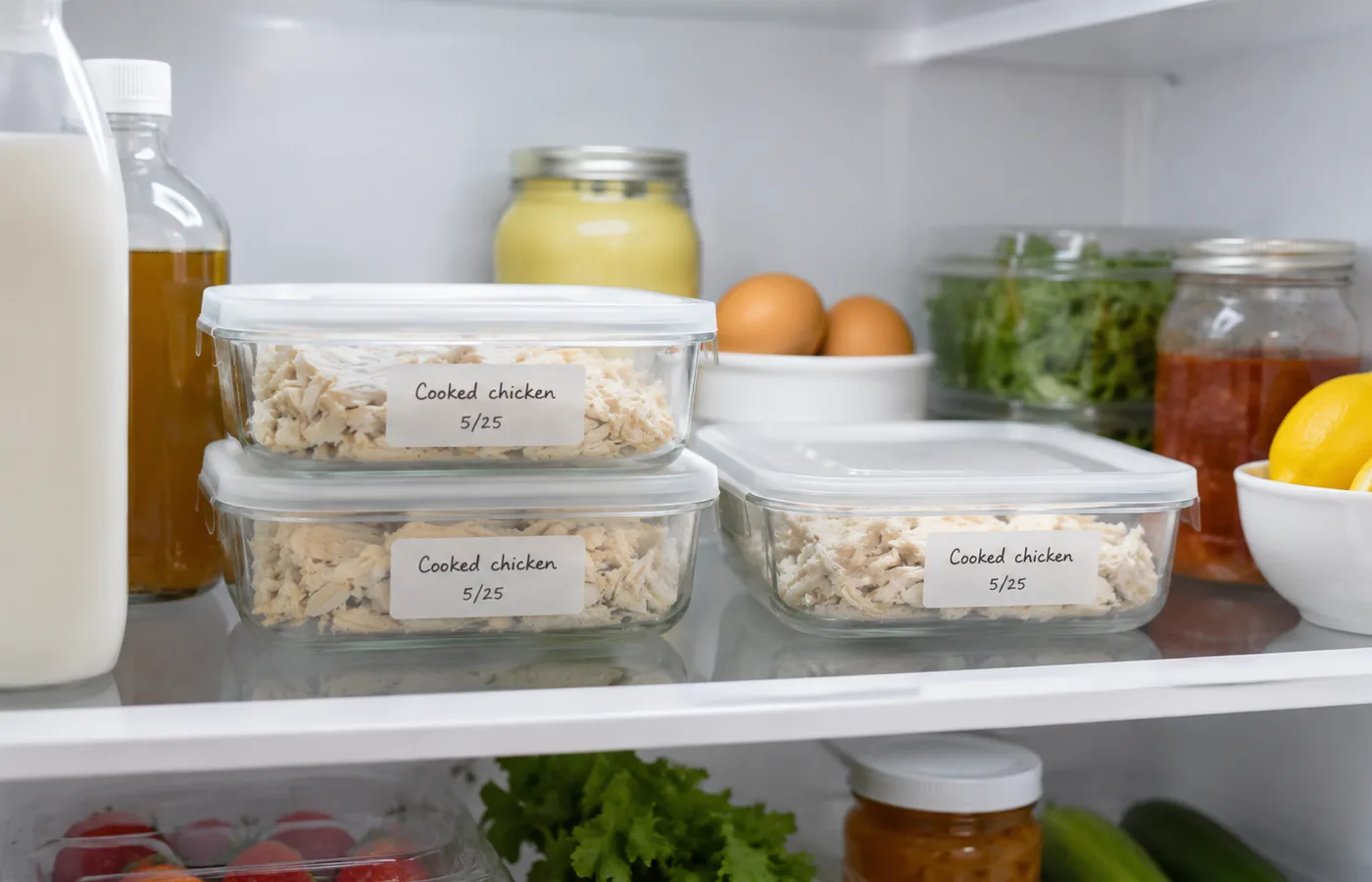
Memory is the weakest link in this entire process.
Storage, by scenario
Rotisserie and takeout chicken. The 2-hour clock starts when it leaves the hot case or the fryer, not when you get home. Refrigerate within two hours of purchase and count the drive.[1]
Chicken in sauce, curry or gravy. Same 3–4 days, but the cooling rule is stricter — these are dense and hold heat. Divide into shallow containers rather than refrigerating the whole pot.[5]
Meal-prep shredded chicken. Portion it on day one. Every time a container is opened, warmed and returned, it spends more time in the danger zone.
Chicken left in the oven overnight. Unless the oven actively held it at 140°F / 60°C or above, this is room-temperature storage. Discard.
Store-bought cooked chicken, unopened. Follow the manufacturer's date on the package. Once opened, the 3–4 day window applies.
Freezing. Chicken that was cooked and handled safely stays safe indefinitely while continuously frozen at 0°F / -18°C. For best quality, use plain cooked chicken within about 4 months and mixed leftovers within 3–4 months. These months are quality estimates, not safety limits. Freeze within 3–4 days of cooking only if it was refrigerated promptly and held at 40°F / 4°C or below. Freezing sooner helps preserve quality; it cannot make mishandled chicken safe.[1][6][7]
Reheating
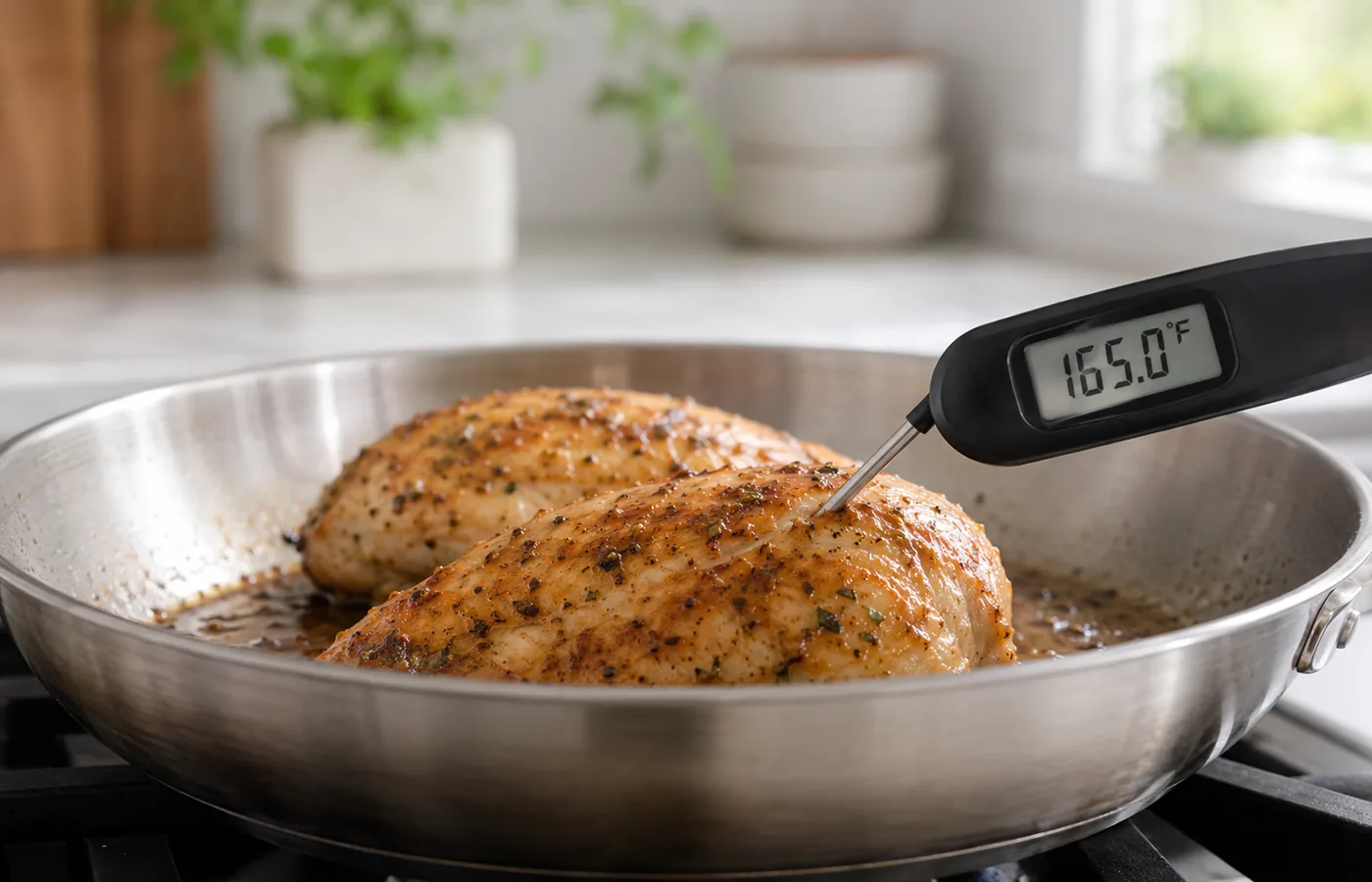
Reheat cooked chicken to 165°F / 74°C throughout, measured at the thickest part with a thermometer rather than judged by steam or colour.[1][2] Stir sauces and soups partway through, and let microwaved food stand a minute so the heat evens out — microwaves leave cold pockets, and cold pockets are where survivors live.
One firm limit: reheating is not a rescue. Some bacteria produce heat-stable toxins that survive a thorough reheat entirely. Chicken that was mishandled cannot be repaired by making it hot again.
How to tell if cooked chicken has gone bad
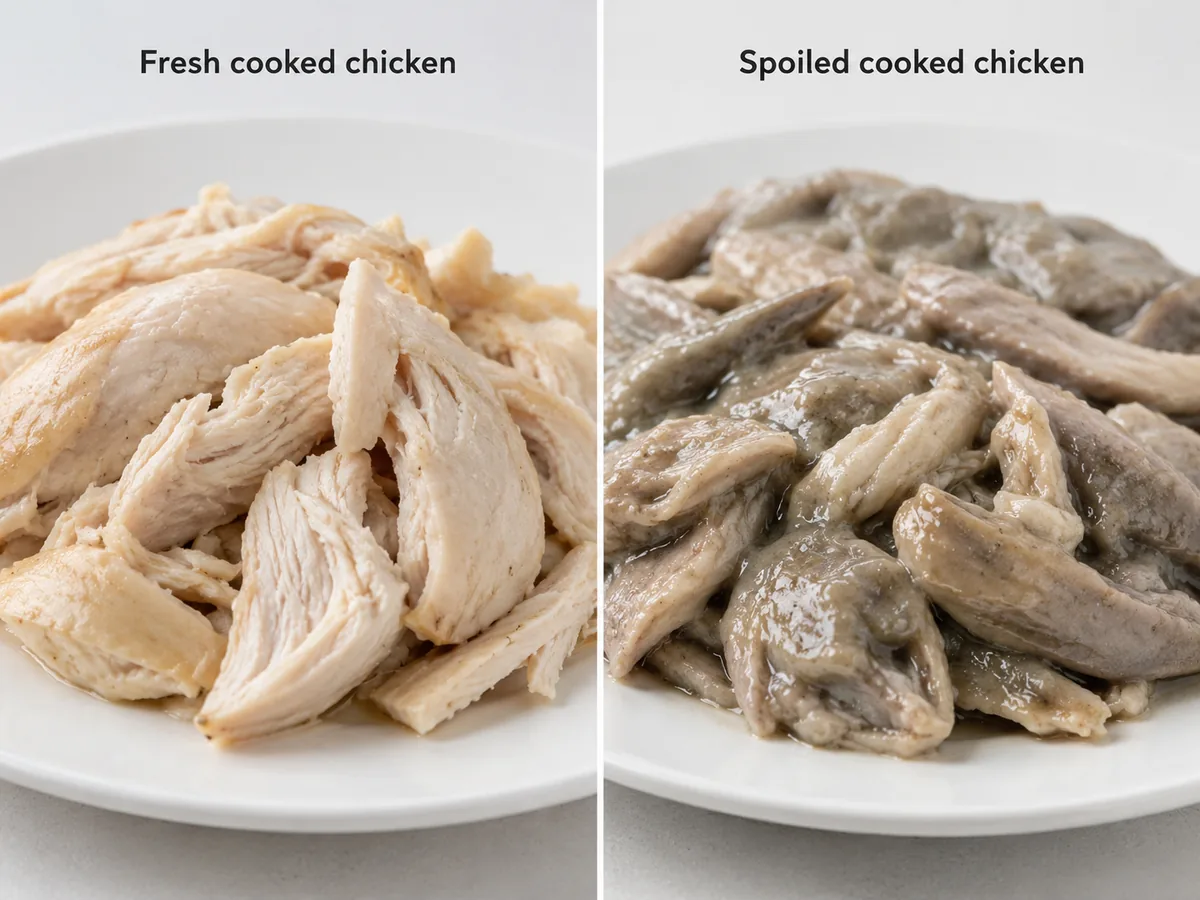
Discard cooked chicken that shows a sour, sulfurous or ammonia-like smell, a slimy or sticky surface, a grey, green or dull cast where the meat was white, or any visible mould.
But read that list the right way round. These are the signs that prove chicken is spoiled. Their absence proves nothing, because the organisms that cause serious foodborne illness do not necessarily announce themselves. Chicken can look fine, smell fine, and still make you ill. The date on the lid is better evidence than any of your senses.
India and hot climates
In India, the Gulf, and anywhere summer kitchens run above 90°F / 32°C, the room-temperature window is one hour, not two.[1][3] Cooling is also slower in a warm kitchen, so shallow containers matter more, not less. Check that your refrigerator actually holds 40°F / 4°C with a fridge thermometer — during a heatwave, and with the door opening constantly, many do not.
Three myths worth retiring
"It's fine, I can smell it." Spoilage bacteria create odours. Pathogens frequently do not. The two groups are different, and only one of them warns you.
"Reheating kills everything." Heat kills active bacteria. It does not reliably destroy heat-stable toxins already produced in the food.
"It was covered, so it was fine." A lid is a dust barrier, not a temperature control. Bacteria grow at exactly the same rate underneath it.
Frequently asked questions
Can I eat cooked chicken cold from the fridge?
Yes, within the 3–4 day window, if it has been continuously refrigerated at 40°F / 4°C or below.[1]
Chicken sat out for 3 hours — can I cook it further?
No. Past the 2-hour limit it should be discarded, and additional cooking does not make it safe.
How long does rotisserie chicken last in the fridge?
The same 3–4 days, but the 2-hour clock starts when it leaves the hot case, so refrigerate within two hours of purchase and count the drive home.[1]
Does the fridge stop bacteria?
It slows them down. It does not stop them, which is why the limit is days rather than weeks.[8]
Can I freeze cooked chicken, and for how long?
Yes. Chicken that was cooked and handled safely stays safe indefinitely while continuously frozen at 0°F / -18°C. For best quality, use plain cooked chicken within about 4 months and mixed leftovers within 3–4 months. Freeze within 3–4 days of cooking only if it was refrigerated promptly and held at 40°F / 4°C or below. Freezing sooner helps preserve quality; it cannot make mishandled chicken safe.[1][6][7]
Can I refreeze chicken I thawed in the fridge?
Yes, if it thawed in the refrigerator and stayed cold throughout, though quality will suffer.[6]
Bottom line
Cooked chicken keeps 3–4 days in the fridge at 40°F / 4°C or below. Refrigerate within 2 hours of cooking, or 1 hour above 90°F / 32°C, cooling it fast in shallow containers. Reheat to 165°F / 74°C.
Chicken left out overnight, or with a storage history you cannot verify, should be thrown out — and no amount of reheating buys it back.
Related WillItExpire guides
Sources
- USDA FSIS — Leftovers and Food Safety.
- USDA FSIS — How long can you keep cooked chicken?
- FoodSafety.gov — Cold Food Storage Chart.
- CDC — About C. perfringens food poisoning.
- FoodSafety.gov — Prevent Illness from C. perfringens.
- USDA FSIS — Freezing and Food Safety.
- USDA FSIS — Chicken from Farm to Table.
- USDA FSIS — Refrigeration & Food Safety.
This article provides general food-safety information using a U.S. baseline with clearly labelled hot-climate context. Follow stricter local, package, restaurant or appliance instructions. It is not medical advice.