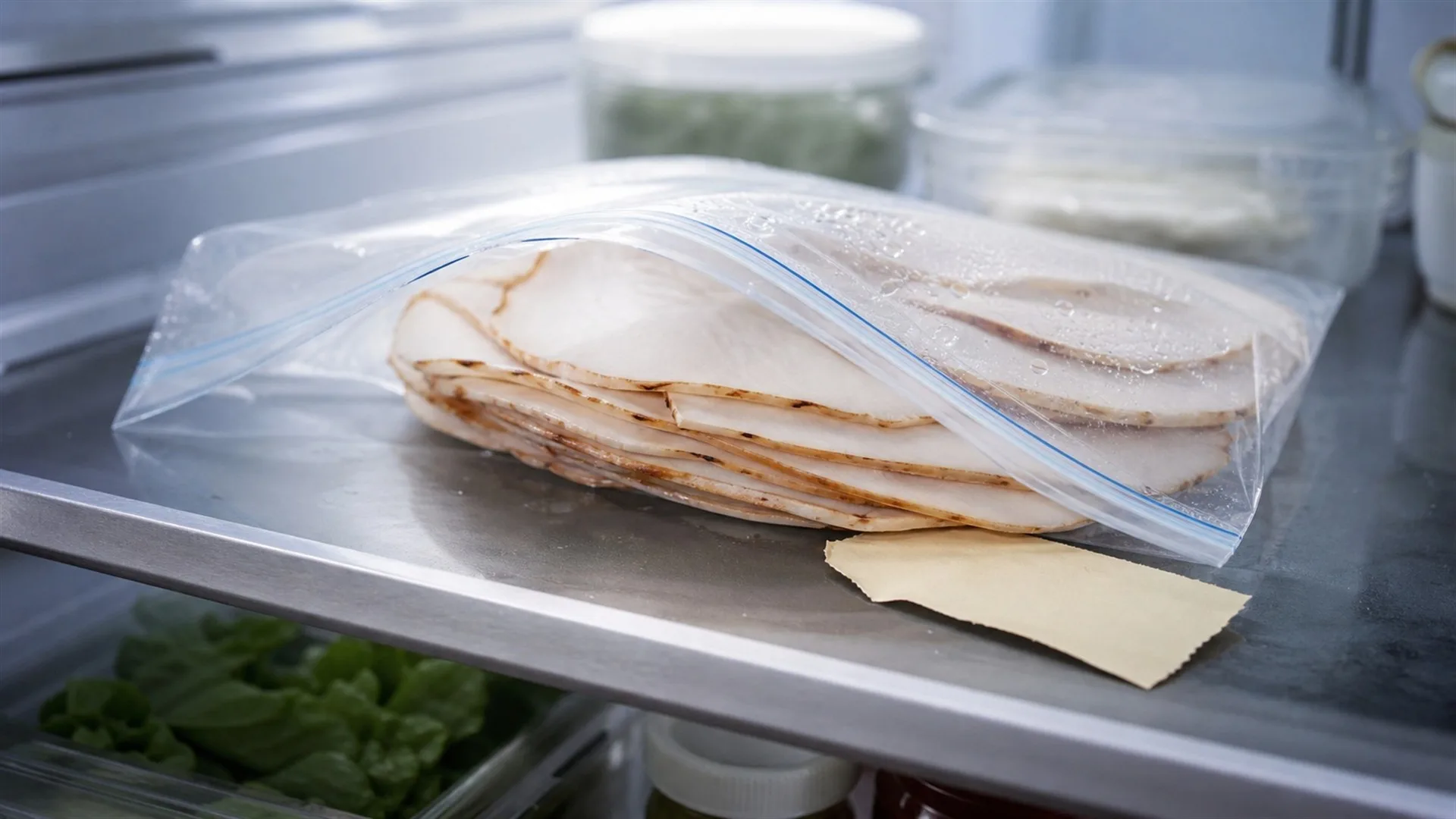
The turkey slices have been in the drawer since... Tuesday? Maybe the Tuesday before. The bag doesn't smell of much, the meat still looks pink, and there's just enough left for one sandwich. So you hover. Deli meat is the one fridge item where "looks fine" doesn't mean fine, because the bacterium that makes it dangerous doesn't smell, doesn't turn slimy, and grows just fine at fridge temperature.
- Opened package or deli-sliced meat: 3 to 5 days at 40°F (4°C) or below.[1]
- Unopened, vacuum-sealed at the plant: 2 weeks, or the use-by date — whichever comes first.[1]
- Freezer: 1 to 2 months for quality. Freezing stops Listeria from multiplying but won't necessarily kill it.[1][8]
- Once you open it, the printed date no longer applies — a new clock starts.
- Higher-risk eaters: heat it to 165°F (74°C) or until it's steaming first.[3]
So how long does deli meat actually last?
Once you break the seal, you've got 3 to 5 days in the fridge — true whether it's a package of luncheon meat or something sliced fresh at the counter. Leave the factory seal intact and it's good for 2 weeks, or until the use-by date, whichever lands first.[1]
The gap between those numbers tells you what's really going on. A factory seal means low oxygen and no handling. Open it and you add air, your hands, and a warm-up cycle every time it comes out of the fridge. Counter-sliced meat never had that seal at all.
Treat the printed date as a ceiling, not a promise: five days from opening, or the use-by date, whichever comes first.
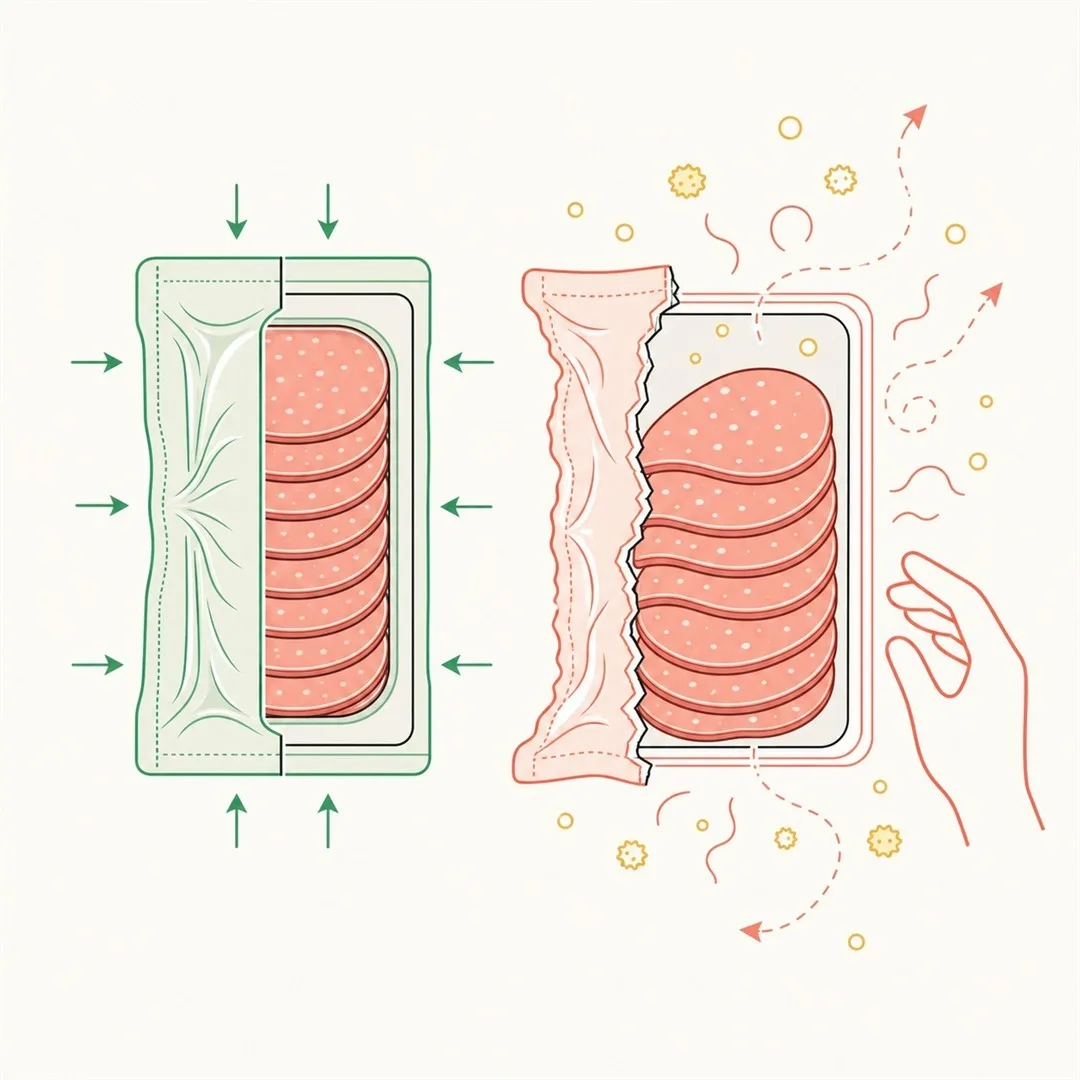
Deli meat storage times at a glance
| Product & state | Fridge (40°F / 4°C) | Freezer (0°F / -18°C) |
|---|---|---|
| Luncheon meat, opened or deli-sliced | 3 to 5 days | 1 to 2 months |
| Luncheon meat, unopened (plant-sealed) | 2 weeks or use-by date | 1 to 2 months |
| Ham, cooked — slices, half or spiral | 3 to 5 days | 1 to 2 months |
| Ham, cooked — vacuum-sealed, unopened | 2 weeks or use-by date | 1 to 2 months |
| Hot dogs, opened | 1 week | 1 to 2 months |
| Hot dogs, unopened | 2 weeks | 1 to 2 months |
Every number in that table comes from the USDA/FDA cold storage chart.[1] Whole dry sausages — hard salami, pepperoni — aren't on that chart at all. Dry-cured hams are: prosciutto, Parma and Serrano, which hold for 2 to 3 months refrigerated once cut — call it ten times longer than sliced turkey, for the reasons below.[1]
The freezer numbers are about quality, not safety. Ice crystals tear up thin wet slices, so freeze in sandwich-sized portions if you're going to, and plan to cook them once thawed rather than eating them cold.
Why deli meat, specifically? The Listeria problem
Most bacteria that spoil food stall out in the cold. Listeria monocytogenes doesn't. It keeps growing at temperatures as low as 34°F (1°C), which sits inside the range your fridge is supposed to run at.[8] Cold slows it down. It doesn't stop it.
Two things make it unusual. It hides — unlike the bacteria behind ordinary spoilage, it doesn't produce a sour smell or slime, so contaminated meat looks and tastes completely normal. And it's slow: severe illness usually shows up 1 to 4 weeks after you ate the meat, though it can start the same day or take as long as 70 days.[5]
CDC puts the toll at roughly 1,250 infections and 172 deaths a year in the US — call it one death for every seven infections, which makes listeriosis the fourth leading cause of death from foodborne illness.[2]
The 2024 Boar's Head outbreak is the case study: 61 illnesses and 10 deaths across 19 states, traced back to liverwurst and other deli meats.[6] About 7 million pounds got recalled and the Virginia plant that made it shut down, not reopening until February 2026.[9] In response, USDA widened Listeria testing across ready-to-eat products and now requires weekly inspector checks at plants like it.[14]
Deli meat and pregnancy: what the guidance actually says
CDC's actual position is narrower than people assume: deli meat, cold cuts, hot dogs and dry sausage are all fine for pregnant women once they're heated to 165°F (74°C) or until steaming hot.[3] The instruction isn't to give up the sandwich. It's to heat it first.
Pregnant women are 10 times more likely to get a Listeria infection.[3] Often the mother has mild symptoms or none at all, yet infection during pregnancy commonly causes miscarriage, stillbirth, premature delivery, or a life-threatening infection in the newborn.[4] That gap between how she feels and what's happening is why the advice is blunt.
Microwave the slices until they're visibly steaming, then build the sandwich. The test is the meat itself — steaming hot right through, or 165°F (74°C) on a thermometer.[3] Toasting a made-up sub doesn't count: it browns the bread without reliably bringing the filling to temperature. A cold Italian sub doesn't come close.
Counter-sliced vs pre-packaged, cured vs cooked
Counter-sliced meat carries more risk: it comes off a shared slicer, gets handled more, and never had a sealed barrier protecting it. That's exactly why CDC's advice to at-risk groups singles out "meats sliced at deli counters" by name.[5]
Cooked meats — turkey, ham, roast beef, bologna — are moist and only lightly salted, which is exactly the environment Listeria likes and why they spoil fastest. Dry-cured meats — salami, prosciutto — are preserved by salt, nitrite, and by having had most of their water removed. Less available water means less room for bacteria to grow, which is the whole reason a salami stick can hang at room temperature while sliced turkey can't.
How to tell if deli meat has gone bad
| Sign | What it means | Verdict |
|---|---|---|
| Slimy or tacky film | Bacterial growth on the surface | Bin it |
| Sour or ammonia smell | Protein breakdown | Bin it |
| Grey-brown throughout, or any mould | Advanced oxidation or spoilage | Bin it |
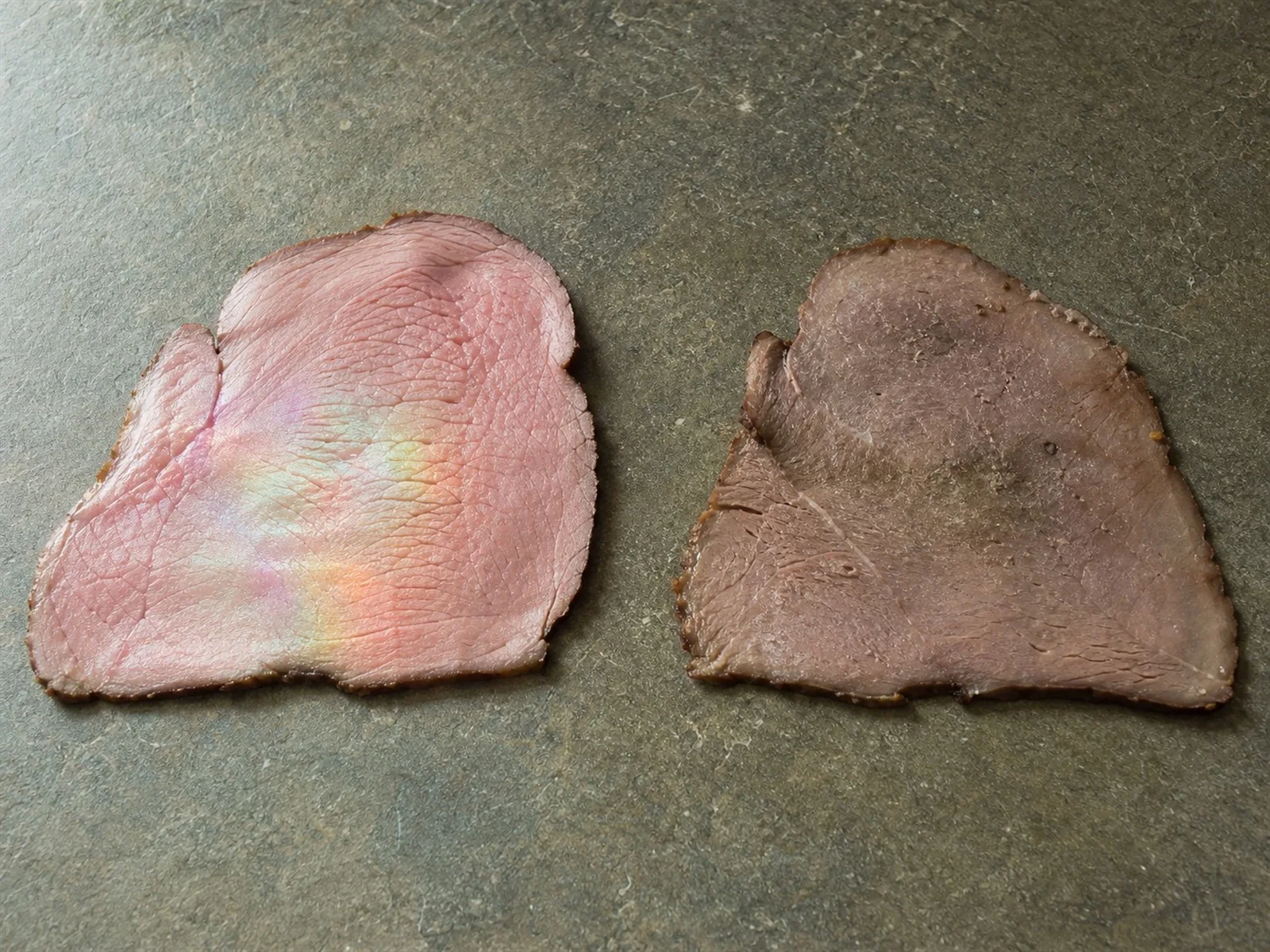
| Rainbow sheen on roast beef | Light diffracting off cut muscle fibres | Usually fine |
| Perfect look and smell, day 8 | Nothing — Listeria is silent | Bin it |
That rainbow sheen is the great deli-counter myth. A clean cross-cut leaves the muscle fibres lined up in a regular array, and light splits across them the way it does off a CD. Meat scientists describe it as a natural optical effect with no bearing on quality or palatability.[10] Slimy and green means the bin. Firm, dry and shimmering just means lunch.
Myth vs fact
| Myth | Fact |
|---|---|
| "If it smells fine, it's fine." | Smell only catches spoilage bacteria. Listeria grows right at fridge temperature and gives no warning — heat it, don't sniff it.[5][8] |
| "The use-by date is the deadline, even after opening." | Once you open the pack, the 3-to-5-day clock takes over from the printed date.[1] |
| "Freezing kills Listeria." | It doesn't. Freezing stops it multiplying, but it may not kill it — growth picks back up once it thaws.[8] |
| "Rinsing freshens it up." | Washing doesn't remove bacteria. Research on rinsing raw meat and poultry found splash can carry them up to 3 feet around the sink; there's no reason wet deli slices behave differently.[13] |
| "Reheating is only for hot sandwiches." | 165°F (74°C) is the control step for higher-risk eaters — hot sandwich or not.[3] |
Keeping it cold: fridge, lunchboxes and the 2-hour rule
Run your fridge at 40°F (4°C) or below, and check it with a cheap appliance thermometer — the dial lies more often than you'd think. Don't store deli meat in the door. That's the warmest, most variable spot in the whole unit. Use the meat drawer, or the back of a low shelf.
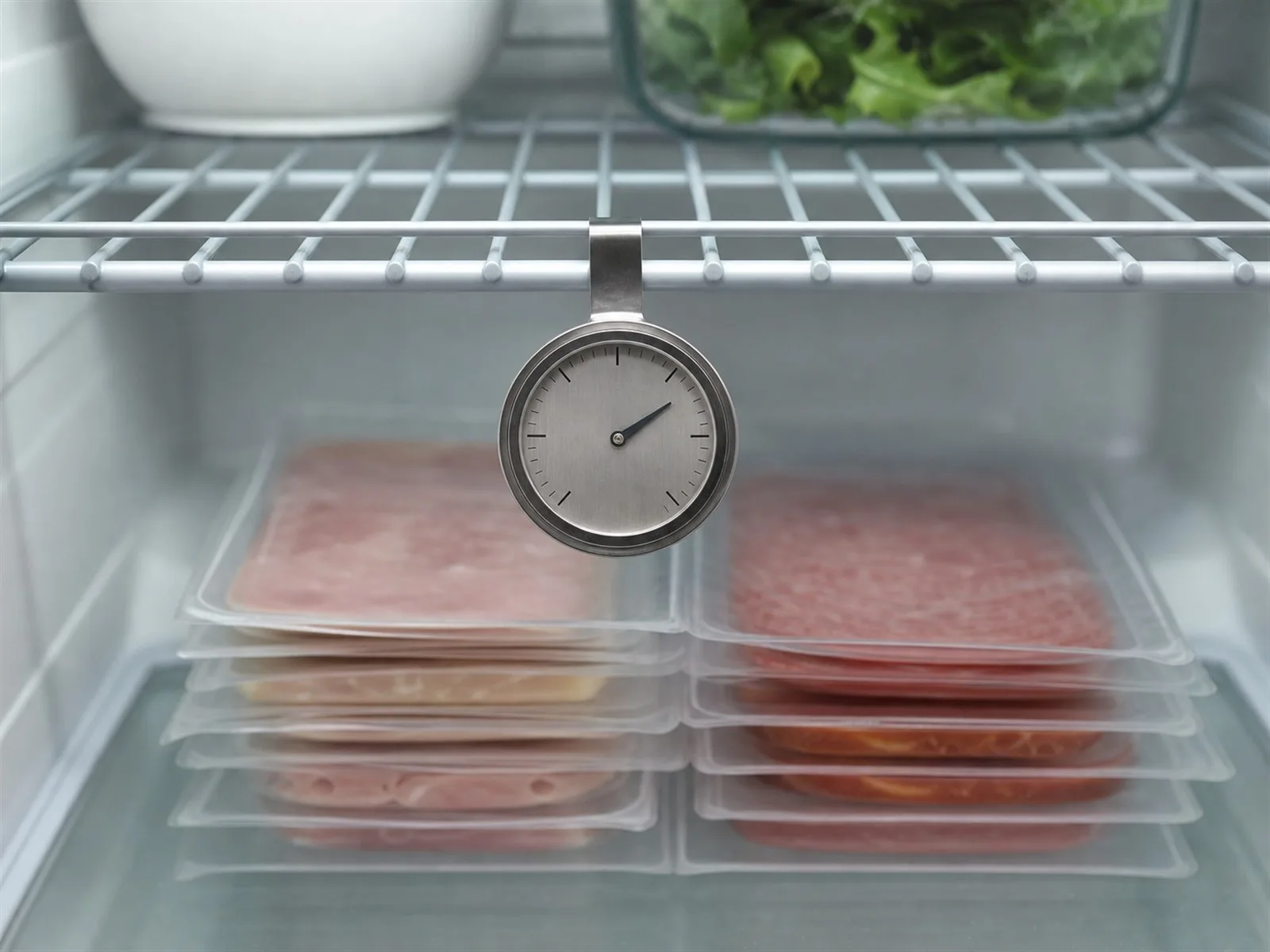
Outside the fridge, you're in the danger zone between 40°F and 140°F (4°C to 60°C). Perishable food gets 2 hours out there, or just 1 hour if it's above 90°F (32°C) — a hot car, a summer picnic table.[7]
For a packed lunch: build it cold, use an insulated bag with two ice packs, and keep it out of direct sunlight. A sandwich sitting in a warm bag from 8am to 1pm has already logged five hours in the danger zone — the same logic that applies to how long cooked rice can sit out.
Nitrites, processed meat and cancer risk — in proportion
IARC puts processed meat in Group 1: carcinogenic to humans. That sounds alarming until you know what the category actually measures. Group 1 is about how strong the evidence is, not how big the risk is. WHO says so directly — Group 1 items are "NOT all equally dangerous," because the classification reflects "the strength of the scientific evidence... rather than assessing the level of risk."[11]
Here's the actual number: eating 50g of processed meat every day raises colorectal cancer risk by about 18%.[11] That's a relative increase on a modest baseline, not 18 percentage points added to your absolute odds. Fifty grams is roughly two slices of ham, every day, for years.
A few deli sandwiches a week is a long-run dietary question, not an emergency. It has no bearing on whether the packet in your fridge is safe to eat today.
Hot-climate and India-specific advice
Cold cuts are showing up more and more in Indian metros, but it's the cold chain behind them that's the weak point. FSSAI sets 4°C for chilled meat storage and -18°C or below for frozen, and recommends eating chilled meat within 2 to 4 days.[12] The standard itself is fine. What tends to fail is everything around it.
- Power cuts. A closed fridge holds its temperature for a few hours. If you buy cold cuts often, inverter backup is worth having. After a long outage, go by what the fridge thermometer says, not how the meat looks.
- The trip home. Thirty minutes in a hot car can undo everything the shop's fridge did. Carry an insulated bag.
- Ambient heat. FSSAI recommends refrigerating within 1 to 2 hours if food has sat between 5°C and 60°C.[12] That lands in the same place as the US rule, which already tightens from two hours to one above 90°F (32°C)[7] — so once it's 35°C outside, work to the one-hour end of both.
- Buy smaller, more often. A 100g pack you finish in two days beats a 400g pack limping through a week.
More in our Indian pantry storage guide.
Frequently asked questions
How long is deli meat good for after opening?
Three to five days, kept at 40°F (4°C) or below.[1] The clock starts the moment you break the seal, no matter what the printed date says — unless that date falls sooner, in which case the date wins. Write the opening date on the pack. After two days, nobody actually remembers.
Can I eat deli meat that's a week old?
Is deli meat safe during pregnancy?
Does freezing deli meat kill Listeria?
Why is my roast beef shiny green?
Almost certainly light, not rot. A clean slice through muscle fibres diffracts light into greens and purples — a natural optical effect, nothing to do with quality or palatability.[10] Turn the slice and watch it: iridescence shifts with the angle, spoilage doesn't move at all. Check for slime and smell before you decide anything.
How long can a deli sandwich sit out?
Two hours at room temperature, or just one hour above 90°F (32°C).[7] The danger zone runs from 40°F to 140°F (4°C to 60°C). For a packed lunch, use an insulated bag with two ice packs — a warm desk drawer from morning to lunchtime blows straight past the limit.
Is counter-sliced deli meat riskier than pre-packaged?
Yes. Freshly sliced meat gets handled more, is cut on shared equipment, and never had a sealed barrier — which is exactly why CDC's advice to higher-risk groups calls out "meats sliced at deli counters" by name.[5] Pre-packaged meat gets a longer sealed window, though contamination at the plant level can reach more people at once.
Should I rinse deli meat that smells slightly off?
No — bin it. Washing doesn't remove bacteria, and USDA's work on rinsing raw meat and poultry found splash spreading them up to 3 feet around the sink.[13] An off smell already means spoilage is well underway. The bigger trap runs the other way: smell only catches spoilage bacteria, while Listeria grows quietly at fridge temperature without giving anything away.[8]
Bottom line
Deli meat is one of the few things in the fridge where the printed date and your nose can both mislead you. Once you break the seal, you've got 3 to 5 days at 40°F (4°C) or below — 2 weeks if the factory seal is still intact, or the use-by date, whichever comes first. Freezing buys another 1 to 2 months for quality, but it pauses Listeria rather than killing it.
Listeria monocytogenes grows right at fridge temperature and gives no warning — no smell, no slime, no off taste. That's exactly why the guidance for pregnant, older or immunocompromised eaters is to heat deli meat to 165°F (74°C) or until steaming, rather than judge it by how it looks.
Related WillItExpire guides
Sources
- FoodSafety.gov (USDA/FDA/CDC) — Cold Food Storage Charts. Last updated 19 September 2023.
- CDC — About Listeria Infection. Last reviewed 2 August 2024.
- CDC — Safer Food Choices for Pregnant Women. Last reviewed 2 May 2024.
- CDC — Symptoms of Listeria Infection. Last reviewed 3 February 2025.
- CDC Newsroom — More illnesses and deaths in Listeria outbreak linked to deli meats. 28 August 2024.
- CDC — Listeria Outbreak Linked to Meats Sliced at Delis. Updated 31 January 2025.
- FoodSafety.gov — 4 Steps to Food Safety. Last updated 18 September 2023.
- NC State Extension (Curtis P, Rushing J) — Listeria. Revised 24 July 2024.
- Food Engineering — Boar's Head Reopens Plant Connected to Listeria Outbreak. 6 February 2026.
- Ohio State University Meat Science Extension — Iridescence in Raw and Cooked Meats.
- World Health Organization / IARC — Q&A: Carcinogenicity of the consumption of red meat and processed meat. 26 October 2015.
- FSSAI — Guidance Note on Meat Safety. 3 February 2021.
- USDA (Gravely M, FSIS Food Safety Education Staff) — To Wash or Not Wash. 16 November 2016.
- Food Safety Magazine — USDA Announces Immediate Changes to Listeria Rule, Inspections for RTE Food Facilities. 17 December 2024.
This article provides general information using a U.S. baseline with clearly labelled hot-climate context. It is not medical advice. If you are pregnant, immunocompromised, or think you have a foodborne illness, contact a healthcare professional.