You need two tablespoons of mirin, but the bottle has been sitting behind the soy sauce since your last stir-fry. Should it have gone in the fridge? Before deciding, turn it around and read the full product name. Bottles sold as mirin can have different storage instructions.
Quick answer
Mirin can lose quality and may spoil if mishandled. There isn't one opened-bottle shelf life for every type. Kikkoman's Japanese hon-mirin guidance allows cool, dark storage and gives an approximately two-month use guideline. Its US Kotteri Mirin page recommends refrigeration and use within one month for best quality. Those are product-specific recommendations, not universal safety deadlines. Follow your own bottle's instructions. 1 2
This guide covers commercially bottled mirin and mirin-style seasonings. Homemade fermented mirin, cooking sake and ordinary cooking wine need their own guidance.
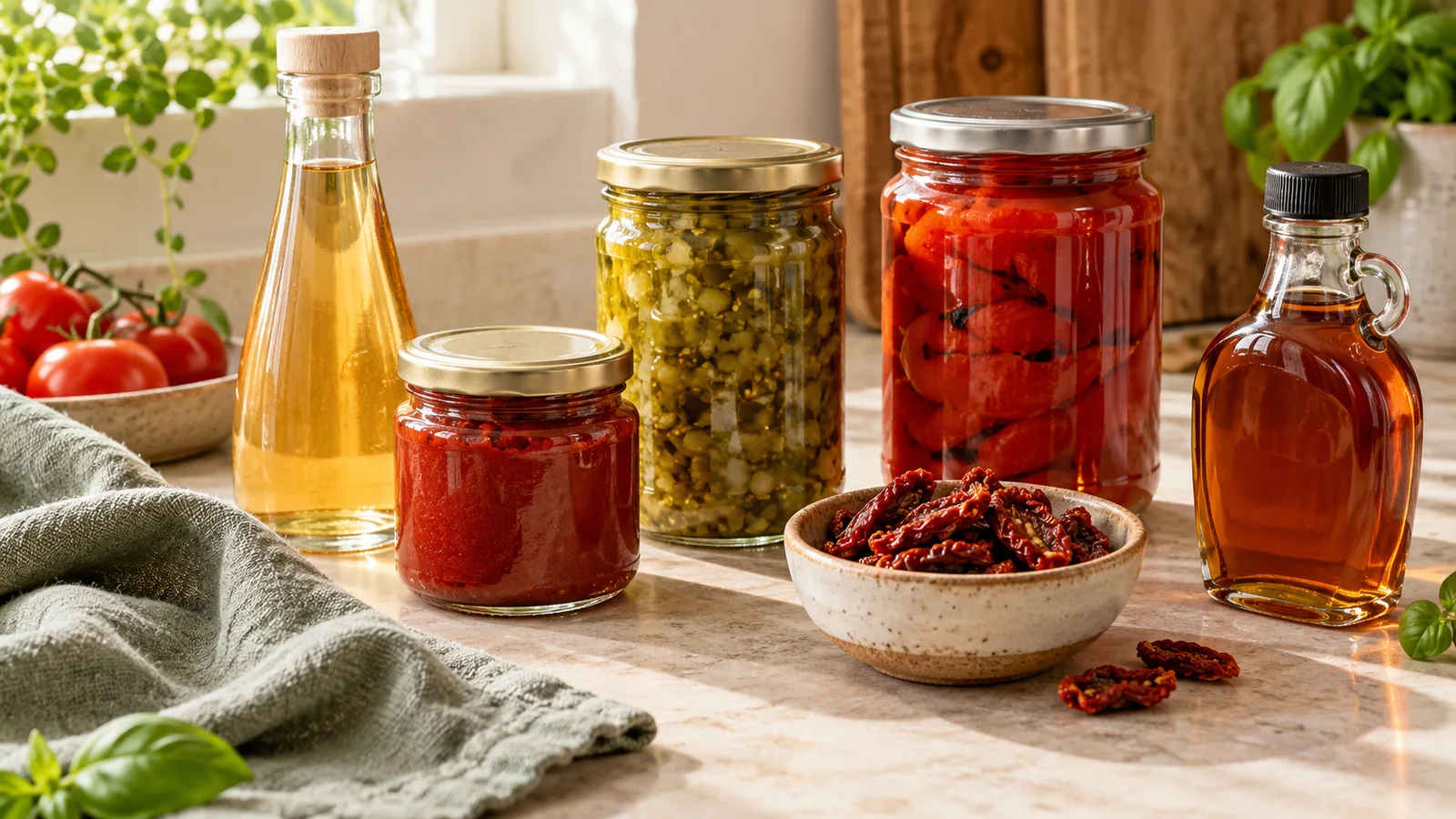
How long does mirin last after opening?
Match the product and market before using a number from this table. Imported bottles may have different formulations or instructions.
| Product or condition | Storage | Manufacturer guidance |
|---|---|---|
| Kikkoman hon-mirin, Japanese guidance | Cool, dark place, away from sunlight; close the cap | About 2 months after opening. The guidance assumes the product is still within its best-before date and is not a guarantee. [1] |
| Kikkoman Kotteri Mirin, US product page | Refrigerate after opening | Within 1 month for best quality. [2] |
| Mizkan Honteri mirin-style seasoning, Japanese guidance | Refrigerate after opening | About 3 months as a guide, not a guaranteed period. [3] |
| Another brand, an Aji-Mirin bottle, or an unreadable label | Check the exact package and manufacturer's advice | Do not borrow another product's number. |
Manufacturer sources: 1, 2, 3. Refrigerated storage should be 4°C (40°F) or below. 7
If the label names a different product, leave this table behind and use that bottle’s instructions.
Hon-mirin, Aji-Mirin and mirin-style seasoning
Kikkoman distinguishes three products in its glossary: alcohol-based hon-mirin; Manjo Aji-Mirin, a sweet cooking rice seasoning containing salt; and Kotteri Mirin, a sweetened cooking seasoning with less than 1% alcohol. Aji-Mirin and Kotteri Mirin are not interchangeable names for the same formulation. 4
Start with the complete product name, then look for the storage line and any opening instructions. A familiar brand name or bottle shape isn't enough. If the imported label is unclear, check the maker's information for that specific market rather than guessing from a different bottle online.
What does the date on an unopened bottle mean?
For an unopened bottle, use the printed date and storage directions. Don't add an online estimate to the day you bought it: you may not know when it was made.
The FDA describes “Best if Used By” as a quality date. Passing it alone doesn't establish that food is unsafe, but neither does the date prove a poorly stored bottle is safe. For questions about a particular dated product, the FDA recommends asking its manufacturer. Follow any stricter safety-use-by instruction on your package. 5
Keep the opening date separately. Opening an old bottle doesn't give it a fresh, full lifespan. Kikkoman explicitly makes its Japanese hon-mirin opened-use guideline conditional on remaining within the printed best-before period. 1
Darker color and white crystals: what do they mean?
Hon-mirin can darken as its sugars and amino acids react, a process called the Maillard reaction. Kikkoman explains that this color change alone does not impair its mirin's quality or cooking effect. Cold storage can also make sugar crystallize. 6
That explanation is specific. It does not establish that every white patch, floating growth or cloudy liquid in every mirin-style product is harmless. If you cannot tell what has changed, don't taste it to investigate. Set the bottle aside and ask the maker, or discard it.
Throw out moldy or otherwise suspicious food. Normal smell and appearance cannot prove food is safe; the FDA distinguishes visible spoilage from illness-causing contamination that may have no obvious signs. 7
A small storage routine that helps
Read the instructions when you first open the bottle, while the label is still easy to find. Write the opening date on a small piece of tape without covering the printed date or product code.
Close the cap properly after pouring. Where the maker allows cupboard storage, choose a cool, dark location away from sunlight, rather than leaving the bottle beside a hot hob. Where the label requires refrigeration, return it promptly to the fridge. 1 7
A smaller bottle may suit occasional cooking better than a large one that takes many months to finish. Keep the label: transferring mirin into an unmarked decorative bottle makes the next storage decision harder.
Questions that come up in the kitchen
I stored an opened bottle in the cupboard. What should I do?
First check whether that particular product required refrigeration after opening. Hon-mirin guidance permitting cool cupboard storage is different from a refrigerator instruction. If you neglected required refrigeration, the FDA says discarding the food is usually best. A normal smell is not a way to clear it for use. 7
Will cooking remove all the alcohol?
Don't assume so. Kikkoman notes that heating reduces mirin's alcohol but does not remove it completely. If you need to avoid alcohol, check the exact product and recipe; “mirin-style” or “less than 1%” does not mean zero. 6 4
Can a dish made with mirin keep as long as the bottle?
No. For cooked chicken, vegetables or other perishable leftovers, use ordinary leftover handling: refrigerate promptly in shallow containers, within 2 hours, or 1 hour above 32°C (90°F). Keep cold and use within 3–4 days of cooking, unless the dish needs a shorter limit. Mirin doesn't give a meal the bottle's storage period. Reheating is not a rescue for food left out too long. 7 8 9
Related storage guides
Sources
- Kikkoman Japan: opened hon-mirin storage and use period (Japanese)
- Kikkoman USA: Kotteri Mirin product and storage FAQs
- Mizkan Japan: storage and use periods after opening (Japanese)
- Kikkoman: mirin product glossary
- FDA: How to Cut Food Waste and Maintain Food Safety
- Kikkoman: Mirin Museum FAQ
- FDA: Are You Storing Food Safely?
- University of Illinois Extension: Leftovers
- University of Nebraska–Lincoln: Leftover Food Safety
General household food-storage information, not a test of an individual bottle. Product examples are specific to the markets named. Follow your package and stricter local guidance.
Sources checked 2026-11-04. Manufacturer advice applies to the named product; follow the instructions on your package. How we research our guides.