Quick answer
Vacuum sealing does not make refrigerated food last longer safely. Sealed raw poultry and ground meat still keep 1–2 days, raw steaks 3–5 days and cooked leftovers 3–4 days in the fridge. The real benefit is in the freezer at 0°F (−18°C), where sealing helps prevent freezer burn. Utah State University Extension; FoodSafety.gov.
Countertop sealers are often marketed as making food last much longer. For refrigerated food, none of the US food-safety agencies or university extension services we checked gives longer refrigerator times for home vacuum-sealed food. Use the same limits as you would for any wrapped food.
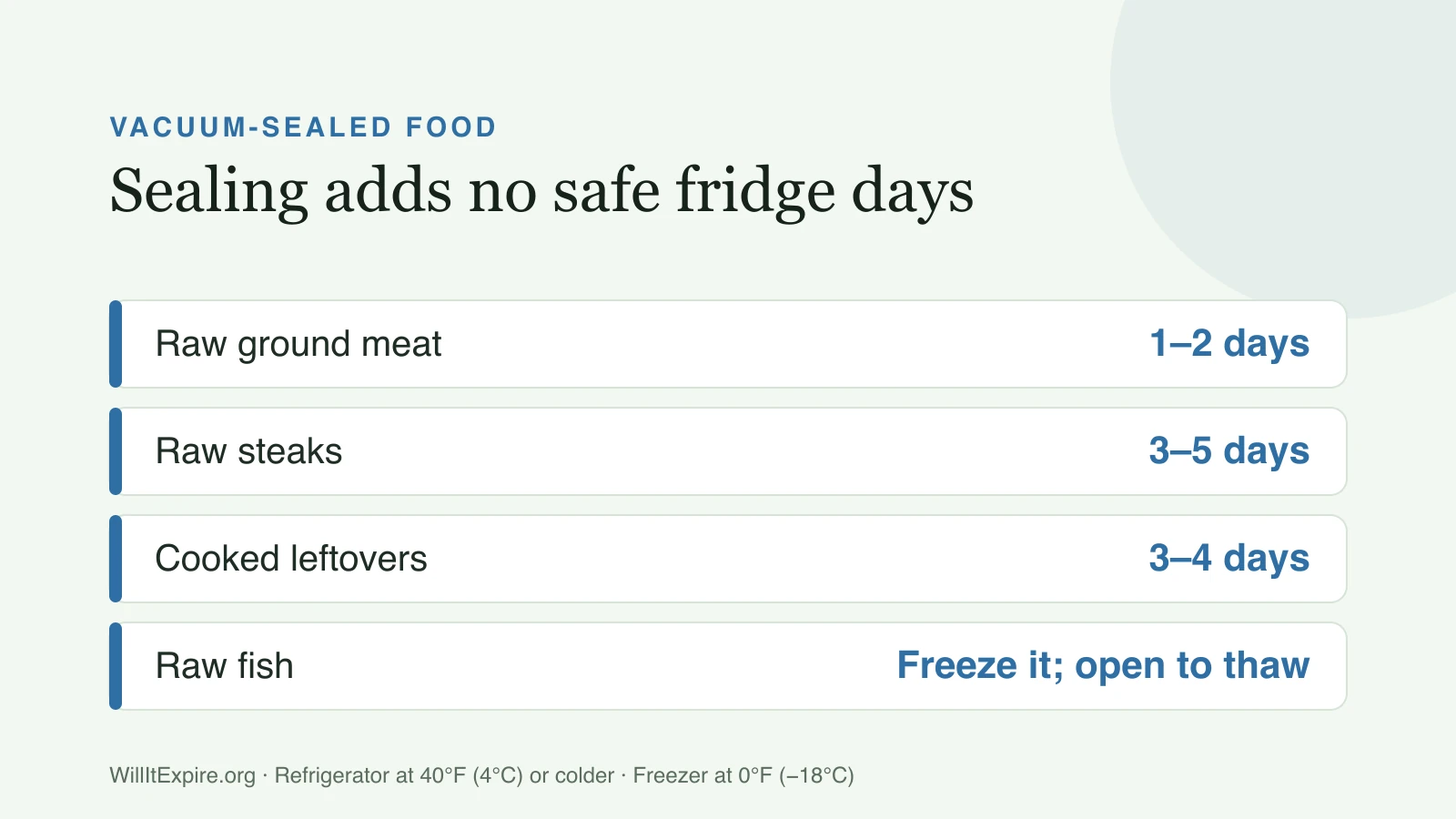
Fridge and freezer times for vacuum-sealed food
| Food | Fridge at 40°F (4°C), sealed or not | Freezer at 0°F (−18°C), for quality |
|---|---|---|
| Raw ground meat or ground poultry | 1–2 days | 3–4 months |
| Raw whole chicken or turkey | 1–2 days | 1 year |
| Raw steaks | 3–5 days | 4–12 months |
| Raw fatty fish such as salmon | Within 2 days (FDA); keep it frozen if it is vacuum-sealed | 2–3 months |
| Cooked meat or poultry leftovers | 3–4 days | 2–6 months |
Sources: FoodSafety.gov cold food storage chart, FDA seafood guidance and USDA FSIS freezing guidance. FoodSafety.gov notes that food kept continuously at 0°F or below can be kept indefinitely; freezer times are for best quality.
Why removing the air doesn't add safe fridge days
Utah State University Extension is direct about it: vacuum packaging "is NOT a food preservation method by itself." If a food needed refrigeration or freezing before you sealed it, it still does. Removing oxygen slows changes such as rancidity, but it can also make it easier for botulism bacteria to grow. Utah State University Extension.
University of Maine Extension adds that sealing does not kill germs that are already in the food, and that bacteria able to grow without oxygen, such as those that cause botulism, can still be present in a sealed pack. University of Maine Extension. Michigan State University Extension says the same thing in plainer terms: refrigerated foods still require refrigeration, or freezing. Michigan State University Extension.
The cold does not settle the question either. FDA guidance for the seafood industry says some types of Clostridium botulinum can grow at 38°F (3.3°C), and surveys of home refrigerators show temperatures can exceed 50°F (10°C). FDA Fish and Fishery Products Hazards and Controls Guidance, Chapter 13. A sealed bag that looks fine may not be safe, so go by the day counts above, not by appearance.
Fish needs extra care
Fish is where vacuum sealing in the fridge matters most. Michigan State University Extension notes that some cold-tolerant strains of botulism bacteria are found in fish, so a sealed package of fish can allow toxin to form even while it is kept cold. Michigan State University Extension. For vacuum-packed raw fish relying on refrigeration alone, FDA's seafood guidance tells processors to hold it below 38°F (3.3°C) all the way from packing to eating, which a home refrigerator cannot promise. FDA, Chapter 13.
Our practical rule follows from that: seal fish for the freezer, not the fridge. When you thaw it:
- Take the fish out of the vacuum bag, or cut a hole in the bag, before you put it in the refrigerator to thaw. NC State Extension; University of Maine Extension.
- Exposing the fish to oxygen prevents the toxin from forming, according to Michigan State University Extension. MSU Extension.
- Cook it within 2 days of thawing, the limit FDA gives for refrigerated fresh fish. FDA
Where vacuum sealing does help: the freezer
USDA says food stored constantly at 0°F will always be safe, and that freezer storage times are about quality. Proper packaging helps maintain that quality and prevents freezer burn, the dry, grayish-brown patches caused by air touching the food. Freezer burn affects quality, not safety. USDA also says to freeze unopened vacuum packages just as they are. USDA FSIS.
So a well-sealed bag should help food stay closer to the best-quality end of the freezer times in the table. We did not find an official chart that gives longer freezer times specifically for home vacuum-sealed food, so we use the standard quality times above rather than the multi-year figures in sealer marketing. Freezing also does not kill bacteria. Once food is thawed, handle it as you would any perishable food. USDA FSIS; see also is freezer-burned food safe to eat?.
How to vacuum-seal leftovers safely
- Cool first. Refrigerate leftovers within 2 hours, divided into shallow containers so they chill quickly. USDA FSIS
- Seal when cold, then label. Write the date on the bag so you know which fridge or freezer limit applies.
- Freeze anything you won't eat within 3–4 days. USDA says to freeze leftovers within 3–4 days. USDA FSIS
- Thaw safely. Use the refrigerator, cold water or the microwave, never the counter. USDA FSIS; see how to defrost meat safely.
- Skip the sealer for fresh mushrooms. Mushrooms keep breathing after harvest and use up the oxygen in a sealed package. See how to store mushrooms.
- Treat garlic or herbs in oil as a 4-day food. CDC says to refrigerate homemade oils made with garlic or herbs and throw them away after 4 days, sealed or not. CDC
FAQs
How long does vacuum-sealed meat last in the fridge?
The same as unsealed meat: 1–2 days for raw ground meat and poultry, 3–5 days for raw steaks, and 3–4 days for cooked leftovers. Freeze it if you need longer.
Can you thaw vacuum-sealed fish in the package?
No. Take the fish out of the bag, or cut the bag open, before thawing it, and thaw it in the refrigerator so the fish is exposed to air.
Does vacuum-sealed food last longer in the freezer?
It usually keeps better quality, because sealing helps prevent freezer burn. Food held at 0°F stays safe either way; the freezer times are a quality guide.
Sources
- Utah State University Extension: Packaging Foods
- University of Maine Extension: Vacuum Sealing Safely at Home (2024)
- Michigan State University Extension: Vacuum-sealed food safety concerns (2022)
- NC State Extension: Thawing Vacuum Packed Fish
- FDA: Fish and Fishery Products Hazards and Controls Guidance, Chapter 13
- FDA: Selecting and Serving Fresh and Frozen Seafood Safely
- FoodSafety.gov: Cold Food Storage Chart
- USDA FSIS: Freezing and Food Safety
- USDA FSIS: Leftovers and Food Safety
- CDC: Botulism Prevention
This article uses US, UK and Canadian food-safety and university extension guidance. Follow stricter local advice and product instructions. Sources checked November 23, 2026. How we research our guides.