Quick answer
Freshly pumped breast milk lasts up to 4 hours at room temperature (77°F or colder), up to 4 days in the refrigerator, and about 6 months in the freezer, with up to 12 months acceptable. Thawed milk keeps 24 hours in the fridge, and only 2 hours once warmed or at room temperature. CDC.
The clock gets shorter every time the milk changes state, which is where most mistakes happen. Thawing, warming and a partly finished bottle each have their own limit. Our reading: these are CDC home-use times. For a premature or hospitalized baby, follow your care team's instructions.
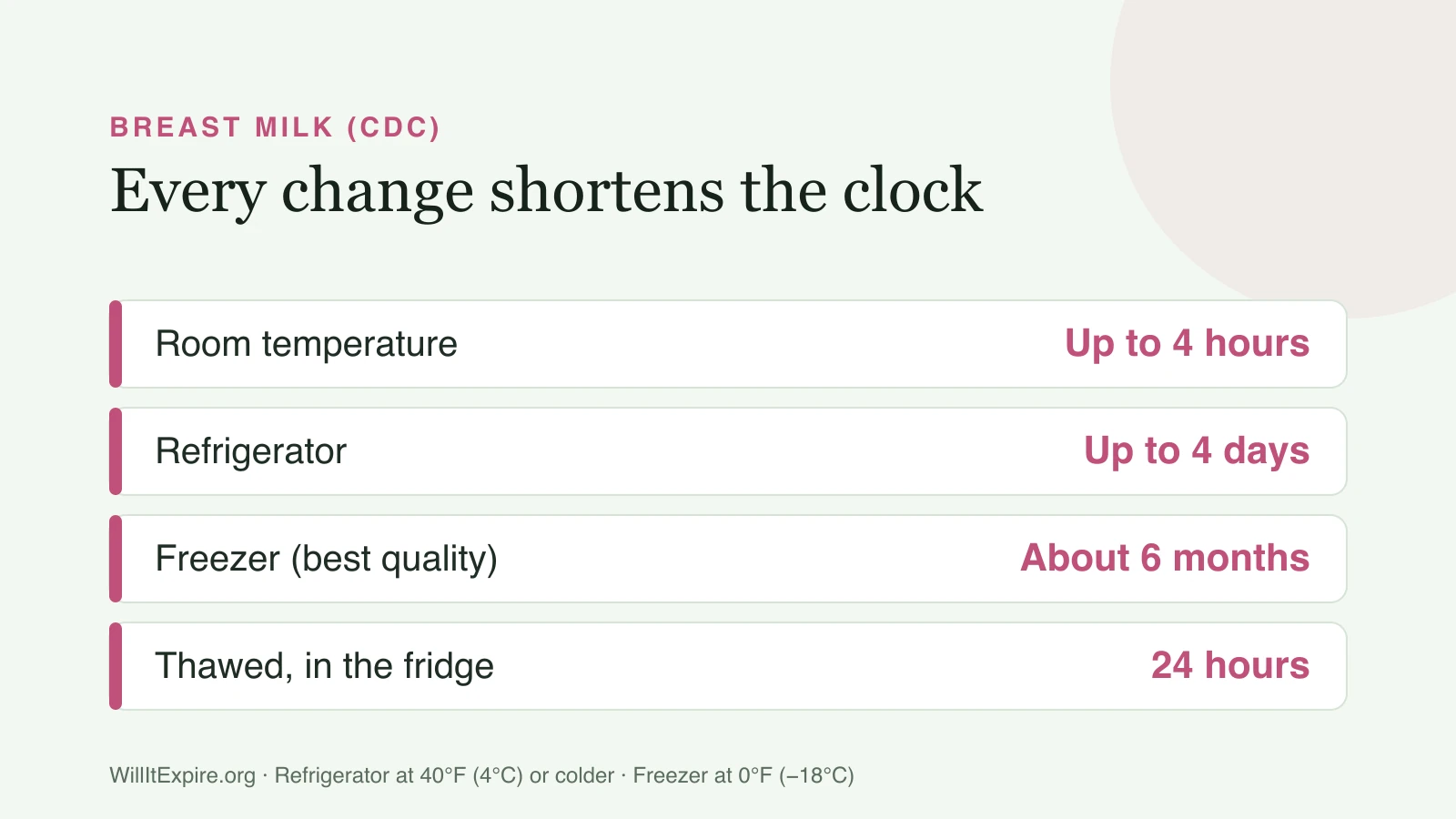
Breast milk storage times at a glance
| Situation | Time limit | Notes |
|---|---|---|
| Freshly pumped, room temperature (77°F / 25°C or colder) | Up to 4 hours | CDC advises refrigerating it if it will not be used within a few hours, especially in a warm room |
| Freshly pumped, in the refrigerator (40°F / 4°C or colder) | Up to 4 days | Freeze it right away if you will not use it within 4 days |
| Freshly pumped, in the freezer (0°F / −18°C or colder) | About 6 months is best; up to 12 months is acceptable | Count from the day it was first frozen |
| In an insulated cooler with frozen ice packs | Up to 24 hours | Use it, refrigerate it or freeze it when you arrive |
| Thawed in the refrigerator | Use within 24 hours | Count from when it is completely thawed |
| Thawed, brought to room temperature or warmed | Use within 2 hours (CDC's child care guide says 1–2 hours) | Do not refreeze thawed milk (see the power-outage exception below) |
| Left in the bottle after a feed | Use within 2 hours | After 2 hours, throw it away |
Sources: CDC: Breast Milk Storage and Preparation and CDC: Breast Milk Storage Questions and Answers.
Why UK advice says 8 days in the fridge
If you have seen "up to 8 days" for refrigerated milk, that is the NHS figure. The NHS says breast milk can be kept at the back of the fridge, not the door, for up to 8 days at 4°C or colder. The NHS also gives 2 weeks in the ice compartment of a fridge and 6 months in a freezer at −18°C or colder. NHS.
CDC says 4 days in the refrigerator, and that milk's natural protection against bacteria begins to decline after a few days of refrigeration. CDC. Our application: if you are in the US, use CDC's 4 days. If you are in the UK, the NHS figure applies only at 4°C or colder, so check your fridge with a thermometer. If you cannot confirm the temperature, our reading is to use the shorter CDC figure. The NHS also says thawed milk must be used immediately and leftovers thrown away after feeding, which is stricter than CDC's 24 hours in the fridge, so UK readers should follow the NHS on thawed milk.
How to store pumped milk
- Use breast milk storage bags or clean, food-grade glass or plastic containers with tight lids. CDC says never to use disposable bottle liners or plastic bags that are not made for storing breast milk. CDC
- Label each container with the date it was expressed.
- Do not store milk in the door of the fridge or freezer. Further inside, it is protected from temperature changes when the door opens and closes (CDC).
- If you will not use milk within 4 days, freeze it right away.
- Freeze small amounts, 2 to 4 ounces or one feeding's worth, and leave about one inch of space at the top because milk expands as it freezes.
Mixing milk from different pumping sessions
CDC says mixing freshly expressed milk with already cooled or frozen milk is not advised because it can rewarm the older milk. Cool the fresh milk first, then combine. When you combine milk pumped on different days, base the storage time on when the older milk was first stored. CDC
Thawing and warming breast milk safely
- Thaw the oldest milk first.
- CDC says you can thaw milk in the refrigerator overnight, in warm or lukewarm water, or under lukewarm running water. Never thaw or heat breast milk in a microwave. CDC
- Count the 24 hours in the fridge from when the milk is completely thawed, not from when you took it out of the freezer.
- Milk does not need to be warmed. If you do warm it, keep the container sealed and stand it in warm water, then test a few drops on your wrist. Do not heat it directly on the stove or in the microwave.
- Swirl to mix the fat, which may have separated.
- Never refreeze breast milk after it has thawed (the only CDC exception is a power outage, below).
What if the power goes out?
CDC says a full, unopened freezer keeps food safe for about 48 hours, and a half-full one for about 24 hours. An unopened refrigerator stays cold for about 4 hours. After the power returns, frozen milk that has started to thaw but still contains ice crystals can be refrozen. Milk that has completely thawed but still feels cold should go into the refrigerator and be used within the next day, or thrown away. CDC
Pump hygiene and babies at higher risk
Clean pump parts that touch the breast or milk as soon as possible after pumping. CDC says to sanitize them at least once a day for extra protection, and that this matters most if your baby is less than 2 months old, was born prematurely, or has a weakened immune system. CDC: Breast Pump Hygiene. Wash your hands before pumping or handling milk.
Child care and travel
If you give milk to a child care provider, label the container with the baby's name and the date it was expressed. CDC's guidance for child care programs says leftover milk not used within 2 hours is discarded, and unused frozen milk is returned to the family within 6 months from the date it was expressed. CDC: Child care programs. For travel, milk can stay in an insulated cooler with frozen ice packs for up to 24 hours.
What we could not verify
We did not find a primary-source number for how long milk is safe after it smells or looks different, so we give none. CDC says the fat may separate and to swirl the milk to mix it. Our reading: if you are unsure whether milk is safe, do not feed it. For questions about your baby's feeding, ask your pediatrician or a lactation consultant. See also our guide to opened baby food.
FAQs
How long can pumped breast milk sit out?
Freshly pumped milk can sit at room temperature (77°F or colder) for up to 4 hours, according to CDC. If the room is warm, refrigerate it sooner. Milk that has been thawed or warmed must be used within 2 hours.
Can you refreeze breast milk?
No. CDC says never to refreeze breast milk after it has thawed. The one exception is a power outage: milk that has started to thaw but still contains ice crystals can be refrozen.
How long does thawed breast milk last in the fridge?
Use thawed breast milk within 24 hours, counting from when it is completely thawed, not from when it left the freezer. Once it reaches room temperature or is warmed, use it within 2 hours.
Sources
This article uses US, UK and Canadian food-safety and university extension guidance. Follow stricter local advice and product instructions. Sources checked November 23, 2026. How we research our guides.