Quick answer
Keep commercial frozen dumplings at 0°F (−18°C) or below, using their package date for best quality. Properly handled food kept continuously frozen can remain safe indefinitely, although quality declines. There is no universal freezer expiry for every filling and wrapper.
This guide covers packaged frozen dumplings, mandu and potstickers before preparation at home. A factory-cooked frozen dumpling and last night’s cooked leftovers have different storage needs.
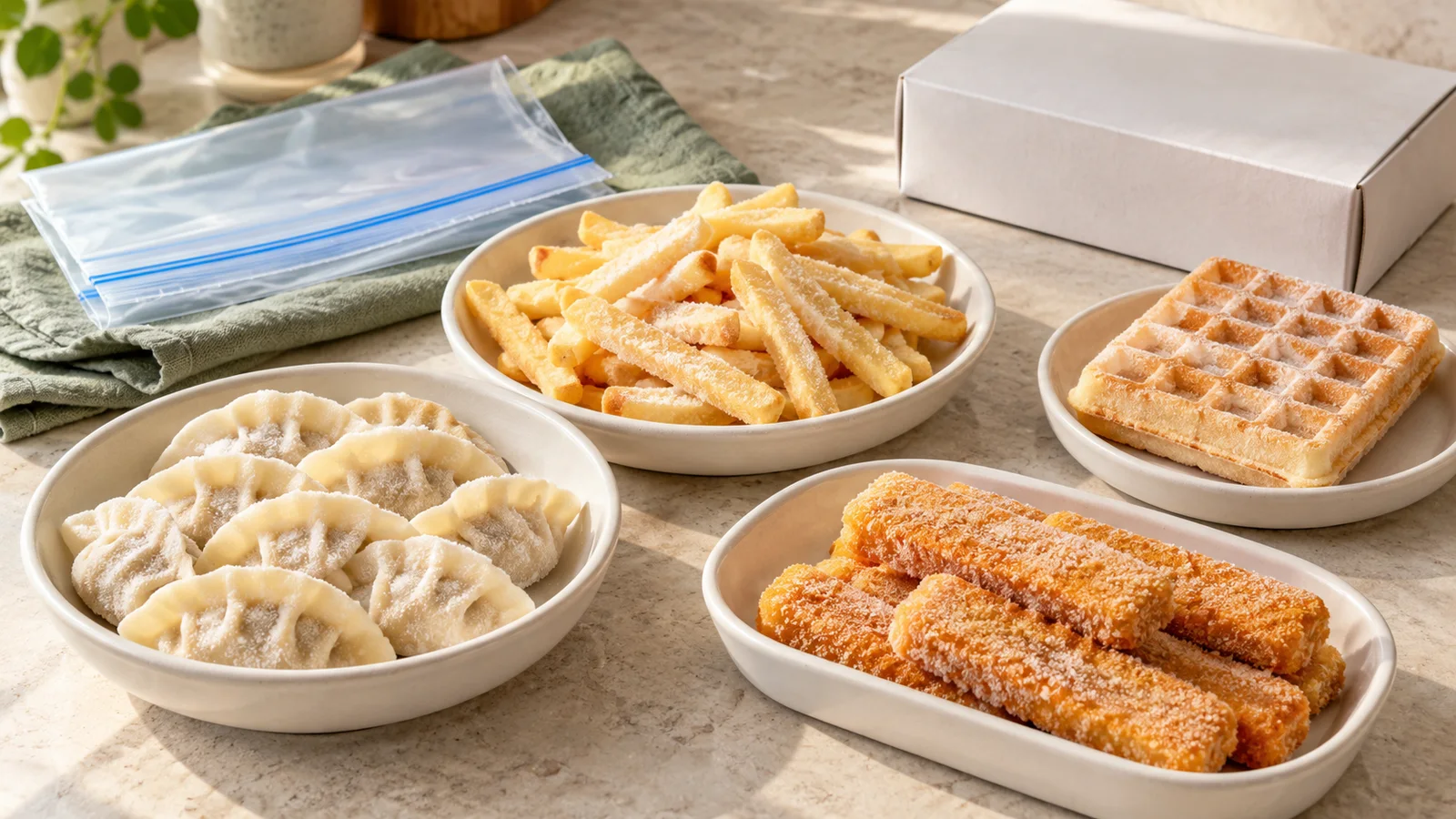
Match the advice to the state
| What you have | What to do |
|---|---|
| Unopened, continuously frozen package | Follow its quality date and keep-frozen directions. |
| Opened bag, remaining pieces still frozen | Reseal and return promptly to the freezer. |
| Fully thawed uncooked dumplings | Follow the maker’s advice; no universal refrigerated allowance is established here. |
| Dumplings cooked at home | Apply leftover guidance and any stricter product restrictions. |
Opening the bag is not a reason to move the unprepared remainder into the refrigerator. Keep it in the storage conditions specified on the label; a cooked-leftover allowance does not apply to an uncooked filling.
Raw or cooked? Read the label
A browned wrapper does not answer that question. Joyce Chen’s Home-style Chicken and Vegetable and Pork and Vegetable Potstickers are sold frozen raw; the maker says to cook them and not microwave them.
Tai Pei’s 10.5-ounce Vegetable Potstickers with Sauce are described as fully cooked, yet their instructions still require heating to 165°F and keeping frozen until use. Those are named-product examples, not one method for every dumpling.
Follow the actual appliance, portion, water, covering and standing directions, including any internal-temperature target. Check the filling with a food thermometer rather than judging only the wrapper.
Do you need to thaw them?
If the package says to cook from frozen, keep them frozen. Bibigo’s 6.6-ounce Chicken & Vegetable Steamed Dumplings say not to thaw, exclude frying, baking and other direct-heat methods, and do not recommend reheating. Those restrictions belong to that product, not every Bibigo dumpling.
If a product permits thawing, use an approved safe method rather than the counter. Do not borrow a cooked-leftover refrigerator period for an uncooked thawed bag. Ask the maker when its directions do not cover what happened.
After a freezer failure
FoodSafety.gov generally permits refreezing food with ice crystals or at 40°F (4°C) or below, with possible quality loss. Its frozen convenience-food category says discard after exposure to 40°F or above for more than two hours. Follow stricter product directions.
This is emergency guidance, not permission for indefinite refrigerated storage. A cold measurement after the freezer restarts does not establish earlier handling. Discard perishable dumplings left out more than two hours, or one hour above 90°F (32°C), and food whose safe history cannot be established.
FAQs
Does freezer burn make dumplings dangerous?
Freezer burn alone reduces quality. It does not rule out separate thawing concerns. Discard moldy or suspicious-smelling food; normal smell cannot prove safety.
Can extra cooking rescue dumplings left warm too long?
No. Some toxins can survive cooking. Discard mishandled food rather than trying to rescue it.
What should I keep when transferring the bag?
Save the product name, date, lot information and complete preparation panel. Use freezer-suitable airtight packaging and return the food promptly.
Sources
Sources and draft evidence reviewed October 31, 2026. Manufacturer advice applies to the named product; follow stricter local guidance and your package. How we research our guides.