The bottle you opened for one caprese salad is still mostly full. Should it go beside the vinegar or in the fridge? With balsamic glaze, the answer starts with the particular bottle. Manufacturers give different storage instructions, and a long unopened shelf life does not tell you how long an opened glaze will keep.
Quick answer
Yes, balsamic glaze can spoil, and storage instructions vary. Follow your bottle's label rather than a rule for plain vinegar. Some glazes belong in a cupboard; others need refrigeration. Earthy Delights, for example, gives a six-month after-opening quality target under refrigeration. That is not a universal deadline. Keep refrigerated products at 4°C (40°F) or below, and discard moldy or suspicious glaze. [1][3][11]
This guide covers commercially bottled balsamic glaze. Plain balsamic vinegar, homemade reductions and dressings mixed in your kitchen need their own guidance.
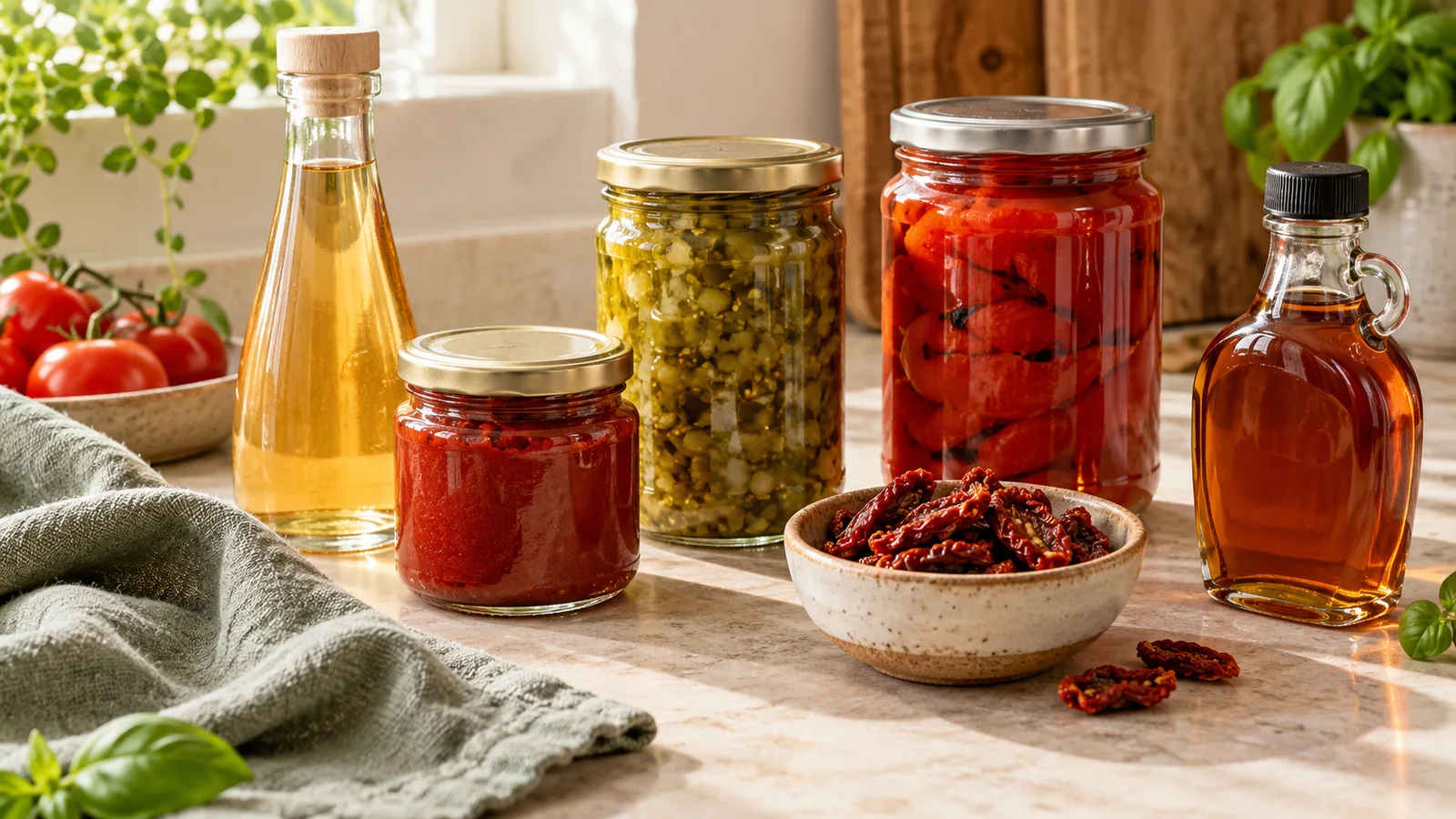
Does balsamic glaze need refrigeration?
Check the storage panel, not just the word “balsamic” on the front. Here are three examples of why brand-specific advice matters:
| Product checked | Published storage advice | What the published time means |
|---|---|---|
| Mussini balsamic glazes | After opening, keep tightly closed in a cool, dry cupboard away from sunlight. | Its stated three-year period is a best-before period, not a new three-year clock after opening. |
| Knorr Professional Italian Glaze with Balsamic, 500 g, Australia/New Zealand | Store unopened in a cool, dry place; refrigerate after opening. | Its specification gives 24 months for unopened ambient storage. The opened-duration field has no number. |
| Earthy Delights Balsamic Glaze, 355 ml, produced by Food for Thought, US | Refrigerate after opening. | The maker recommends using it within six months of opening for best quality. |
These are examples, not instructions for every glaze sold under those brand names or in every country. Use the directions on your actual package if they differ. Manufacturer information can change. [1][2][4][11]
Glazes also differ in how they are made. Nonna Pia's describes a reduced-vinegar product without added thickeners; Bertolli lists modified starch and xanthan gum among its glaze ingredients. You cannot work out the correct storage period simply by checking whether vinegar appears first in the ingredients. [5][6]
How to read the date on an unopened bottle
Look for both the date and the words beside it. A best-before date concerns quality. It does not mean the glaze suddenly becomes unsafe the next day, but it also does not guarantee that a damaged or badly stored bottle is safe. In Australia and New Zealand, a use-by date is safety-based: do not eat the food after that date. Date-label meanings differ by jurisdiction, so follow your label and local guidance. [7]
Use the printed date rather than adding a manufacturer's total shelf life to the day you bought the bottle. It may already have spent time in distribution or on a shop shelf. Likewise, a bottle with plenty of time before its best-before date may still have separate instructions for after opening.
If the only marking looks like a batch code, ask the manufacturer to decode it. Provide the exact product name, size and code. Do not borrow the date from another bottle that looks similar. If a seal was already broken when you bought it, or the container is leaking or damaged, do not use the glaze. [8]
Keeping an opened bottle in good condition
Write the opening date on the bottle. If the label specifies an opened-use period, calculate it from that date and follow it alongside the printed date and storage instructions.
For a glaze that permits cupboard storage, choose somewhere away from the hob and direct sun. A windowsill or a cupboard warmed by an oven is a poor match for “cool” storage. Keep the cap firmly closed. For a product requiring refrigeration, return it to the fridge after serving rather than leaving it on the table for the evening. [1][3]
Keep food out of the bottle. Squeeze a little into a clean dish if you need to brush it onto food. Do not dip a brush that has touched raw meat back into the original glaze, and do not pour used sauce back into it. These are practical ways to avoid cross-contamination, not ways to extend an expired storage allowance. [8]
If the label gives no opened-use time, the honest answer is that the sources here do not establish one for your bottle. Ask its maker instead of assuming six months, a year or indefinite storage.
When should you throw it away?
Discard glaze with visible mold or unexplained growth, an abnormal odor, or unusual foaming or spurting when opened. Do not skim mold from the top and keep the rest. FDA advises discarding moldy food and warns that food can be unsafe even when it looks and smells normal. A taste test cannot establish safety. [3][8]
Glaze is meant to be thick. Thickness alone is not evidence that it has spoiled, and it is not proof that an old bottle is safe. If a change is unfamiliar, check with the maker rather than identifying it as harmless vinegar sediment from a photograph. Advice about the “mother” in plain vinegar should not be used to explain unexpected growth in a different product. [5][6]
Common questions
I forgot to refrigerate it. Can I still use it?
First check whether your particular glaze requires refrigeration. Some do not. If yours does and it has been left out contrary to those instructions, do not use another brand's cupboard advice to clear it. FDA says that food neglected outside its required refrigeration is usually best discarded. Refrigerating it now does not establish that earlier storage was acceptable. [1][2][3]
Does glaze keep a salad or cooked meal fresh for longer?
Follow storage guidance for the finished dish and its perishable ingredients; adding glaze gives no established extension. Under US household guidance, refrigerate cooked leftovers promptly in shallow containers, within two hours, or one hour above 32°C (90°F). Keep them at 4°C (40°F) or below and use within 3–4 days. Those are leftover-meal rules, not an opened-bottle lifespan. Follow any shorter applicable guidance. [9][10]
Can I use these times for a homemade reduction?
No. Bottled-product guidance does not validate your recipe or its storage life. Adding fruit, water or other ingredients also changes what you are storing. Use tested guidance for the actual preparation rather than copying a commercial bottle's date.
Should I freeze the bottle to make it last?
The manufacturer sources checked here do not establish a freezing method or quality period for every glaze. Follow your maker's advice; do not assume its squeeze bottle is freezer-safe. Buying a smaller bottle is a simpler option if you rarely use it.
Before putting the bottle away, check its storage instruction once and mark when you opened it. That saves having to guess the next time dinner needs a drizzle.
General food-storage information, not a guarantee that a particular bottle is safe. Follow current product instructions and stricter local guidance.
Sources
- Mussini: Balsamic Glaze, including storage and best-before FAQ.
- Unilever Food Solutions Australia: Knorr Italian Glaze with Balsamic, 500 g.
- FDA: Are You Storing Food Safely?.
- Unilever: Knorr 500 g product specification, revision 4.
- Nonna Pia's: Product FAQs.
- Bertolli: Balsamic Glaze ingredients.
- Food Standards Australia New Zealand: Use-by and best-before dates.
- FDA: Food Tampering, An Extra Ounce of Caution, packaging and hygiene sections.
- University of Illinois Extension: Leftovers.
- FoodSafety.gov: Four Steps to Food Safety.
- Food for Thought: Earthy Delights Balsamic Glaze, 355 ml.
Sources checked 2026-11-04. Manufacturer advice applies to the named product; follow the instructions on your package. How we research our guides.