Quick answer
Raw salmon lasts 1–2 days in the refrigerator at 40°F (4°C) or colder, or 2–3 months in the freezer for best quality, according to USDA FoodKeeper. FDA says to refrigerate seafood you will use within 2 days of purchase and otherwise freeze it. Cook salmon to 145°F. FoodKeeper; FDA.
Salmon is a fatty fish, which is why FoodKeeper groups it with bluefish, mackerel and tuna and gives it a short window.
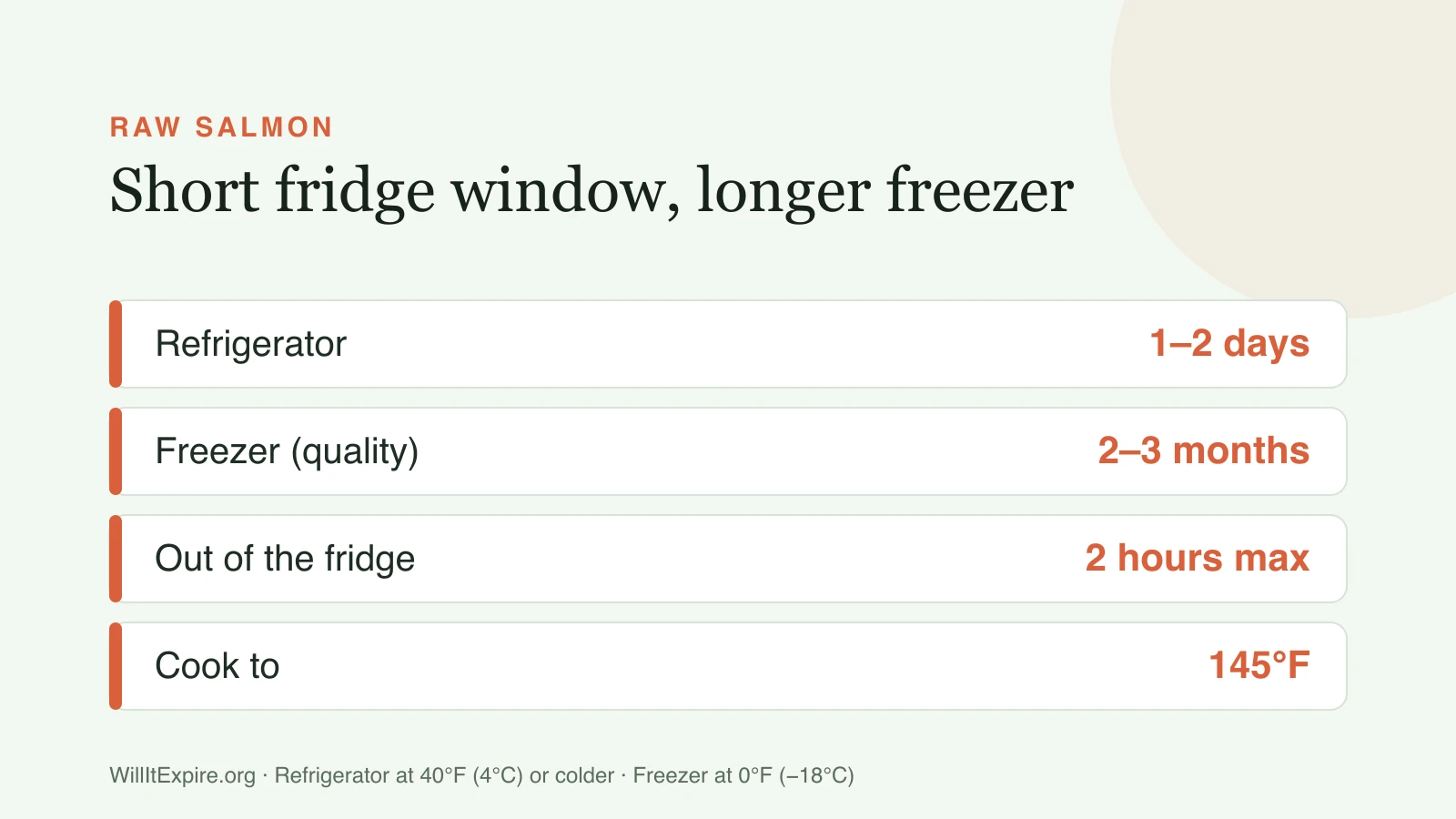
Raw salmon storage times
| Situation | Time | Source |
|---|---|---|
| Fresh raw salmon, refrigerator, 40°F (4°C) or below | 1–2 days | FoodKeeper (fatty fish) |
| Raw seafood you will use within 2 days of purchase | Clean refrigerator, 40°F or below | FDA |
| Raw salmon, freezer | 2–3 months (quality) | FoodKeeper (fatty fish) |
| Out of the refrigerator | No more than 2 hours (1 hour above 90°F) | FDA |
Sources: USDA FoodKeeper (data checked 2026-11-23) and FDA.
Why you'll see 1–3 days
FoodSafety.gov's Cold Food Storage Chart, last reviewed September 19, 2023, lists fatty fish such as salmon at 1–3 days in the fridge and 2–3 months in the freezer. FoodSafety.gov chart. Current FoodKeeper data says 1–2 days, and FDA says to use seafood within 2 days of purchase. Our application: use 1–2 days.
How to store raw salmon
- Put seafood on ice or in the refrigerator or freezer soon after buying it. FDA
- If you will use it within 2 days, keep it in a clean refrigerator at 40°F or below and check with a thermometer. Otherwise wrap it tightly in plastic, foil or moisture-proof paper and freeze it. FDA
- Never leave seafood out for more than 2 hours, or 1 hour when it is above 90°F. FDA
- Cook fish to a minimum internal temperature of 145°F (62.8°C). FSIS
For how long cooked salmon lasts, see cooked salmon. For smoked salmon, see how long smoked salmon lasts.
Eating salmon raw: sushi, sashimi and ceviche
FDA says some species of fish can contain parasites and freezing will kill any that are present. If you choose to eat raw fish anyway, its rule of thumb is to eat fish that has been previously frozen. FDA also warns that freezing does not kill all harmful germs, which is why the safest route is to cook seafood. FDA
For restaurants and retailers, the FDA Food Code requires raw or marinated fish served ready-to-eat to be frozen and stored at −20°C (−4°F) or below for at least 168 hours (7 days), or frozen by other listed methods. FDA Food Code 2017 edition; later editions may differ. That is a business rule, not a home instruction. We did not find a consumer figure for freezing salmon at home to make it safe to eat raw, so we do not give one. Our reading: do not treat a fillet you froze at home as safe for raw dishes.
Who should not eat raw salmon
FDA says pregnant women, children, older adults and people with weakened immune systems should avoid raw or undercooked fish or shellfish, or food containing it, such as the sashimi found in some sushi or ceviche. They should also avoid refrigerated smoked seafood unless it is in a cooked recipe. FDA.
FAQs
How long can raw salmon stay in the fridge?
1–2 days at 40°F (4°C) or colder, according to USDA FoodKeeper. FDA says to use seafood within 2 days of purchase or freeze it.
Can you freeze raw salmon?
Yes. FoodKeeper lists 2–3 months in the freezer for fatty fish such as salmon, for best quality. Wrap it tightly in plastic, foil or moisture-proof paper.
Can raw salmon sit out?
No more than 2 hours, or 1 hour when it is above 90°F, according to FDA. After that, throw it away.
Sources
This article uses US, UK and Canadian food-safety and university extension guidance. Follow stricter local advice and product instructions. Sources checked November 23, 2026. How we research our guides.