Quick answer
Leftover baked potatoes keep 3 to 4 days in the refrigerator. Refrigerate them within 2 hours of baking (1 hour above 90°F), and remove any foil first, because foil-wrapped potatoes left at room temperature have caused botulism outbreaks. Reheat to 165°F before eating. FSIS; UC Master Food Preservers.
The risky part is not the fridge. It is the hours after baking, when a foil-wrapped potato stays warm on the counter or in a warm oven.
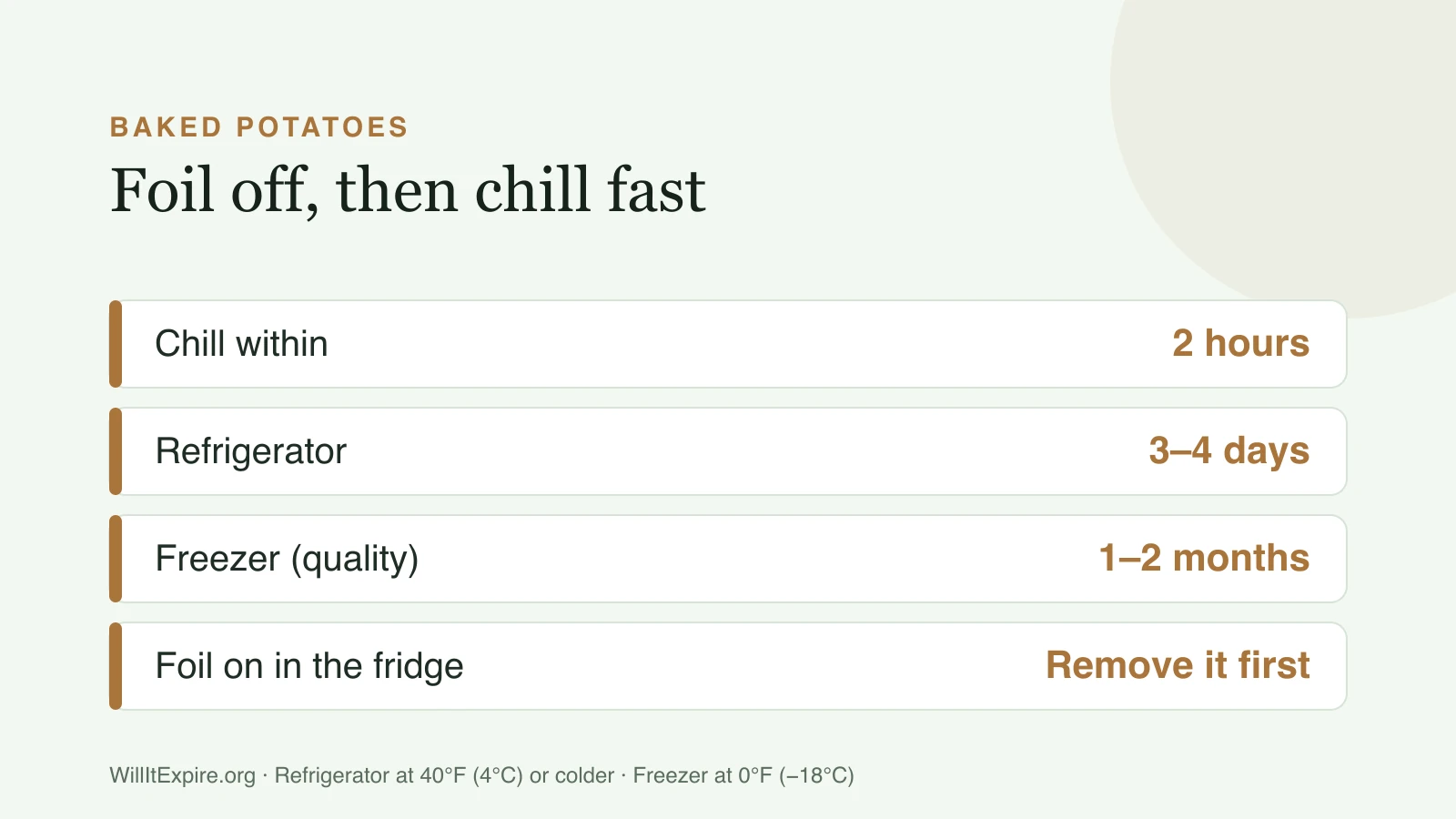
Baked potato storage times
| Situation | What to do | Time |
|---|---|---|
| Just baked, foil on, left on the counter | Unwrap and refrigerate within 2 hours | Over 2 hours: throw it away (FSIS) |
| Cooked potatoes in the refrigerator | Foil off | 3–4 days (FSIS, FoodKeeper) |
| Cooked potatoes in the freezer, 0°F (−18°C) | Cool, then wrap airtight | FoodKeeper: 1–2 months for cooked potatoes without meat, fish, poultry or egg |
| Kept hot until serving | Hold at 60°C (140°F) or hotter | Not below 60°C (BCCDC) |
Sources: FSIS, USDA FoodKeeper, BCCDC.
Why foil makes baked potatoes risky
The UC Master Food Preservers explain that foil keeps potatoes hot longer once they leave the oven, and that this is one of the things that makes foil-baking a concern. The main worry is Clostridium botulinum, which can cause botulism. They say botulism outbreaks from potatoes baked in foil are rare but have happened. UC Master Food Preservers
A published outbreak report describes a large botulism outbreak in which toxin formed after foil-wrapped baked potatoes were held at room temperature, apparently for several days, before being used in dips. PubMed: Angulo et al., 1998
How to bake, hold and store them safely
- Wrap potatoes loosely if you use foil, and remove the foil as soon as they come out of the oven or off the grill. UC Master Food Preservers
- If they will not be served right away, refrigerate them without the foil. If the potato is still warm, the foil keeps it in the temperature range where bacteria can grow. UC Master Food Preservers
- CDC says for potatoes baked in foil, keep them at 140°F or hotter until served, or refrigerate them at 40°F or colder with the foil loosened so they get air. CDC. Our application is the stricter UC advice to remove the foil completely before refrigerating.
- BCCDC says never to leave foil-wrapped baked potatoes at room temperature or in a warming oven set below 60°C (140°F). Eat them within 2 hours of cooking, keep them at 60°C or hotter, or refrigerate them within 2 hours. BCCDC
- FSIS says to discard perishable leftovers left out more than 2 hours, or 1 hour when it is above 90°F. FSIS
Why you'll see different freezer times
FSIS says leftovers can be frozen for 3 to 4 months. USDA's FoodKeeper is more specific for cooked potatoes: its leftovers entry for foods without meat, fish, poultry or egg, such as cooked potatoes, gives 1–2 months in the freezer. FSIS; FoodKeeper. FoodKeeper also has a separate "Potatoes" entry that gives 10–12 months in the freezer and notes the timeline applies to cooked and mashed potatoes. Our application: use the shorter 1–2 months for baked potatoes, because that is the entry written for cooked leftovers. This is a quality guide, not a safety cutoff. For other potato dishes see mashed potatoes.
Reheating
FSIS says to reheat leftovers to 165°F measured with a food thermometer. FSIS. We did not find a primary-source figure for how many times a baked potato can be reheated, so we give none.
FAQs
Can you leave baked potatoes out overnight?
No. FSIS says to throw away perishable food left at room temperature for more than 2 hours (1 hour above 90°F). Foil-wrapped baked potatoes left at room temperature have also been linked to botulism, so do not keep them for later.
Can you put baked potatoes in the fridge with the foil on?
No. Take the foil off first. UC Master Food Preservers say a still-warm potato in foil stays in the temperature range where bacteria can grow, so unwrap it and refrigerate it quickly.
How long do baked potatoes last in the fridge?
3 to 4 days at 40°F (4°C) or colder, according to FSIS and USDA FoodKeeper. Reheat to 165°F before eating.
Sources
This article uses US, UK and Canadian food-safety and university extension guidance. Follow stricter local advice and product instructions. Sources checked November 23, 2026. How we research our guides.