You reach into the refrigerator and find a carton dated yesterday. It has stayed cold, the package looks normal, and you would rather not pour good milk down the drain. But the same date can mean different things depending on the label, the country, and the product.
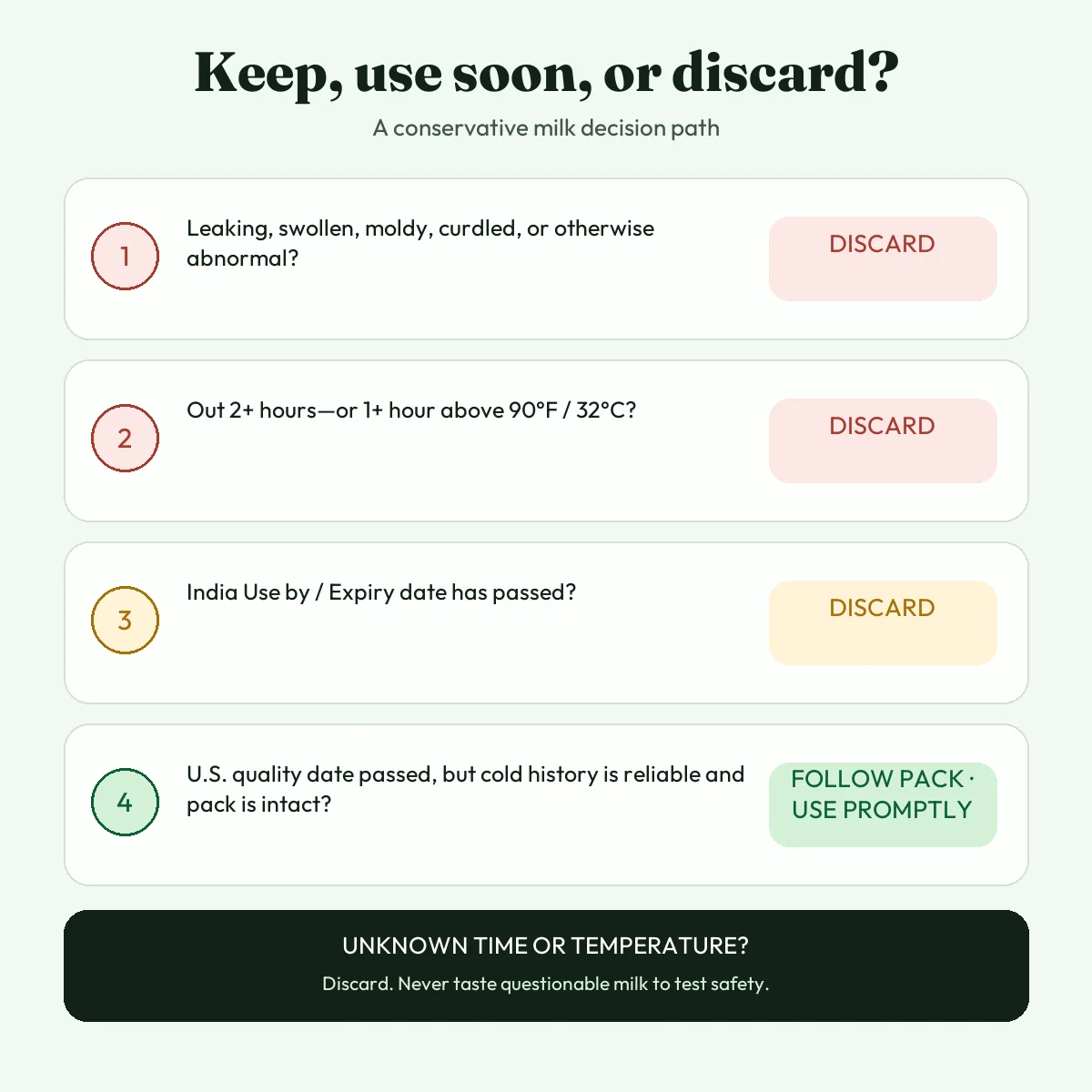
Ask three things: What kind of date is it, what happened to the milk, and what does the package instruct you to do?
Milk decision table: keep, use soon, or discard
| Situation | Evidence type | What to do |
|---|---|---|
| U.S. Best if Used By/Best By date has passed; milk stayed at 40°F / 4°C or below and the package is intact | Quality date, not a federal safety cutoff | Follow the package or producer guidance. Use promptly only if the storage history is reliable and there are no spoilage signs. |
| U.S. Sell-By date has passed | Retail inventory date, not a household safety deadline | Do not add a universal number of “safe days.” Check the cold-chain history, package directions, and condition. |
| U.S. ordinary milk has a Use-By date | Usually manufacturer peak-quality guidance under the federal baseline; state rules may differ | Follow the package. Do not assume the wording has one legal meaning in every state or country. |
| India Best before date has passed | Quality/marketability date under stated storage conditions | Quality may have declined. Do not use it to override a broken cold chain or a separate Use by/Expiry instruction. |
| India Expiry/Use by date has passed | Regulatory safety-and-quality endpoint | Discard; do not sell, distribute, or consume it past that date.[9] |
| Refrigerated milk has been at room temperature for under 2 hours, or under 1 hour above 90°F / 32°C | U.S. federal safety limit | Refrigerate immediately and use promptly. Count shopping, transport, serving, and counter time together.[4] |
| Milk has been out 2 hours or more, or 1 hour or more above 90°F / 32°C | U.S. federal safety limit | Discard, even if the printed date is still in the future.[4] |
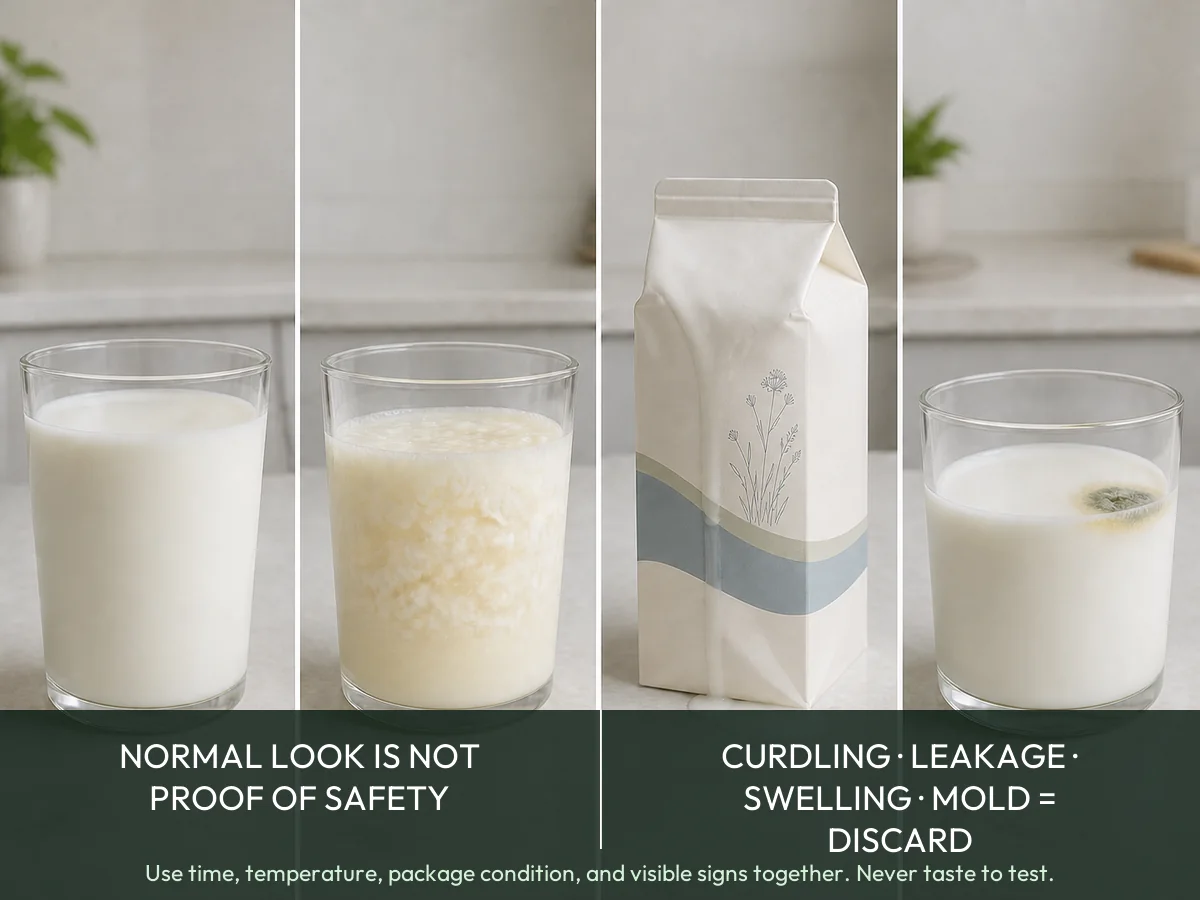
| Sour/off odor, curdling, mold, unusual color, slimy texture, leakage, or a swollen package | Spoilage or package-failure evidence | Discard. Do not taste it. |
| Time or temperature history is unknown | Conservative editorial recommendation | Discard. A normal smell cannot reconstruct the cold chain. |
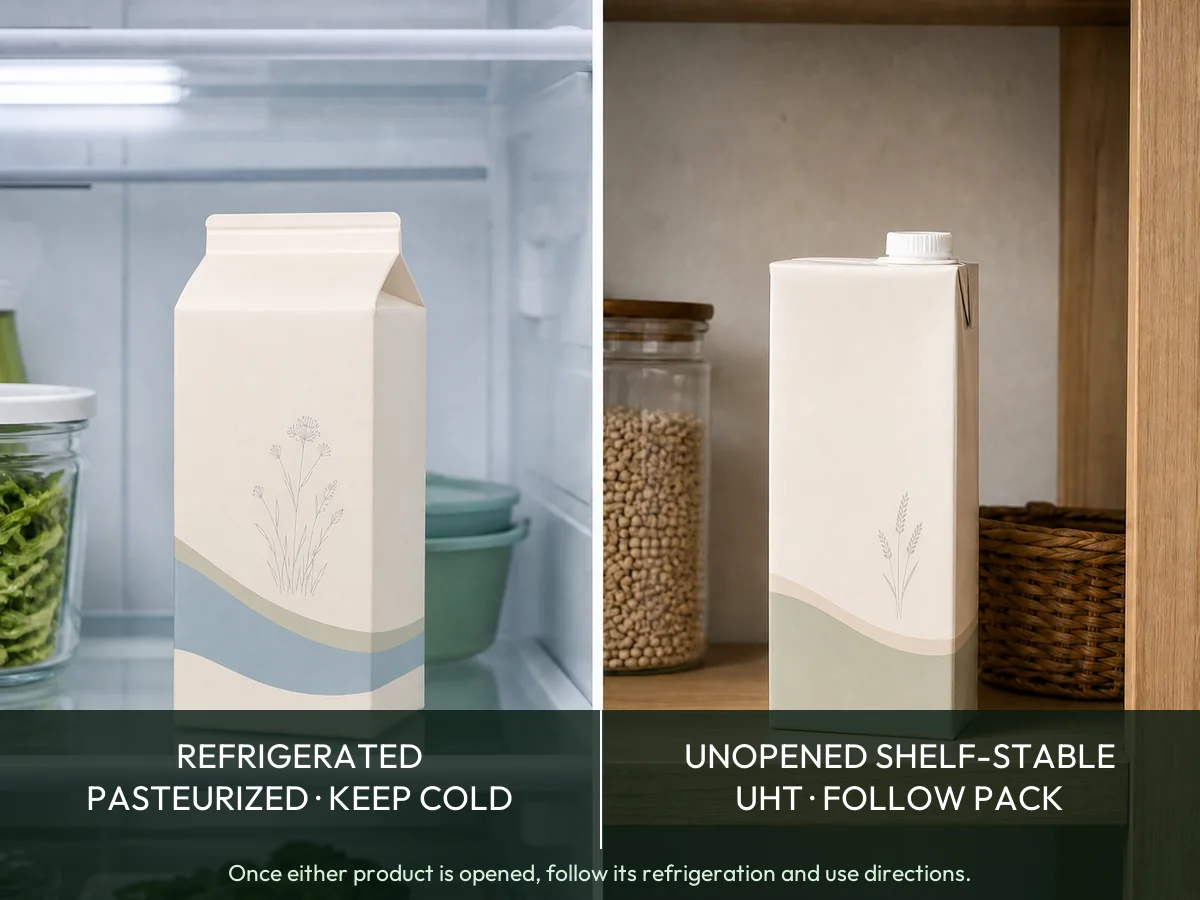
| Unopened shelf-stable UHT milk, package intact | Manufacturer storage instruction | Store as directed and use before the applicable date. Once opened, refrigerate and follow the after-opening instruction. |
Time out of refrigeration is cumulative: shopping, transport, and serving time all count. Returning the carton to the refrigerator does not erase earlier warm time.
What the date on a milk carton means in the United States
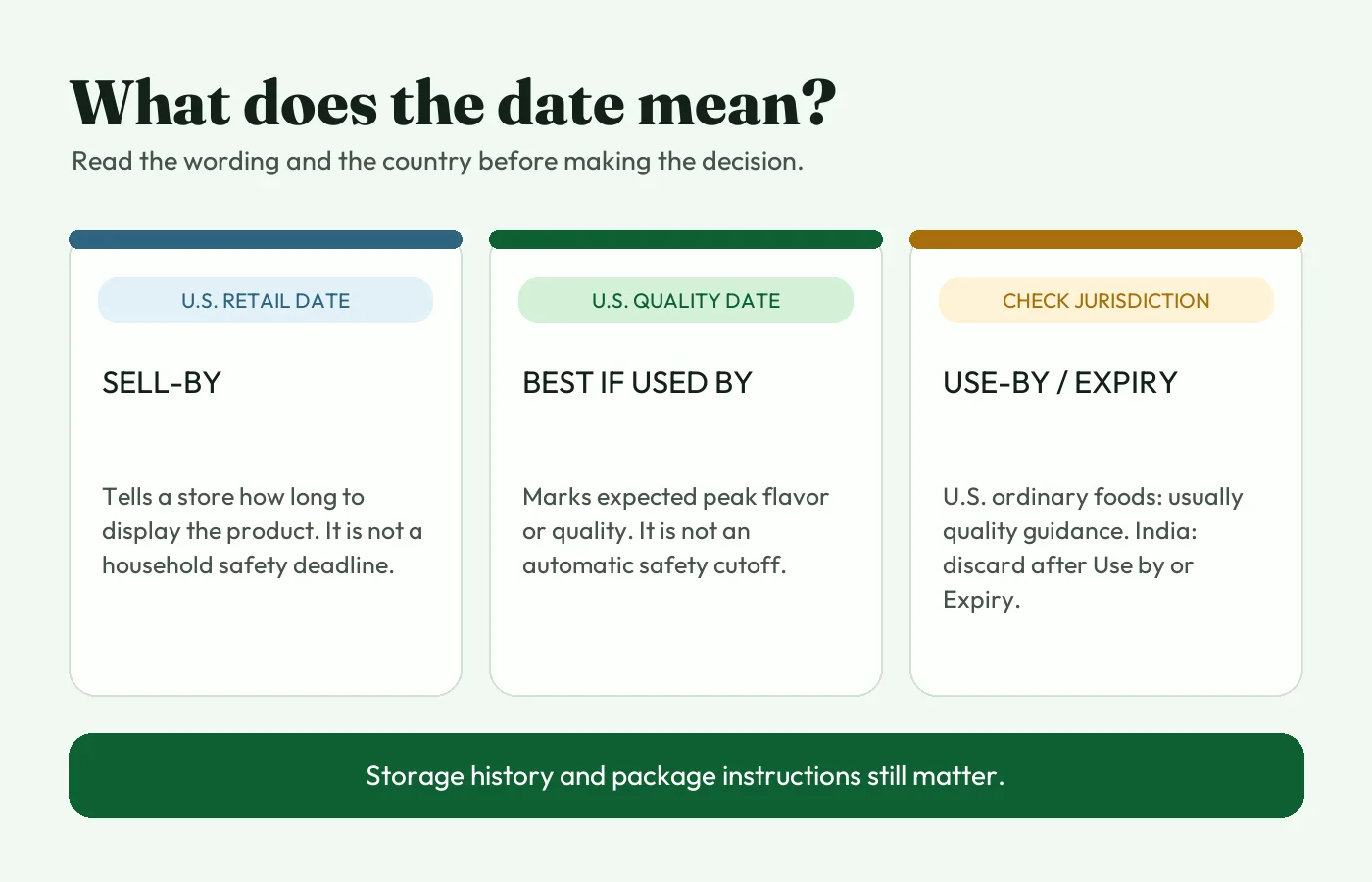
The United States has no nationally uniform date-label vocabulary. Except for infant formula, federal law generally does not require quality-based dates. FDA and USDA recommend “Best if Used By” for peak flavor or quality.[1][2]
- Best if Used By/Before: best flavor or quality; not a purchase or safety date under USDA's federal guidance.
- Sell-By: tells the retailer how long to display the product for inventory management; it is not a consumer safety deadline.
- Use-By: the manufacturer's last recommended date for peak quality under general federal guidance. The major federal exception is infant formula, which must not be used after its Use-By date.
- Freeze-By: when to freeze for peak quality; not a safety deadline.
Dates are not meaningless. Package directions can be stricter, and state laws can add requirements. The narrower takeaway is: a U.S. quality date is not an automatic microbial switch.
USDA gives a general storage estimate of about seven days refrigerated for milk.[3] This is not a safety limit, not date-plus-seven, and not a separate opened/unopened guarantee. Product conditions and opening history vary.
India: Best before and Expiry/Use by are not interchangeable
Indian labels need a separate reading. Current FSSAI rules define Best before as a quality/marketability date under the stated storage conditions. Use by/Expiry marks the end of the estimated period after which the food may not remain safe; FSSAI prohibits sale or distribution after that date. For consumers, the conservative action is to discard.[9]
Storage conditions are part of the date. “Keep refrigerated” assumes the cold chain was maintained; it cannot validate a warm or leaking pack.
FSSAI's institutional dairy guidance uses 4°C or below for refrigerated transport and post-pasteurization cooling.[10][11] An older FSSAI household FAQ gives a broader 5–8°C range.[13] Our conservative home recommendation is 5°C or below, preferably near 4°C, verified with a thermometer, while following the pack.
Why milk changes even in the refrigerator
Pasteurization greatly reduces disease-causing organisms, but it does not make ordinary refrigerated milk sterile or shelf-stable; FDA notes that pasteurized milk still needs refrigeration.[5] Cold storage slows microbial growth rather than stopping it. Milk can also be contaminated after processing or opening. A peer-reviewed review identifies cold-tolerant Pseudomonas and Acinetobacter among important spoilage organisms.[12]
Spoilage organisms are not a map of pathogen risk. A spoilage sign tells you to discard; no spoilage sign does not prove safety.
How to handle milk so the date remains meaningful
- Choose pasteurized milk. CDC advises avoiding raw milk because it can carry Campylobacter, E. coli, Listeria, Salmonella, and other harmful germs.[7]
- Buy refrigerated items last. Go from the store to a refrigerator promptly; use an insulated bag with a cold source for a long or hot trip.
- Keep the refrigerator at 40°F / 4°C or below under the U.S. baseline. Verify it with an appliance thermometer.[4]
- Use a consistently cold interior shelf when practical. The door is not a standalone safety cutoff.
- Close and return the carton promptly. Mark the opening date so you do not have to guess later.
- Respect package damage and storage instructions. A printed date cannot overrule a broken seal, leak, or swollen pack.
Common milk scenarios
| Scenario | Answer |
|---|---|
| U.S. Best By date was yesterday; carton stayed cold | The date alone is not an automatic cutoff. If storage and opening history are known, the pack is intact, and there is no spoilage, follow producer guidance and use promptly. |
| Date is next week; milk sat in a warm car | Discard at the two-hour limit—or one hour above 90°F / 32°C. The future date does not help.[4] |
| Opening date is unknown | Discard. There is no universal after-opening number for every process and pack. |
| Milk was in the refrigerator door | Door storage alone is not proof of danger if the appliance held 40°F / 4°C or below, but an interior shelf is more consistently cold. |
| Power outage | Keep the door closed. Discard milk above 40°F / 4°C for four hours or more; appearance and odor cannot clear it.[8] |
| Unopened UHT/shelf-stable milk | Store at room temperature only if the intact pack says it is shelf-stable. After opening, refrigerate and follow that product's instruction. |
| Raw/unpasteurized milk | Refrigeration does not make it equivalent to pasteurized milk. CDC recommends choosing pasteurized milk, especially for higher-risk groups.[7] |
Can boiling or cooking rescue old milk?
No. FDA warns that inadequately refrigerated perishables may cause illness even after thorough cooking.[8] Heating milk for a drink or recipe is not a rescue for spoilage, unsafe warm holding, or unknown storage.
FSSAI consumer guidance describes boiling fresh unpasteurized milk, then cooling and refrigerating it in a clean, covered container.[14] That product-specific household practice is not a reset button for a pasteurized pouch, a UHT pack past its package instruction, or milk left warm for an unknown time.
Can you freeze milk?
Yes—freeze milk while it is still in good condition, not as a rescue for a questionable carton. USDA's milk-specific estimate is about three months frozen for quality.[3] Food kept continuously frozen at 0°F / -18°C remains safe much longer, but quality declines.[6] Leave expansion space, thaw in the refrigerator, and expect possible separation or graininess.[15]
Freezing pauses change. It does not rewind unsafe room-temperature time, kill every pathogen, or repair spoilage.
Milk spoilage signs
| What you notice | What it means | Action |
|---|---|---|
| Sour or otherwise off odor | Evidence of spoilage/quality loss | Discard; do not taste |
| Curdling, lumps, stringiness, or slimy texture | Abnormal physical change | Discard |
| Unusual color or visible mold | Clear deterioration or contamination | Discard |
| Swollen, leaking, or damaged pack | Package failure or abnormal gas/pressure | Discard |
| Separation after freezing | Often a quality change if the milk was sound before freezing | Thaw in the refrigerator, then stir or shake; discard if other spoilage signs appear |
| Looks and smells normal after unsafe warm holding | Not a safety clearance | Apply the time-and-temperature rule and discard if the limit was exceeded |
Do not taste milk to confirm any item in this table. Smell and appearance can be enough reason to discard; their absence cannot prove microbial safety.[4]
Hot-climate guidance
Above 90°F / 32°C, the room-temperature safety limit falls from two hours to one hour.[4] We use this U.S. federal rule as a conservative hot-climate baseline for Indian summers, hot cars, markets, and delivery bags; it is not an FSSAI statute. Follow stricter package or local instructions. If warm time is unknown, discard.
Who should be extra careful?
Children under five, pregnant people, adults 65 and older, and people with weakened immune systems face higher risk from some foodborne germs. Choose pasteurized milk, follow the label, and discard milk with uncertain storage, damage, or excessive warm time. Ask a healthcare professional about individual concerns.[7]
Milk expiration myths
Does a Sell-By date create a midnight safety cutoff? No. In the U.S., it is an inventory date.[1]
Can a normal smell clear milk? No. An off odor supports discarding; a normal odor cannot rule out pathogens.[4]
Is UHT milk exempt from expiration? No. Ambient storage requires an intact shelf-stable pack within its printed conditions; refrigerate after opening.
Does USDA's seven-day estimate mean seven days after the label? No. It is general storage guidance, not a safety limit or date-plus-seven promise.[3]
Frequently asked questions
Does milk expire on the date printed on the carton?
Can you drink milk after the Sell-By date?
The date alone does not decide. Use it only when storage and opening history are known, the pack is intact, no spoilage appears, and no stricter instruction applies.[1]
What does Best if Used By mean on milk?
Is Use-By always a legal safety deadline?
How long does opened milk last in the refrigerator?
There is no universal number for every product. Follow the pack and discard when opening or storage history is uncertain.
Can milk be unsafe before the printed date?
Yes. Discard it after excessive warm time, package damage, spoilage, or uncertain storage.[4]
How can you tell if milk has spoiled?
Sour/off odor, curdling, mold, abnormal color or texture, and a leaking or swollen pack are discard signs. Their absence does not prove safety.
Should I taste milk to check it?
No. Never taste questionable milk as a safety test.
How long can milk sit out?
Under the U.S. federal baseline, no more than two hours at room temperature, or one hour when the air is above 90°F / 32°C.[4]
Does UHT milk expire?
Yes. Follow the date and storage directions. Ambient storage requires an intact shelf-stable pack; refrigerate after opening.
Does lactose-free milk last longer?
Some products do because their heat treatment and packaging differ, but lactose removal alone does not create one universal shelf life. Follow that carton.
Can you freeze milk?
Can boiling or cooking make spoiled milk safe?
No. Do not use heat to rescue milk that is spoiled, temperature-abused, or of unknown history.[8]
What should I do with milk after a power outage?
Keep the refrigerator closed and use a thermometer. FDA says to discard milk and other refrigerated perishables that have been above 40°F / 4°C for four hours or more.[8]
Is expired milk safe during pregnancy or for young children?
A date alone cannot answer that. Choose pasteurized milk, follow the package, and discard milk with uncertain storage, temperature abuse, damage, or spoilage. Ask a healthcare professional for individual advice.[7]
Bottom line
Milk does expire, but the printed date is only one part of the decision. Read the label in its jurisdiction, keep pasteurized milk cold, and follow the two-hour rule—or one hour above 90°F / 32°C under the U.S. baseline. Discard spoiled, damaged, temperature-abused, or uncertain milk. Never taste it to test safety.
Related WillItExpire guides
Sources
- USDA Food Safety and Inspection Service — Food Product Dating
- U.S. Food and Drug Administration — How to Cut Food Waste and Maintain Food Safety
- AskUSDA — How long can you keep dairy products like yogurt, milk, and cheese in the refrigerator?
- U.S. Food and Drug Administration — Are You Storing Food Safely?
- U.S. Food and Drug Administration — Raw Milk Questions & Answers
- FoodSafety.gov — Cold Food Storage Chart
- U.S. Centers for Disease Control and Prevention — Raw Milk
- U.S. Food and Drug Administration — Food and Water Safety During Power Outages and Floods
- Food Safety and Standards Authority of India — Food Safety and Standards (Labelling and Display) Regulations, 2020, consolidated Version VIII, with the 2026 amendment listing
- Food Safety and Standards Authority of India — Guidance Document for Milk and Milk Products
- Food Safety and Standards Authority of India — Dairy Products and Analogues, Version 3
- Fusco et al. (2020) — Microbial quality and safety of milk and milk products in the 21st century (peer-reviewed review)
- Food Safety and Standards Authority of India — How should food products be stored in a refrigerator? (older household FAQ; read alongside current dairy guidance)
- Food Safety and Standards Authority of India — Eat Right India Handbook (household guidance for fresh unpasteurized milk)
- University of Nebraska–Lincoln Extension — Freezing Milk and Cheese
Last reviewed: August 31, 2026. U.S. guidance baseline with India and hot-climate context. Follow stricter package and local instructions. This article provides general food-safety information, not medical advice.