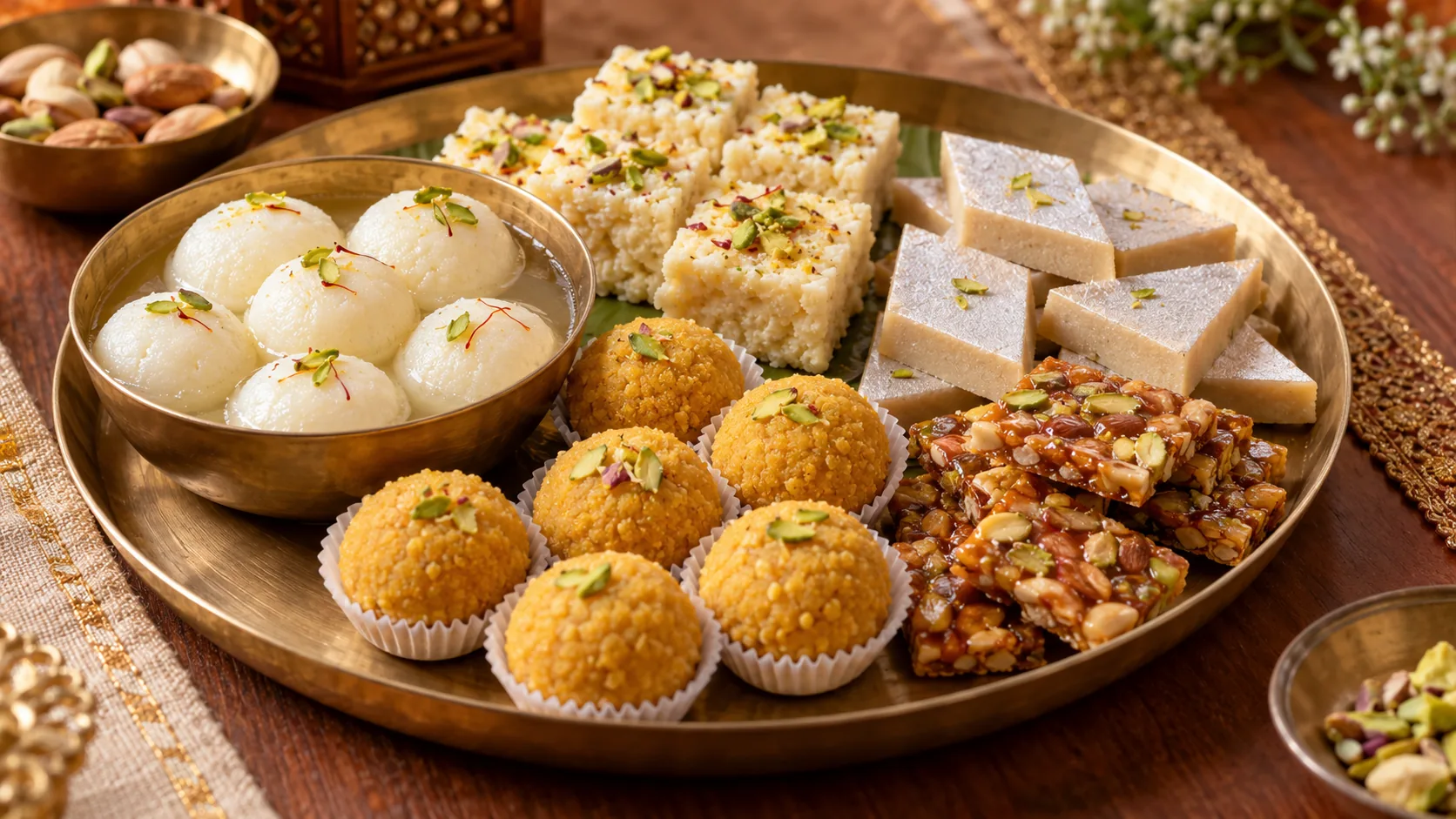
Diwali boxes often mix syrupy milk sweets with drier ladoo, katli and chikki. They cannot share one automatic “fresh for” number because moisture, ingredients, packaging and the making date change the decision.
Quick answer
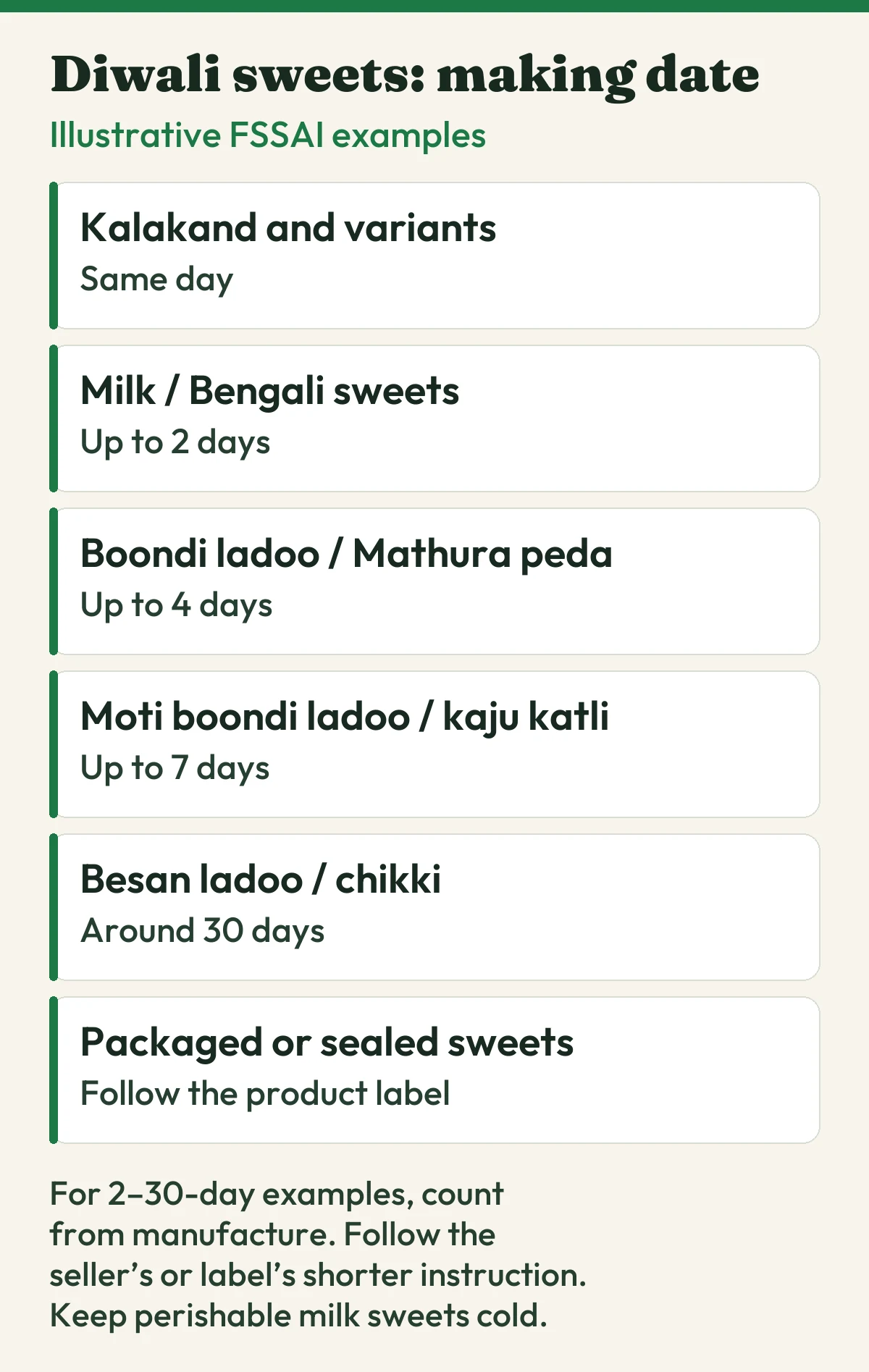
FSSAI lists kalakand for same-day consumption. Its other illustrative examples count from manufacture: 2 days for milk or Bengali sweets; 4 days for boondi ladoo or Mathura peda; 7 days for Moti boondi ladoo or kaju katli; and around 30 days for besan ladoo or chikki. [1] These are category examples, not a new allowance after purchase. Keep perishable milk sweets cold and follow the seller’s or manufacturer’s shorter instruction. [2]
Mithai shelf life by state
| Sweet state or example | Storage condition | Time and evidence label | What to do |
|---|---|---|---|
| Kalakand and variants | FSSAI room-temperature display category; household perishable handling still matters | Same day — illustrative FSSAI guidance [1] | Use the making date; refrigerate promptly rather than treating “same day” as an all-day counter pass |
| Milk or Bengali sweets, such as rasgulla, ras malai or sandesh | Refrigerate covered at 4°C (40°F) or below | Up to 2 days from manufacture — illustrative FSSAI guidance [1] | Ask when it was made; purchase does not reset the clock |
| Boondi ladoo or Mathura peda | Follow the shop or package; refrigerate if perishable | Up to 4 days from manufacture — illustrative FSSAI guidance [1] | Keep the original date and use a shorter label instruction |
| Moti boondi ladoo or kaju katli | Covered, cool and dry unless the product label says otherwise | Up to 7 days from manufacture — illustrative FSSAI guidance [1] | Keep moisture and heat away; do not transfer the figure to every recipe |
| Besan ladoo or chikki | Sealed in a clean, dry container | Around 30 days from manufacture — illustrative FSSAI guidance [1] | Treat this as a category example, not an opened-pack promise |
| Packaged or sealed product | Use the printed storage and best-before/use-by directions | Manufacturer guidance — product-specific | Keep the label and follow its shorter or stricter direction |
FSSAI says its list is illustrative and has no force of law. For a real purchase, ask the seller when a loose sweet was made and read the exact storage and date wording on a packaged sweet. [1]
Why moist milk sweets need the shortest plan
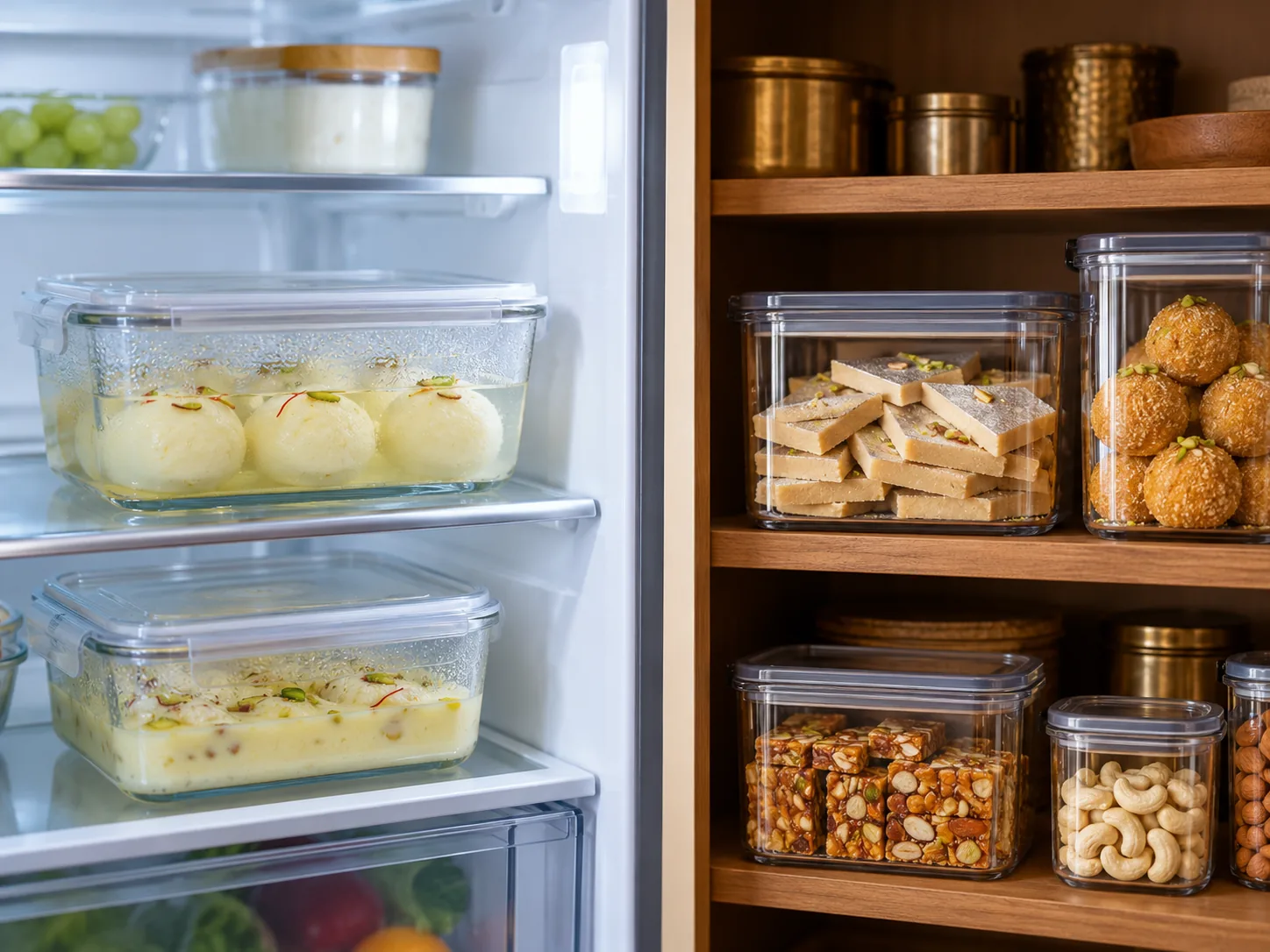
Milk, khoya, chhena and syrup add moisture that supports faster quality loss and microbial growth. FSSAI describes traditional milk-based sweets as having a shorter shelf life, commonly 1–4 days, and separates them from drier flour, ghee and nut-based sweets. [1] That range is a product-category description, not permission to pick the longest number for a moist sweet.
Identify the actual sweet first, then find its making date and storage instruction. A new box, clean paper liner or transfer to an airtight container does not make an older sweet newly made. If the date or temperature history is unknown, do not guess.
A safer Diwali buying and serving plan
- Ask for the manufacture date. If the seller cannot tell you when a loose batch was made, choose a product with a clear date or a sealed label. [1]
- Separate moist from dry sweets. Put rasgulla, ras malai, kalakand and similar milk sweets in the refrigerator promptly. Store dry katli, ladoo or chikki covered and away from heat and humidity, unless their package says otherwise.
- Keep cold food cold. FDA household guidance uses a refrigerator at 4°C (40°F) or below. Perishable food left above that control should not remain out for more than 2 hours, or 1 hour when the surrounding temperature is above 32°C (90°F). [2]
- Serve a small portion. Keep the main container closed and return the rest to the instructed storage condition. Serving time adds to the same exposure history; it does not start a fresh shelf-life period.
- Follow the package first. A branded sweet may use a tested recipe, sealed process or stabilizer system that differs from a loose shop sweet. The exact label beats a category estimate.
Use the category examples carefully
The FSSAI list helps you ask a better question at the counter; it is not a calculator that can identify a sweet from its colour or name alone. A “ladoo” may be made mostly from flour and ghee, or it may contain khoya, milk solids, syrup or a moist filling. Those preparations do not necessarily share the same keeping behaviour. The same caution applies to sweets made at home, where cooking, cooling, utensils and packaging may differ from a licensed shop’s process.
For packaged mithai, the printed date and storage statement belong to that formulation and seal. For loose mithai, retain the tray information or ask the seller to write the manufacture and best-before dates on your box. If the product has travelled warm, leaked, been opened by many people or lost its label, the category estimate cannot reconstruct its history. Choose a dated replacement when you cannot establish how it was handled.
When to discard
Discard perishable mithai that exceeded the applicable room-temperature limit, has an uncertain storage history, or has a damaged or tampered package. Visible mould, leaking syrup, unexpected fermentation or a clearly altered texture are discard signals, but a normal-looking sweet cannot prove safety. Do not taste a questionable sweet to decide whether it is safe.
FAQs
Does buying mithai today give it a new shelf life?
No. For the 2–30-day examples, FSSAI counts from manufacture. Kalakand is listed for same-day consumption. Ask for the making date and follow any shorter shop or package instruction. [1]
Can I use the 30-day example for a milk sweet?
No. FSSAI separates moist milk or Bengali sweets from drier atta, besan and chana examples. Match the ingredient and preparation category instead of borrowing the longest figure. [1]
Should milk-based Diwali sweets be refrigerated?
Yes. Keep perishable milk sweets covered and refrigerated at 4°C (40°F) or below, and do not let them remain out beyond the FDA household limit of 2 hours, or 1 hour above 32°C (90°F). [2]
What if the sweet has no date?
Ask the seller for its manufacture date and storage condition. If age, temperature history or package integrity remains uncertain, choose a fresh dated item or discard it rather than relying on appearance.
Bottom line. Before you buy, write down the making date and separate milk sweets from dry sweets. Put the moist box into the refrigerator as soon as you get home, keep the original date with the box, and use the package or seller instruction when it is stricter than the illustrative FSSAI category.
Sources
- FSSAI Guidance Note No. 14/2020 — Safety and Quality of Traditional Milk Products (illustrative categories and manufacture-based examples).
- U.S. FDA: Are You Storing Food Safely? (4°C/40°F refrigeration and 2-hour/1-hour household limits).
FSSAI examples are illustrative product guidance, not a universal safety guarantee. This article does not replace the exact label, seller instruction or stricter local food-safety advice. Sources checked October 30, 2026. General information, not medical advice. How we research our guides.